Civilizations
Ancient India: Summary and Study Notes
From the Mauryas to the Guptas: Ashoka, zero and the classical age
Study this topic in OriaThe essentials
Between the 6th century BC and the 6th century AD, northern India saw the birth of Buddhism and Jainism, then two great empires. The Mauryas unified almost the entire subcontinent; their emperor Ashoka, horrified by his own war, had a morality of nonviolence and tolerance carved into stone. Later, the Guptas presided over a classical age that produced the decimal system with zero, the calculations of Aryabhata and the poems of Kalidasa. You'll discover who these rulers were, how we know about them, how much truth lies in their legends and what they left to the world.
Key dates and facts
- 326 BC
- Alexander defeats Porus on the Hydaspes
- c. 320 BC
- Founding of the Maurya Empire
- c. 302 BC
- Treaty between Chandragupta and Seleucus
- c. 297 BC
- Accession of Bindusara
- c. 261 BC
- Kalinga War
- c. 250 BC
- Lion Capital of Sarnath
- 1838
- Prinsep translates the edicts
- January 26, 1950
- The Lion Capital becomes the emblem of the Republic of India
- c. 319
- Accession of Chandragupta I
- c. 375 – 415
- Reign of Chandragupta II
🌿 Before the empires: Vedas, kingdoms and new sages
Ancient India here means the world of the Indian subcontinent, which covers present-day India, Pakistan, Bangladesh and Nepal, between the rise of the first great kingdoms, around 600 BC, and the end of the Gupta Empire, around AD 550. It is a story that begins long before the empires.
📜 The age of the Vedas
After the decline of the cities of the Indus civilization came the Vedic period (c. 1500–500 BC). Peoples speaking an Indo-Aryan language, the ancestor of Sanskrit, settled in the northwest of the subcontinent. They composed the Vedas, hymns and liturgical texts passed down orally with remarkable precision. Around 1200–1000 BC, this culture spread into the Ganges plain, where the adoption of iron tools made it possible to clear the forests.
An idealized classification of society into four groups, described in the Brahmanical texts: the Brahmins (priests), the Kshatriyas (warriors and kings), the Vaishyas (producers and merchants) and the Shudras (servants). It is distinct from the jati, the countless hereditary groups we call “castes.”
🏙️ Sixteen kingdoms and a capital on the Ganges
Around 600 BC, a second urbanization began in the Ganges plain. From the 6th to the 4th century BC, sixteen great states, kingdoms or aristocratic republics, shared the north between them: the mahajanapadas. The most powerful became Magadha, in present-day Bihar. In the 5th century BC its kings founded, where the Ganges meets the Son River, the city of Pataliputra, today's Patna, which would serve as the capital of several great Indian empires for nearly a thousand years. In the 4th century, the Nanda dynasty built a vast, centralized empire there, famous for its wealth.
🧘 The Buddha and Mahavira
In these new cities, wandering teachers challenged the authority of the Brahmins and their sacrifices. In the 6th or 5th century BC, Siddhartha Gautama, the Buddha (“the Awakened One”), born according to tradition in Lumbini, in present-day Nepal, taught a “middle way” to free oneself from suffering. In the same era, Mahavira reformed Jainism, which places nonviolence toward all living beings at the heart of its ethics. These so-called shramana movements would leave a deep mark on the empires to come.
⚔️ Alexander at the gates of India
In 327 BC, Alexander the Great, conqueror of the Persian Empire, entered the northwest of the subcontinent. In 326 he defeated King Porus on the Hydaspes, in what is now the Pakistani Punjab, in what was probably his costliest battle. But his army, exhausted and fearful of facing the immense army of the Nandas, mutinied on the banks of the Hyphasis. Alexander turned back and left India in 325. The vacuum he left behind would benefit an ambitious young man.
🐘 Chandragupta Maurya, founder of the first Indian empire
Around 320 BC, a man about whom almost nothing is known founded the first empire to unify most of the Indian subcontinent: Chandragupta Maurya. The Greeks called him Sandrokottos; Plutarch claims that, as a young man, he had seen Alexander.
🎭 A rise wrapped in legend
His origins are obscure. The Greek sources tell of his dealings with the Greeks but almost nothing about his conquest of India; the Indian sources, written centuries later, speak only of the conquest of the Nanda Empire. According to a very popular legend, an adviser humiliated by the Nanda king, Chanakya, spotted the young Chandragupta and guided him to the throne. A play from the Gupta era embellished the story even further, and historians such as Thomas Trautmann consider it largely legendary. What is certain is that Chandragupta took the Punjab after the Greeks left, then Pataliputra, sometime between 322 and 305 BC depending on the estimate.
🤝 Five hundred elephants for a few provinces
Around 303 BC, the Greek king Seleucus I, heir to the eastern part of Alexander's empire, crossed the Indus. Rather than fight a decisive war, the two rulers concluded a treaty and a marriage alliance around 302 BC. Seleucus ceded his easternmost satrapies to Chandragupta, including Gandhara, in present-day Afghanistan and Pakistan; in exchange he received 500 war elephants, which played a decisive role in his victory at Ipsus in 301 BC.
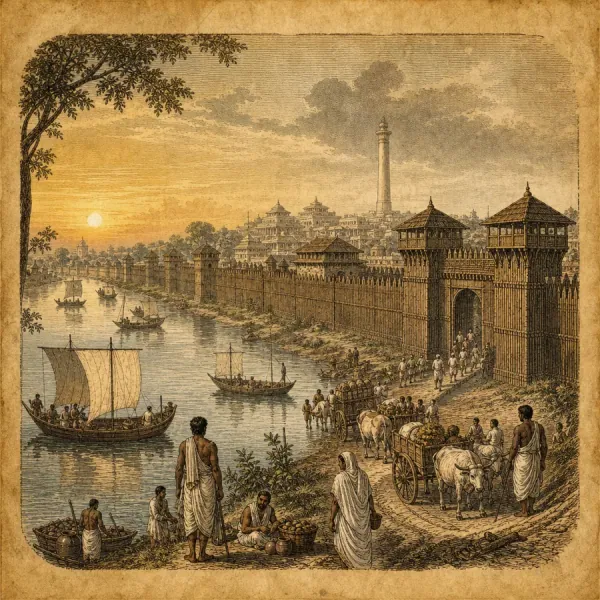
Seleucus also sent an ambassador to Pataliputra: Megasthenes. His book, the Indica, is lost, but fragments of it are quoted by later Greek and Roman authors. In it he describes a capital surrounded by a wooden wall pierced by 64 gates and 570 towers. Pataliputra was then one of the largest cities in the world: about 25 square kilometers and perhaps 150,000 to 400,000 inhabitants. At Kumhrar, archaeologists have found the remains of an immense hall with 80 columns, each 7 meters tall.
🍇 Figs, wine and a philosopher
According to a much later Jain tradition, Chandragupta eventually abdicated to live as a Jain monk in the south, at Shravanabelagola, in Karnataka. His son Bindusara succeeded him around 297 BC and extended the empire as far as Karnataka, without conquering the friendly Tamil kingdoms of the far south. He maintained excellent relations with the Greeks: an ancient author relates that he asked the Seleucid king Antiochus I to send him dried figs, sweet wine and a sophist. Antiochus agreed to the figs and the wine, but replied that in Greece it was not lawful to sell a philosopher.
The rest of the course
This page publishes the first 2 parts. The full course has 9: here is what the next ones cover.
- 🛣️ Ruling an empire of roads and cities
How the Maurya Empire worked: a center and four provinces, a network of cities and roads rather than a uniform territory, the city administration described by Megasthenes, coinage, the army and its elephants, religions, society, and the question of the Arthashastra.
- ☸️ Ashoka: from the Kalinga War to the dhamma
The reign of Ashoka (c. 268–232 BC): legends of his youth, the Kalinga War and the remorse expressed in Edict XIII, his gradual conversion to Buddhism, the policy of dhamma (nonviolence, tolerance, medical care, wells and trees), missions abroad and the limits of this image.
- 🪨 The edicts and pillars: a message carved for eternity
Ashoka's inscriptions, the first major inscriptions in India: languages and scripts (Prakrit, Brahmi, Kharosthi, Greek, Aramaic), their decipherment by James Prinsep, the polished pillars and the Lion Capital of Sarnath, which became the emblem of India.
- 🛤️ Between two empires: Greeks, Kushans and the Silk Roads
The end of the Mauryas (c. 185 BC) and its debated causes, then five centuries of rival kingdoms: the Shungas, the Indo-Greek kingdoms and King Menander, the Kushan Empire of Kanishka, the art of Gandhara and the first images of the Buddha, the Satavahanas of the Deccan, and trade between Rome and China.
- 👑 The Guptas, a new empire in the 4th century
The Gupta Empire (c. 240–550): its origins, Chandragupta I, the conquests of Samudragupta and the Allahabad inscription, the height of power under Chandragupta II Vikramaditya, the iron pillar, the testimony of the Chinese pilgrim Faxian, administration and religion.
- ✨ Zero, Aryabhata and Kalidasa: a “golden age”?
The achievements of the Gupta era: decimal place-value notation and zero, the astronomy of Aryabhata (the Earth's rotation, the value of pi), the literature of Kalidasa, the Kama Sutra, the great epics, the art of Ajanta, the monastery of Nalanda, and the debate over the idea of a “golden age.”
- 🌅 The end of the Guptas and the legacy of ancient India
The fall of the Gupta Empire to the Huns (Kidarites and Alchons, Toramana, Mihirakula) and to regional powers, its consequences, then the lasting legacy of ancient India: Buddhism in Asia, numerals, chess, national symbols and modern rediscovery.
Study “Ancient India” with flashcards and quizzes
In Oria, you read the full course, then practice on it: flashcards, multiple-choice quizzes, open questions or the Feynman method. Cards and questions then come back in your daily review, paced by spaced repetition.
Study this topic in OriaSources
These notes draw on the sources below. If a point seems doubtful, refer back to them.