Civilizations
Mesopotamia: Summary and Study Notes
The land between the rivers, where cities and writing were born
Study this topic in OriaThe essentials
More than five thousand years ago, in what is now southern Iraq, scribes began pressing a cut reed into fresh clay: writing was born. You'll discover Uruk, the first great city, the city-states of Sumer and Akkad, Sargon's first empire, the famous Code of Hammurabi, the palaces of the Assyrian kings and Nebuchadnezzar's Babylon. You'll also see what the Mesopotamians believed, what they knew how to calculate and observe in the sky, why their world faded away, and how it was rediscovered in the 19th century.
Key dates and facts
- c. 6500 – 3900 BC
- Ubaid period, first temples at Eridu
- after 6000
- First irrigation canals
- c. 3400 – 3200
- Uruk becomes a city and writing appears
- c. 2900
- The city-states of Sumer and Akkad begin
- c. 2400 BC
- Stele of the Vultures of Eannatum of Lagash
- c. 2340
- Sargon founds the Akkadian Empire
- 2112 – 2004
- Third Dynasty of Ur (Ur III)
- c. 1792 – 1750 BC
- Reign of Hammurabi in Babylon
- 1595
- The Hittites take Babylon
- 934
- The Neo-Assyrian period begins
🌾 The land between the rivers
The word Mesopotamia comes from Greek and means “the land between the rivers.” The two rivers are the Tigris to the east and the Euphrates to the west, which rise in the mountains of eastern Turkey and flow into the Persian Gulf. The region corresponds mostly to present-day Iraq, along with part of Syria and southeastern Turkey. A curious fact: the Mesopotamians themselves never used this name. They called themselves people of Sumer, Akkad, Assur or Babylon. The term was coined by the Greeks, then taken up by modern historians to refer to this civilization as a whole.
🏜️ A plain without stone or timber, but full of clay
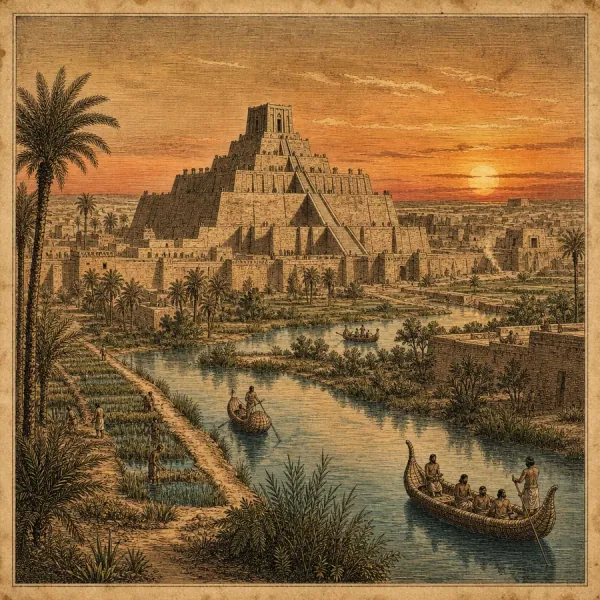
There are two regions. In the north, Upper Mesopotamia is a plateau where rainfall is enough to grow crops. In the south, Lower Mesopotamia is a vast, very flat plain built up from the silt of the two rivers, where less than 200 mm of rain falls per year. Without canals, nothing grows. The region also lacks stone, building timber and metals, which have to be brought from far away. On the other hand, it is rich in two materials that would shape its whole culture: clay, for bricks and tablets, and reeds, for huts, boats and the scribes' styluses.
🌱 From the first villages to irrigation
Farming and herding appeared in the Near East from the 10th millennium BC, first in the hills surrounding the plain. The first irrigation canals are attested after 6000 BC. It was this mastery of water that made it possible to develop the south. The oldest known village in Lower Mesopotamia, Tell el-Oueili, opens the long Ubaid period (c. 6500–3900 BC). At Eridu, archaeologists found a series of buildings stacked one on top of another, probably temples, that herald monumental architecture.
🏙️ Uruk, the “first city”
In the 4th millennium BC, everything sped up. Social inequality deepened, trades became specialized, and leaders ran ever larger communities. The site of Uruk, in the south, is often presented as the “first city” in history. It covered about 100 hectares around 3400 BC and some 230 hectares around 3000, making it by far the largest known settlement of its time. The archaeologist Gordon Childe spoke of an “urban revolution” to describe this shift. Recent research adds nuance, however: large settlements also existed in the north, such as Tell Brak.
At the center of Uruk rose monumental buildings, in the district later known as the Eanna, the domain of the goddess Inanna. It was there, around 3300–3200 BC, that the oldest written tablets appeared. Writing, the state and the city were thus born together: this is the conventional boundary between prehistory and history. In the 3rd millennium, Lower Mesopotamia was divided between two lands: Sumer in the south, where people spoke Sumerian, a language with no known relatives, and Akkad in the north, where they spoke Akkadian, a Semitic language. The two peoples, closely intermingled, forged a single civilization together.
👑 City-states, kings and the first empires
During the 3rd millennium BC, Lower Mesopotamia was a patchwork of small independent states that historians call city-states: a main city, a few secondary towns, villages and their irrigated fields. Kish, Uruk, Ur, Lagash, Umma and Nippur were often rivals. The archives of Girsu, in the kingdom of Lagash, tell of a long border conflict with the neighboring city of Umma. Around 2400 BC, the Stele of the Vultures of King Eannatum of Lagash celebrated a victory over Umma: it is one of the first monuments in which the image of a victory is accompanied by an inscription.
🤴 A king chosen by the gods
Each city was headed by a king, lugal in Sumerian, šarrum in Akkadian. According to the official ideology, he was the earthly representative of the city's patron god, who had entrusted him with his people. The Sumerian King List states that kingship “descended from heaven” at the beginning of time. The king led the army and the administration, dispensed justice, had canals dug and walls and temples built, and oversaw worship. Unlike the pharaohs, Mesopotamian kings were generally not considered gods, with a few exceptions. Historians also stress that, despite their grandiose proclamations, these states had limited means: their real hold over the countryside remained weak.
🏛️ Palaces and temples, the “great institutions”
From the birth of the state, two institutions dominated the economy: the palace, the king's household, and the temple, the god's household. They owned fields, herds, workshops and boats, and employed teams of workers paid in rations of barley, oil, beer or dates, since money did not yet exist. Scribes recorded every item coming in and going out. Historians think that writing was invented precisely to keep these accounts. Alongside them, families of notables, merchants and farmers ran their own households.
⚖️ A deeply unequal society
At the top were the king, his family and his entourage. A large part of the population depended on the palaces and temples for a living. At the very bottom, slaves, often prisoners of war or insolvent debtors, were legally property; historians nonetheless believe that slavery was not a mass phenomenon in Mesopotamia. Women were legally subject to their fathers and then their husbands, and this inequality grew sharper in the 2nd millennium. Some escaped this framework, however: queens and princesses ran estates, women scribes are attested, and women consecrated to a god managed their own property.
🗡️ Sargon and the first empire
Around 2340 BC, a ruler from the small city of Akkad, whose location has still not been found, seized the north of Lower Mesopotamia and then defeated Lugal-zagesi, king of Uruk. His name was Sargon, “the legitimate king.” His campaigns took him as far as Elam, to the east, and to Mari and Ebla, in Syria. For many historians, the Akkadian Empire was the first imperial experiment in history: conquered cities turned into provinces, an elite loyal to the king, propaganda through monuments. His daughter Enheduanna, high priestess of the moon god at Ur, is held to be the author of several hymns. His grandson Naram-Sin proclaimed himself king of the “four quarters” of the world and had himself depicted as a god. But the empire broke apart around the middle of the 22nd century BC.
A later legend, written around the end of the 8th century BC, says that Sargon as a baby was placed by his mother in a reed basket and entrusted to the river. Historians see it as fiction, reminiscent of other stories of abandoned children, such as Moses or Romulus and Remus. After Akkad, the kings of the Third Dynasty of Ur, Ur-Nammu and his son Shulgi, rebuilt an empire (2112–2004 BC) and left behind tens of thousands of administrative tablets. The Code of Ur-Nammu is the oldest known collection of laws.
The rest of the course
This page publishes the first 2 parts. The full course has 8: here is what the next ones cover.
- 🌙 Gods who lived in cities
Mesopotamian religion: a pantheon of great gods who protected the cities, temples conceived as their houses, ziggurats, divination, magic and a bleak vision of the afterlife.
- ✍️ Cuneiform and Gilgamesh
The invention of writing at Uruk around 3300 BC, its evolution into cuneiform, the scribe's profession, the main genres of texts and the Epic of Gilgamesh, one of humanity's oldest stories.
- 🔢 Base 60, stars and glazed bricks
Mesopotamian knowledge (base-60 mathematics, astronomy, medicine, the calendar) and the arts: cylinder seals, statues, Assyrian reliefs, glazed bricks, goldwork and cooking.
- 🦁 Hammurabi, Assyria and Babylon
The great moments of power: Hammurabi of Babylon and his code of laws (c. 1750 BC), then the Neo-Assyrian Empire, the first empire to dominate the Near East for the long term, and Nebuchadnezzar II's Babylon.
- 🌅 From the fall of Nineveh to the last tablet
The fall of Assyria in 612 BC, the splendor of Nebuchadnezzar II's Babylon, the Persian conquest of 539 BC, then the slow fading of Mesopotamian culture down to the last cuneiform tablets of the 1st century.
- 🏺 Rediscovery and legacy
How Europe rediscovered Mesopotamia in the 19th century (excavations, the decipherment of cuneiform, the birth of Assyriology) and what we still owe it: cities, writing, law, timekeeping, biblical stories.
Study “Mesopotamia” with flashcards and quizzes
In Oria, you read the full course, then practice on it: flashcards, multiple-choice quizzes, open questions or the Feynman method. Cards and questions then come back in your daily review, paced by spaced repetition.
Study this topic in OriaSources
These notes draw on the sources below. If a point seems doubtful, refer back to them.