Civilizations
Ramesses II: Biography and Study Notes
The builder pharaoh, from the Battle of Kadesh to the first peace treaty
Study this topic in OriaThe essentials
The grandson of an army officer who became pharaoh, Ramesses II took the throne at around 25 and ruled New Kingdom Egypt for more than sixty-six years. You'll discover how he turned the inconclusive Battle of Kadesh into an epic, then signed with the Hittites the oldest surviving peace treaty. You'll visit his giant building sites, from Abu Simbel to the Ramesseum, see how he had himself worshipped as a god, and follow the astonishing fate of his mummy, all the way to its trip to Paris in 1976.
Key dates and facts
- 1279 BC
- Accession of Ramesses II
- 1274 BC
- Battle of Kadesh
- c. 1259 BC
- Peace treaty with the Hittites
- 1213 BC
- Death of Ramesses II
- 1813
- Great Temple of Abu Simbel rediscovered
- 1817
- Belzoni enters the temple
- 1960
- UNESCO appeal for Nubia
- 1964 – 1968
- Temples dismantled and rebuilt
- 1881
- Deir el-Bahari cache discovered
- 1886
- Maspero unwraps the mummy
🏺 A prince who was not born a prince
When Ramesses II was born, around 1303 BC according to the most widely used chronology (estimates vary by a few years), nothing destined him to become pharaoh. His family did not belong to the royal line: they were soldiers from the region of Avaris, in the Nile Delta. His great-grandfather, grandfather and father were all officers. Egypt was then ruled by Horemheb, himself a military man before becoming pharaoh.
🎖️ A family of officers on the throne
Horemheb had no heir. He chose as his successor his vizier and military commander, Paramessu, the grandfather of the future Ramesses II, who became pharaoh under the name Ramesses I and founded the 19th Dynasty. The boy was then about ten. Ramesses I reigned for two years at most. His son Seti I, Ramesses' father, succeeded him for about ten years. He was a great war leader who restored Egyptian power in the Near East. The prince's mother was Queen Tuya, also called Mut-Tuya; he had an older sister, Tia.
🧒 The prince with the sidelock
On his father's monuments, young Ramesses appears with the sidelock of youth, the hairstyle of Egyptian children, then with the titles of “king's son” and fan-bearer on the king's right. In the temple of Seti I at Abydos, he stands beside his father before a famous list of seventy-two kings who had reigned before them: a way of showing that this family of officers belonged to the long line of pharaohs. At the end of Seti's reign, he oversaw the ordering of obelisks and colossal statues in Aswan granite. One of those obelisks, later erected in front of Luxor Temple, now stands on the Place de la Concorde in Paris.
Did Seti make him co-regent at around fourteen? An inscription at Abydos has been read that way, but most scholars remain cautious about this interpretation.
👑 Pharaoh at 25: a new capital
Ramesses took the throne the day after his father's death, on the 27th day of the 11th month of the Egyptian year. Most Egyptologists place that day on May 31, 1279 BC. He was about 25. He took the throne name Usermaatre Setepenre and called himself Ramesses Meryamun, “Ramesses beloved of Amun.” It was from the first part of this name, Usermaatre, that the Greeks would later derive the name Ozymandias. Letters found in the Hittite archives show that his foreign contemporaries pronounced his name roughly as “Riamessesa.”
🏙️ Pi-Ramesses, the king's city
The new pharaoh inherited a rich and stable country. But his eyes were on the east, where the Hittite Empire, from Anatolia, was contesting Egypt's control of the wealthy cities of Syria and Lebanon. To be closer to the front, Ramesses turned a residence founded by his father near Avaris into his capital: Pi-Ramesses, which he renamed “Per-Ramesses-Meryamun, great of victories.” By year 5 of his reign, he was living there.
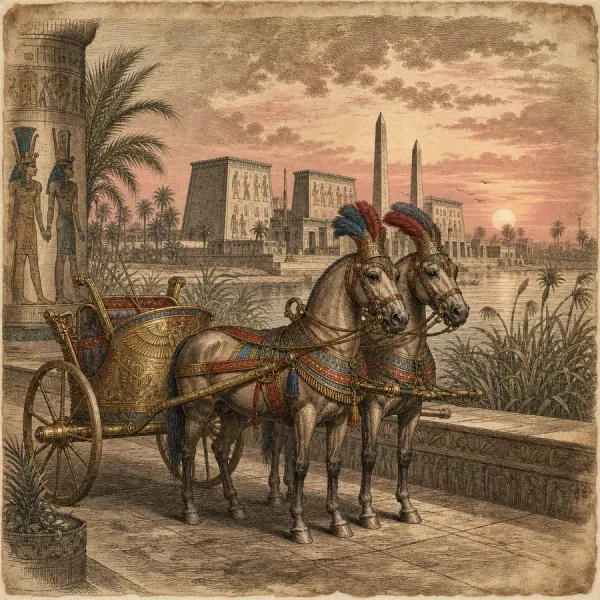
Excavations at Qantir by an Austrian team led by Manfred Bietak have uncovered part of this city: a palace, residential quarters, workshops where bronze chariot parts were made, and vast stables that could hold more than three hundred horses. The war chariot, fast and maneuverable, was the elite weapon of the Egyptian army. Later, most of the monuments of Pi-Ramesses would be dismantled and carried to Tanis, where archaeologists found them.
🌊 First battles
A stela from year 2 celebrates a victory over warriors from the sea, perhaps the Sherden. Ramesses then enlisted them in his army as auxiliary troops. In year 4, he led a first campaign along the coast of Lebanon, where he had stelae carved, notably at Byblos. The goal was probably to support the kingdom of Amurru, which his father had won back from the Hittites. A clash with the great Anatolian power was becoming inevitable.
The rest of the course
This page publishes the first 2 parts. The full course has 9: here is what the next ones cover.
- ⚔️ Kadesh: the battle that became a legend
How the Battle of Kadesh unfolded in year 5 of the reign (1274 BC), the Hittite trap, the counterattack, the inconclusive outcome and how Ramesses turned it into an epic of propaganda.
- 🤝 From war to the oldest peace treaty
The campaigns after Kadesh, the reasons for the rapprochement with the Hittites, the peace treaty of year 21 (c. 1259 BC), its Egyptian and Hittite versions, then the correspondence and the diplomatic marriage of year 34.
- 🏛️ The builder pharaoh
Ramesses II's building program: Luxor, Karnak, Abydos, the Ramesseum, the temples of Nubia and above all Abu Simbel, with its solar phenomenon and the UNESCO rescue of the temples in the 1960s.
- ☀️ A god-king with a huge family
The wives and more than one hundred children of Ramesses II, his Sed festival jubilees and how he had himself worshipped in his lifetime through his statues and temples.
- ⏳ A giant's old age and his plundered tomb
The last years of Ramesses II at Pi-Ramesses, his illnesses, his death at about 90 in 1213 BC, the succession of Merneptah and the fate of his tomb KV7 in the Valley of the Kings.
- 🧳 The mummy's long journey
How priests in antiquity moved the mummy of Ramesses II, its discovery in the Deir el-Bahari cache in 1881, its examination, its trip to Paris in 1976 and its installation at the National Museum of Egyptian Civilization in 2021.
- 📜 Ozymandias: the afterlife of a name
How Ramesses II was remembered after his death: a model for later pharaohs, a posthumous cult, Greek and Latin accounts, Shelley's sonnet, the question of the pharaoh of the Exodus and his place in popular culture.
Study “Ramesses II” with flashcards and quizzes
In Oria, you read the full course, then practice on it: flashcards, multiple-choice quizzes, open questions or the Feynman method. Cards and questions then come back in your daily review, paced by spaced repetition.
Study this topic in OriaSources
These notes draw on the sources below. If a point seems doubtful, refer back to them.