Geography & countries
Antarctica: Summary and Study Notes
The continent of ice devoted to peace and science
Study this topic in OriaThe essentials
Antarctica is a continent almost entirely covered by an ice sheet nearly 2 kilometers thick. You'll discover its landscapes and record-breaking climate, the astonishing life that clings on there, the first navigators, the race to the South Pole between Roald Amundsen and Robert Falcon Scott, the 1959 treaty that made it a land of peace and science, the discoveries made at its research stations, and finally what its ice tells us about our climate and rising seas.
Key dates and facts
- 14.2 million km²
- Area of the continent
- −89.2°C (−128.6°F)
- Record low temperature, measured at Vostok
- 4,892 m
- Mount Vinson, the highest point
- ≈ 60 m
- Sea level rise if all the ice melted
- 1773
- James Cook crosses the Antarctic Circle
- 1820
- First sightings of the continent
- 1895
- First confirmed landing, at Cape Adare
- 1909
- A team reaches the South Magnetic Pole
- December 14, 1911
- Amundsen and his four companions at the South Pole
- January 17, 1912
- Scott reaches the pole in turn
❄️ A continent under the ice
Antarctica is the southernmost continent on Earth. Lying almost entirely within the Antarctic Circle, it surrounds the geographic South Pole and is washed by the Southern Ocean. At about 14.2 million km² (5.5 million square miles), it is the fifth-largest continent: about 40% bigger than Europe, and nearly twice the size of Australia. Its name comes from ancient Greek, by way of the Latin antarcticus: “opposite the Arctic.” For centuries, European geographers imagined a vast Terra Australis in these waters, a southern land supposed to balance the continents of the North.
🧊 An ice sheet two kilometers thick
About 98% of the continent is buried under the Antarctic ice sheet, nearly 2 kilometers (1.2 miles) thick on average. It holds about 26.5 million km³ of ice, or, depending on the estimate, 61 to 70% of all the fresh water on the planet. If it melted completely, sea level would rise by nearly 60 meters (200 feet). Only a few areas are free of ice, such as the McMurdo Dry Valleys, among the most arid landscapes in the world.
The Transantarctic Mountains cut the continent in two. To the east, East Antarctica, the larger and higher part, rests on an ancient bedrock shield. To the west, West Antarctica is very different: beneath its ice, the ground lies in places more than 2,500 meters (8,200 feet) below sea level. Without the ice, it would be seabed. This feature makes this part of the continent more vulnerable to warming.
🌋 Volcanoes and hidden lakes
The highest point is Mount Vinson, at 4,892 meters (16,050 feet). On Ross Island, Mount Erebus is the southernmost active volcano in the world. Hundreds of lakes are also hidden beneath the ice: about 675 are known. The largest, Lake Vostok, lies under about 4,000 meters of ice, beneath the Russian station of the same name; it is one of the largest lakes in the world by surface area.
🌊 Sea ice that breathes
Around the continent, the ocean freezes every winter: sea ice grows from about 3 million km² in February, at the end of the southern summer, to about 18 million km² in September, more than the area of the continent itself. It should not be confused with ice shelves, huge tongues of glacier ice, sometimes a kilometer thick, that float on the sea along the edge of the continent and make up about 44% of its coastline.
🌴 A continent once covered in forests
Antarctica has not always been frozen. For hundreds of millions of years, it was part of the supercontinent Gondwana, along with Africa, South America, India and Australia, and it was covered in forests. Fossils of plants such as Glossopteris have been found there, and even dinosaurs, such as Cryolophosaurus. The ice really took hold about 34 million years ago, mainly because of falling carbon dioxide levels in the atmosphere, and eventually replaced the forests. Around 30 million years ago, the opening of the Drake Passage, between Antarctica and South America, created an ocean current that circles the continent and isolates it.
🐧 The coldest, the driest, the windiest
Antarctica is, on average, the coldest, driest, windiest and highest continent. On July 21, 1983, the Russian station at Vostok recorded −89.2°C (−128.6°F), the lowest air temperature ever measured on Earth by official standards. Satellites have detected temperatures as low as −94.7°C (−138.5°F) in 2010, but at the snow surface rather than two meters above the ground, as records require. Antarctica is far colder than the Arctic, because much of the continent lies more than 3,000 meters (9,800 feet) above sea level, whereas the North Pole sits on an ocean whose relatively warm water moderates the climate.
On the coasts, the temperature can top 10°C (50°F) in summer and drop below −40°C (−40°F) in winter. On the interior plateau, it climbs to around −30°C (−22°F) in summer but falls below −80°C (−112°F) in winter. At the pole, the sun never sets in summer and never rises in winter.
🏜️ A desert of ice
Surprising as it may seem, Antarctica is a polar desert. The continent receives on average the equivalent of about 150 millimeters (6 inches) of water a year, almost entirely as snow, and the interior less than 50 millimeters (2 inches). The ice built up not because it snows a lot, but because it almost never melts. At the edge of the continent blow katabatic winds, masses of cold, heavy air that rush down the slopes of the plateau at storm speeds.
🦐 Krill, at the heart of the food chain
On dry land, life is tiny: the largest purely terrestrial animal is a wingless midge, Belgica antarctica, about 6 millimeters (a quarter inch) long. The flora consists mainly of mosses, liverworts and lichens; only two flowering plants are native to the continent, on the Antarctic Peninsula. The sea, by contrast, teems with life. Antarctic krill, a small crustacean that forms huge swarms, is the key species of the Southern Ocean: it feeds whales, seals, squid, fish and many birds.
A species on which the balance of an entire ecosystem depends. If krill became scarce, the penguins, seals and whales of the Southern Ocean would lose their main source of food.
🐧 Penguins that lay eggs in midwinter
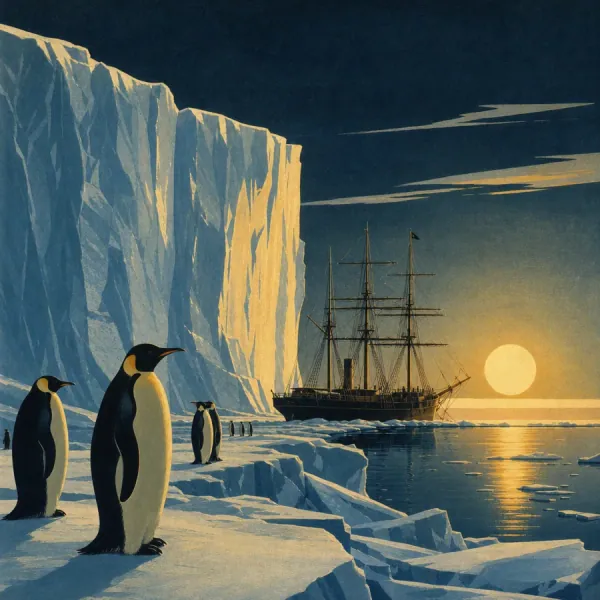
About 40 species of birds breed on or near the continent. The most famous is the emperor penguin, the only penguin that breeds during the Antarctic winter, on the coastal sea ice. Along with the Adélie penguin, it also nests the farthest south. The ocean is also home to blue whales, orcas, colossal squid and seals, including the leopard seal, a top predator of the ecosystem. In the 18th and 19th centuries, fur seals were slaughtered for their skins by American and British sealers.
Even the ice harbors life: algae color the snow in summer, bacteria have been found hundreds of meters below the ice, and some microscopic fungi survive in cracks in the rocks. These extreme organisms interest researchers who imagine the life that might be possible on Mars or on Europa, a moon of Jupiter.
The rest of the course
This page publishes the first 2 parts. The full course has 7: here is what the next ones cover.
- ⛵ From navigators to the first steps on the ice
From James Cook to the first sightings of 1820, the sealers, Dumont d'Urville, the first landing in 1895 and the Heroic Age up to the magnetic pole in 1909.
- 🏁 Amundsen versus Scott: the race to the South Pole
Amundsen's Norwegian expedition, first to the pole on December 14, 1911, and Scott's British expedition, which arrived on January 17, 1912, and perished on the way back; then the odyssey of Shackleton and the Endurance.
- 🕊️ The 1959 treaty: a continent for peace and science
Territorial claims, postwar tensions, the International Geophysical Year, the 1959 Antarctic Treaty and the Madrid Protocol, which bans mining.
- 🔬 A laboratory the size of a continent
Research stations and their residents, ice cores that tell the story of 800,000 years of climate, Lake Vostok, astronomy, meteorites and the discovery of the ozone hole.
- 🌡️ Fragile ice and human pressures
Melting in West Antarctica, the Thwaites Glacier, rising seas, the retreat of sea ice since 2016, threats to emperor penguins, fishing and the boom in tourism.
Study “Antarctica” with flashcards and quizzes
In Oria, you read the full course, then practice on it: flashcards, multiple-choice quizzes, open questions or the Feynman method. Cards and questions then come back in your daily review, paced by spaced repetition.
Study this topic in OriaSources
These notes draw on the sources below. If a point seems doubtful, refer back to them.