Classic novels
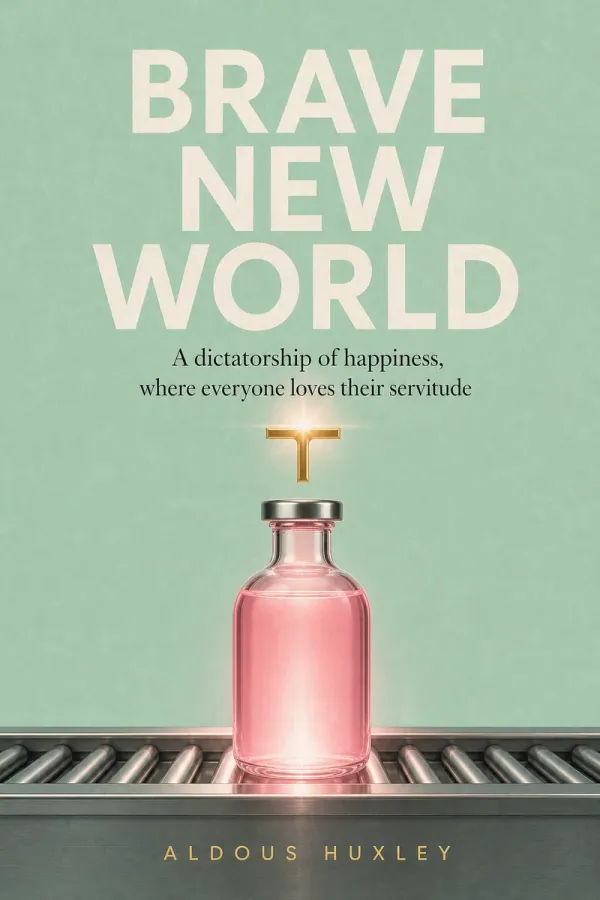
Brave New World by Aldous Huxley: Summary and Study Notes
A dictatorship of happiness, where everyone loves their servitude
Study this topic in OriaThe essentials
Written in four months in 1931 at Sanary-sur-Mer and published in 1932, Brave New World imagines a World State where humans are manufactured in a laboratory, conditioned in their sleep, and soothed by a drug, soma. Everyone there is happy, except for a few misfits and a "Savage" raised far from civilization. You'll discover the book's background, Aldous Huxley, this strange world set in the year 632 After Ford, the plot step by step, the comparison with Orwell's 1984, and the novel's legacy.
Key dates and facts
- 1921
- Crome Yellow already hints at the incubators
- May – Aug. 1931
- Written at Sanary-sur-Mer
- 1932
- Published in London, then by Plon in Paris
- 1958
- Brave New World Revisited , the follow-up essay
- July 26, 1894
- Born in Godalming, Surrey
- 1911
- Eye disease, nearly blind
- 1937
- Moves to Los Angeles
- Nov. 22, 1963
- Dies the day Kennedy is assassinated
🖋️ Four months in Sanary
Brave New World is a science-fiction novel by the British writer Aldous Huxley. He wrote it in four months, from May to August 1931, at Sanary-sur-Mer, in the south of France, where he was living at the time. The book was published in London by Chatto & Windus in 1932, and the same year in France, by Plon, in a translation by Jules Castier titled Le Meilleur des mondes. It is Huxley's fifth novel, already known as a brilliant satirist, and his first dystopia, that is, a story that describes a future society presented as ideal but in fact nightmarish.
📉 Written during the crisis
Huxley wrote in the midst of the Great Depression, the economic crisis triggered by the 1929 crash. In 1931, the United Kingdom was experiencing mass unemployment and abandoned the gold standard. Huxley concluded that stability was the first and ultimate need if civilization was to survive. Shortly before writing, he had visited the ultramodern chemical plant at Billingham, in northeast England, owned by industrialist Alfred Mond: he was deeply impressed, and would give his name to the novel's ruling figure.
A trip to the United States also mattered a great deal. Huxley had been struck by the cult of youth, commercial cheerfulness, and sexual freedom he observed there. On the boat over, he had read My Life and Work, the autobiography of Henry Ford, the inventor of assembly-line production; he said he saw its principles applied everywhere once he arrived in San Francisco.
😏 A parody of H. G. Wells
At first, Huxley wanted to mock the optimistic utopias of H. G. Wells, such as A Modern Utopia (1905) or Men Like Gods (1923), which promised a bright future through science. In a letter, he said he was having fun ribbing Wells, then got carried away by his own ideas. He called his book a "negative utopia." As early as 1921, in his novel Crome Yellow, one character already imagined vast state incubators filled with bottles, and the disappearance of the family.
🎭 A doubly ironic title
The English title comes from Shakespeare's The Tempest (Act V, Scene 1). Young Miranda, who grew up on a deserted island, sees visitors and marvels: "O brave new world, that has such people in't!" The line is ironic, since these visitors are not so admirable. The French translator chose an equally ironic equivalent: "le meilleur des mondes possibles," the phrase coined by the philosopher Leibniz and mocked by Voltaire in Candide (1759), through the character of Pangloss.
👓 Aldous Huxley, heir to a family of scholars
Aldous Huxley was born on July 26, 1894, in Godalming, Surrey, England, into an illustrious family. His grandfather, Thomas Henry Huxley, was one of the greatest naturalists of the nineteenth century, nicknamed "Darwin's bulldog" for his defense of the theory of evolution. His brother Julian Huxley would become a famous biologist, involved, like part of his generation, in the eugenics movement. This scientific background feeds all the biology in Brave New World.
🌫️ A youth marked by tragedy
At 14, in 1908, Aldous lost his mother to cancer. In 1911, an eye disease, keratitis punctata, left him nearly blind for two or three years and put an end to his dream of becoming a doctor. His eyesight would remain very poor for the rest of his life. He nonetheless entered Balliol College, Oxford, in October 1913, where he studied English literature. In 1914, his older brother took his own life. Judged unfit for service, he did not fight in the First World War.
🏫 Orwell's teacher
After Oxford, needing money, he taught French for a year at Eton College. Among his students was a boy named Eric Blair, who would become George Orwell, the author of 1984. Huxley was unable to keep order in his classroom, but his students admired his command of language. He then mixed with the intellectuals of the Bloomsbury group, married the Belgian refugee Maria Nys in 1919, and became known for satirical novels about high society, including Point Counter Point (1928), a major success.
🌴 California and the spiritual quest
In 1937, Huxley moved to Los Angeles, where he would live until his death. A committed pacifist, he became interested in meditation, Vedanta, and mysticism, and wrote screenplays for Hollywood, including an adaptation of Pride and Prejudice (1940). In 1953, he experimented with mescaline under the supervision of psychiatrist Humphry Osmond and wrote The Doors of Perception (1954) about it, whose title would later inspire the name of the band The Doors. In 1962, he published his last novel, Island, a positive utopia, the counterpart to Brave New World.
Suffering from throat cancer, he died in Los Angeles on November 22, 1963, after asking his wife for an injection of LSD. His death went almost unnoticed: on the same day, President John F. Kennedy was assassinated in Dallas, and the writer C. S. Lewis also died. Huxley had been nominated several times for the Nobel Prize in Literature.
The rest of the course
This page publishes the first 2 parts. The full course has 8: here is what the next ones cover.
- 🏭 The year 632 After Ford
The novel's setting: the World State, the cult of Henry Ford, the motto Community, Identity, Stability, and the history that led to this world.
- 🧪 Bottles, castes, and conditioning
How the World State manufactures humans: birth in a bottle, the Bokanovsky process, five castes, infant conditioning, and hypnopaedia.
- 🏜️ Bernard, Lenina, and the reservation
The first half of the plot: Bernard Marx the misfit, Lenina Crowne, Helmholtz Watson, the trip to the New Mexico reservation, and the meeting with Linda and John.
- 🎭 The Savage in London
The second half of the plot: John discovers civilization, Linda's death, the revolt against soma, the debate with Mustapha Mond, and the tragic end at the lighthouse.
- 👁️ Huxley or Orwell: pleasure versus fear
The classic comparison between Brave New World and 1984: control through fear or through pleasure, Huxley's letter to Orwell, and Neil Postman's analysis.
- 📚 Reception, censorship, and legacy
The novel's reception in 1932, Huxley's own view of his book (1946 preface, Brave New World Revisited), censorship, adaptations, and common misreadings.
Study “Brave New World” with flashcards and quizzes
In Oria, you read the full course, then practice on it: flashcards, multiple-choice quizzes, open questions or the Feynman method. Cards and questions then come back in your daily review, paced by spaced repetition.
Study this topic in OriaSources
These notes draw on the sources below. If a point seems doubtful, refer back to them.