Classic novels
Things Fall Apart by Chinua Achebe: Summary and Study Notes
Okonkwo, Umuofia, and the arrival of the British among the Igbo
Study this topic in OriaThe essentials
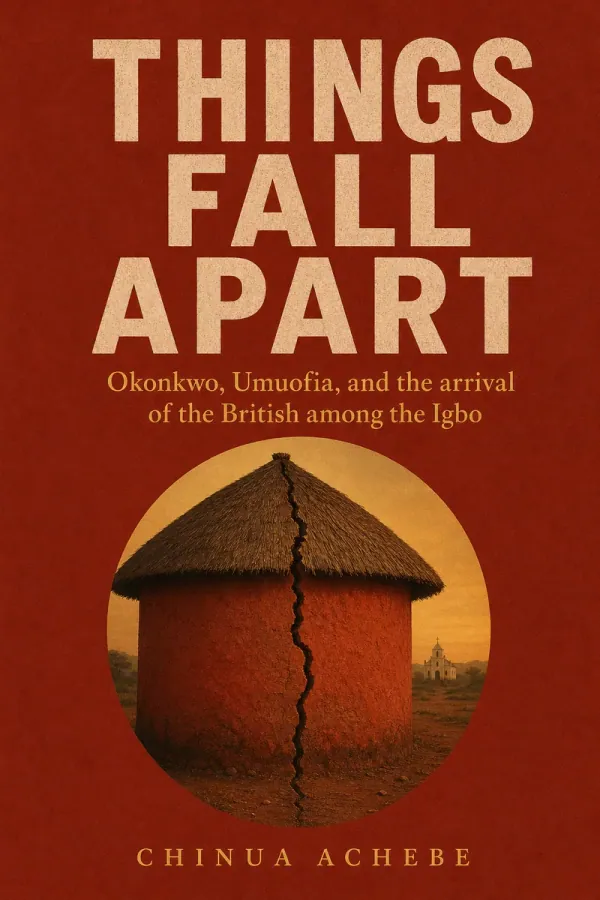
Published in London in 1958 by the Nigerian writer Chinua Achebe, Things Fall Apart tells the life of Okonkwo, a respected man in an Igbo clan in the 1890s, and then the arrival of British missionaries and colonial administrators. For the first time, the colonization of Africa was told from the inside, by an African, in English. You'll discover why Achebe wrote this book, the society of Umuofia, the plot in three parts, the major debates it raises (masculinity, tradition, language), and its immense legacy.
Key dates and facts
- 1948
- University of Ibadan opens
- 1957
- The manuscript is narrowed to Okonkwo
- June 17, 1958
- Published by Heinemann in London
- Oct. 1, 1960
- Nigerian independence
- Nov. 16, 1930
- Born near Ogidi
- 1967 – 1970
- Commitment to Biafra
- 1975
- “An Image of Africa” lecture
- 2007
- Man Booker International Prize
- March 21, 2013
- Dies in Boston
- 1961
- Radio drama Okonkwo
🌍 Telling Africa's story from the inside
When Things Fall Apart came out in London on June 17, 1958, Nigeria was still a British colony: it would not become independent until October 1, 1960. At the time, most novels about Africa were written by Europeans, and many portrayed Africans as “savages” supposedly in need of the West's enlightenment. A 27-year-old Nigerian, Chinua Achebe, wanted to tell the story differently: from the inside, from the point of view of those who had been colonized.
📚 A student's anger
In 1948, Nigeria's first university opened, University College, Ibadan. Achebe was part of its very first class. Reading the English classics about Africa, he grew highly critical, especially of Joseph Conrad's Heart of Darkness. The trigger came from another novel, Joyce Cary's Mister Johnson, whose Nigerian characters are nothing but savages or buffoons: it was while reading it that he decided to become a writer. Years later, he explained the book's success in Nigeria this way: “this was the first time we were seeing ourselves, as autonomous individuals, rather than half-people, or as Conrad would say, ‘rudimentary souls.’”
📻 A manuscript that was almost lost
After graduating in 1953, Achebe taught for a few months, then joined the Nigerian Broadcasting Service in Lagos in 1954. There he wrote scripts to be read on the air, which taught him to write natural dialogue. At the same time, he was working on a novel that at first spanned several generations. In 1957 he removed the second and third parts and kept only the story of Okonkwo. He then sent his only handwritten copy, along with 22 pounds sterling, to a London typing agency he had found in an advertisement. For months, nothing. His supervisor, Angela Beattie, who was passing through London, went to demand an explanation: the manuscript had been sitting in a corner of the office. Had it been lost, Achebe said, he would probably have given up altogether.
📖 “The best novel I have read since the war”
Several publishers rejected the text, on the grounds that fiction by Africans had no market. At Heinemann, an adviser, Donald MacRae, gave an enthusiastic report: in his view, it was the best novel he had read since the war. The book came out in a print run of about 2,000 hardcover copies and was very well received by the British press; the Times Literary Supplement praised a book that succeeds in presenting tribal life “from the inside.” In Nigeria, the reception was at first more mixed: at Ibadan, some teachers were amused that a former student could have written a novel worth reading.
🦅 A title borrowed from Yeats
The title comes from a poem by the Irish poet W. B. Yeats, “The Second Coming,” written in 1919 in the aftermath of the First World War, which describes a world losing its center:
“Things fall apart; the centre cannot hold; / Mere anarchy is loosed upon the world,”
W. B. Yeats, “The Second Coming” (1919)
In French, the novel was first called Le monde s'effondre (translated by Michel Ligny, Présence africaine, 1966), then Tout s'effondre in Pierre Girard's translation (Actes Sud, 2013).
✍️ Chinua Achebe, a writer between two worlds
Albert Chinụalụmọgụ Achebe was born on November 16, 1930, near Ogidi, an Igbo village in southeastern Nigeria. His parents had converted to the Protestantism of the Church Mission Society; his father, Isaiah, was a teacher and evangelist. Yet the family remained tied to tradition: Chinua's great-uncle Udoh, a titled chief of Ogidi known for his tolerance, refused to convert, and Isaiah continued to respect the religion of his ancestors. As a child, Chinua constantly begged for his mother's and sister's folktales, and eagerly awaited the village masquerade ceremonies, which he would recreate in his novels. He grew up exactly at the crossroads his book describes.
🎓 From medicine to literature
Having entered Ibadan in 1948 on a medical scholarship, he switched paths to study English, history, and theology, which cost him his scholarship; his family pooled their money so he could continue. There he also discovered the history of Christianity and traditional African religions. His first short stories, written at the university, already explored the conflict between tradition and modernity, trying to understand both sides.
📚 The work after the novel
Things Fall Apart opened what came to be called the African Trilogy. No Longer at Ease (1960) follows Obi, Okonkwo's grandson, a young civil servant caught up in the corruption of Lagos; Arrow of God (1964) tells the fate of an Igbo chief priest facing the colonial administration. Then came A Man of the People (1966), a satire of a newly independent African country, and Anthills of the Savannah (1987), a Booker Prize finalist. Achebe also became editor of Heinemann's African Writers Series, which brought to prominence authors such as the Kenyan Ngũgĩ wa Thiong'o and the Nigerian Flora Nwapa.
⚔️ Biafra, Conrad, and exile
When southeastern Nigeria seceded in 1967 under the name Biafra, Achebe supported independence and served as an ambassador for the Biafran cause in Europe and North America, until the surrender in January 1970. In 1975, in the United States, he gave a famous lecture, “An Image of Africa,” in which he called Conrad “a thoroughgoing racist”: in his view, Heart of Darkness reduces Africa to a backdrop stripped of humanity. The text caused a scandal, then became essential reading on Conrad's novel; other critics, such as Cedric Watts and Edward Said, defended Conrad's anti-imperialist dimension instead.
🏛️ Recognition
In 1990, a car accident left him paralyzed from the waist down. He then taught in the United States, at Bard College and later at Brown University. He received the Man Booker International Prize in 2007 and more than thirty honorary doctorates, but never the Nobel Prize. He is often called the “father of modern African literature,” a label he vigorously rejected. He died in Boston on March 21, 2013, and was buried in his hometown of Ogidi.
The rest of the course
This page publishes the first 2 parts. The full course has 8: here is what the next ones cover.
- 🌾 Umuofia, an ordered world
The Igbo society described in the novel: the nine villages of Umuofia, the prestige of work, the justice of the egwugwu, the gods, the oracle, and the chi.
- 🔥 Okonkwo, the fear of becoming his father
Part one of the novel: Okonkwo's glory, his father Unoka, the hostage Ikemefuna and his death, and little Ezinma carried off at night by the priestess Chielo.
- 🌿 Seven years of exile in Mbanta
Part two: the accident at Ezeudu's funeral, Okonkwo's exile among his mother's kin, the arrival of the missionaries, and Nwoye's conversion.
- ⛪ The return to Umuofia and the fall
Part three: Umuofia transformed by the Church and the colonial administration, the egwugwu unmasked, the church destroyed, the humiliation of the elders, and Okonkwo's end.
- ⚖️ Masculinity, tradition, and language: the major readings
The main themes and debates: Okonkwo's tragedy, masculinity and the feminine, a past neither idealized nor condemned, and the use of an English steeped in Igbo proverbs.
- 🏆 The most widely read African novel in the world
The novel's worldwide reception, its influence on African writers, its translations, its adaptations, and the debates it still sparks.
Study “Things Fall Apart” with flashcards and quizzes
In Oria, you read the full course, then practice on it: flashcards, multiple-choice quizzes, open questions or the Feynman method. Cards and questions then come back in your daily review, paced by spaced repetition.
Study this topic in OriaSources
These notes draw on the sources below. If a point seems doubtful, refer back to them.