Classic novels
The Lord of the Rings by J. R. R. Tolkien: Summary and Study Notes
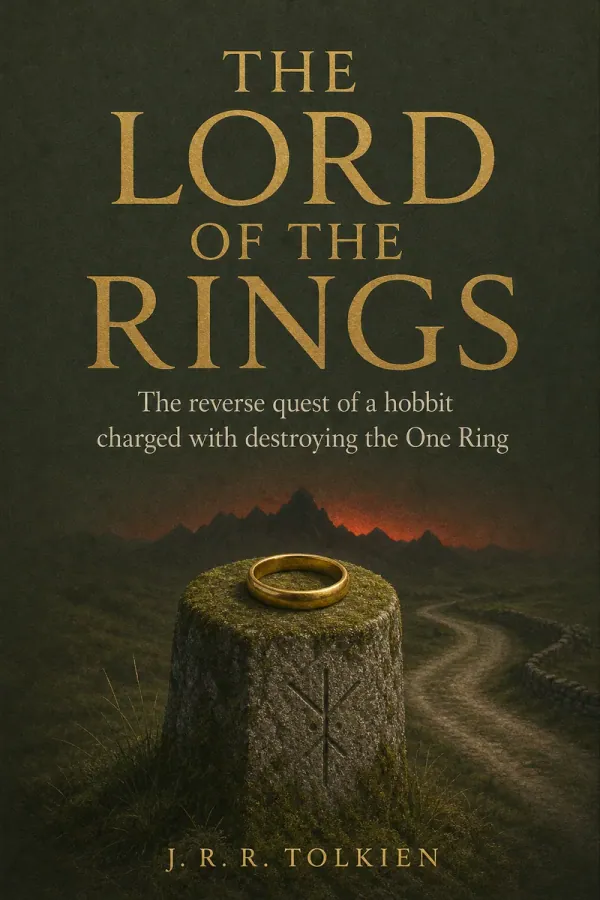
The reverse quest of a hobbit charged with destroying the One Ring
Study this topic in OriaThe essentials
Published in three volumes in 1954 and 1955, J. R. R. Tolkien's The Lord of the Rings follows Frodo, a hobbit from the peaceful Shire, charged with destroying the One Ring forged by Sauron before the Dark Lord can dominate Middle-earth. Written over more than ten years by an Oxford professor passionate about ancient languages, a veteran of the Somme, it has become one of the best-selling books in history. You'll discover how it came to be, its author, the world he built, the plot book by book, its great themes, the debate over allegory, and its immense legacy.
Key dates and facts
- Sept. 21, 1937
- The Hobbit published
- Dec. 19, 1937
- First chapter of the sequel
- 1949
- Revisions completed
- July 29, 1954
- First volume, The Fellowship of the Ring
- Oct. 20, 1955
- Last volume, The Return of the King
- Jan. 3, 1892
- Born in Bloemfontein
- 1916
- Officer on the Somme
- 1925
- Professor of Anglo-Saxon at Oxford
- Sept. 2, 1973
- Dies at 81
- 1957
- International Fantasy Award
🖋️ A Hobbit sequel that took twelve years
It all began with an unexpected success. The Hobbit, a tale an Oxford professor had first written for his children, was published on September 21, 1937, by Allen & Unwin and charmed adults as much as children. His publisher, Stanley Unwin, immediately asked for a sequel. Tolkien, worried, replied that he didn't know what more to say about hobbits, but that he had all too much to say about the world his hobbit had blundered into: for twenty years he had been secretly writing the legends that would become The Silmarillion, which the publisher had just turned down.
💍 An unexpected turn
On December 19, 1937, Tolkien announced that he had written the first chapter, “A Long-expected Party.” The hero was still Bilbo, who had spent his treasure and wanted to set off on another adventure. After several false starts, Tolkien remembered the magic ring Bilbo found in The Hobbit: from rewrite to rewrite, this simple object of invisibility became the One Ring forged by the Dark Lord, Sauron. The tone changed too. In an early draft, a mysterious cloaked rider passes the hobbits, then bursts out laughing: it's Gandalf. Tolkien quickly replaced this scene with a far more sinister one: the hobbits are pursued by Black Riders. The story, he wrote to his publisher, had taken an unexpected turn. The stranger met at the inn was at first just an adventurous hobbit in wooden shoes, nicknamed Trotter; he would become Aragorn, heir of kings.
⏳ Writing in fits and starts
Tolkien taught full time, graded exam papers to make ends meet, and rewrote constantly. He reached Moria in December 1939, then stopped, moved forward again in 1941–1942, and found himself completely stuck in the summer of 1943. He started again only in the spring of 1944, encouraged by his friend C. S. Lewis, sending the chapters one by one to his son Christopher, then training in South Africa with the Royal Air Force. The first draft was finished between mid-August and mid-September 1948, and revisions lasted until the fall of 1949. The manuscripts, more than 9,000 pages, are now held at Marquette University in the United States.
📦 Three volumes to limit the risk
Tolkien wanted to publish the novel together with The Silmarillion. Having fallen out with Allen & Unwin, he turned in 1950 to the publisher Collins, which eventually balked at the length of the text. He went back to Rayner Unwin, his publisher's son, who accepted. To limit possible losses, given the high cost of typesetting and paper after the war, the work was split into three volumes, each made up of two “books,” plus six appendices. Tolkien would earn nothing until sales had covered the costs. People often speak of a “trilogy,” but he conceived it as a single novel.
🎓 Tolkien, philologist and veteran of the Somme
John Ronald Reuel Tolkien was born on January 3, 1892, in Bloemfontein, in the Orange Free State (now in South Africa), where his father managed a bank. At three, he left for England with his mother and younger brother; his father died in Africa before he could join them. In 1896 the family settled in Sarehole, then a village in Worcestershire near Birmingham. The mill, woods, and hills around it would inspire the hobbits' Shire, and the advance of the industrial city over this countryside left a lasting mark on him.
📖 Orphaned and in love with languages
His mother, Mabel, taught him Latin and botany very early on. In 1900 she converted to Catholicism, and her Baptist family cut off all support. She died of diabetes in 1904, when Ronald was twelve. The two boys were entrusted to Father Francis Morgan, a priest of the Birmingham Oratory. As a teenager, Tolkien was already inventing languages with his cousins, then on his own, and studying Old English. With three school friends, he founded a small literary society; he entered Oxford University in 1911 and graduated in 1915 with first-class honors in English language and literature. Meanwhile, he had found Edith Bratt again, whom he had met at sixteen and whom his guardian had forbidden him to see until he came of age: they married on March 22, 1916.
🪖 The Somme
A signals officer in the Lancashire Fusiliers, he arrived on the Somme in early July 1916 and took part in several assaults. At the end of October he contracted trench fever, spread by lice, and was sent back to England in November. Two of his three school friends, Rob Gilson and Geoffrey Smith, were killed in the battle. It was during his convalescence that he began writing the first tales of his mythology, which he wanted to give to England. In 1917, in a small wood in Yorkshire, Edith danced for him among the flowers: this scene would become the story of Beren and Lúthien, at the heart of The Silmarillion.
🏛️ The Oxford professor
After the war, he worked on the great Oxford English Dictionary, on words of Germanic origin beginning with W, then taught at Leeds. In 1925 he became Professor of Anglo-Saxon at Oxford, then in 1945 Professor of English Language and Literature, until his retirement in 1959. His 1936 lecture on Beowulf transformed the study of the poem: the monsters, he explained, are not a flaw but its heart. A devout Catholic, he became friends with C. S. Lewis, author of The Chronicles of Narnia, and belonged to the Inklings, a circle of writers who read their work aloud to one another.
🌅 Fame, late
In retirement, fame caught up with him: he had to remove his number from the phone book and moved to Bournemouth with Edith. She died in 1971; he was made a Commander of the Order of the British Empire in 1972 and died on September 2, 1973, at 81. On their grave in Oxford, he had the names Lúthien and Beren engraved.
The rest of the course
This page publishes the first 2 parts. The full course has 9: here is what the next ones cover.
- 🗺️ Middle-earth, a world born of languages
How Tolkien built Middle-earth: an imaginary past of our own Earth, built from invented languages, maps, and a history spanning several millennia.
- 💍 The Fellowship of the Ring: leaving the Shire
Books I and II: Bilbo's legacy, Frodo's flight from the Black Riders, the Council of Elrond, the forming of the Fellowship, Moria, and the breaking of the company.
- 🏰 The Two Towers: the Fellowship scattered
Books III and IV: the war in Rohan, the return of Gandalf the White, the fall of Isengard, then Frodo and Sam's march toward Mordor with Gollum, all the way to Shelob.
- 👑 The Return of the King: Mount Doom and the Shire
Books V and VI: the siege of Minas Tirith, the Battle of the Pelennor Fields, the destruction of the Ring, Aragorn's coronation, the return to the Shire, and Frodo's departure.
- 🌑 Power, pity, and death: what the novel is about
The major themes studied by critics: the reverse quest, addiction to power, pity for Gollum, death and immortality, nature versus industry, the Christian background, and eucatastrophe.
- ⚔️ Allegory or “applicability”: the book and history
The links between the novel and 20th-century history: the imprint of the First World War, Tolkien's rejection of any allegory of 1939–1945 or the Cold War, and critiques about women, race, and conservatism.
- 🌍 From “juvenile trash” to the favorite book of the century
The novel's reception, from the divided reviews of the 1950s to the triumph of the 1960s, its translations (including into French), its sales records, its influence on fantasy, and its adaptations.
Study “The Lord of the Rings” with flashcards and quizzes
In Oria, you read the full course, then practice on it: flashcards, multiple-choice quizzes, open questions or the Feynman method. Cards and questions then come back in your daily review, paced by spaced repetition.
Study this topic in OriaSources
These notes draw on the sources below. If a point seems doubtful, refer back to them.