Law & society
Democracy: Summary and Study Notes
Power to the people, from Athens to today's indexes
Study this topic in OriaThe essentials
What does “government by the people” mean when the people number hundreds of millions? You'll start in the Athens of Cleisthenes, with its assembly, its selection by lot and the people it left out, then follow the long invention of representative government and the fight for the right to vote, from New Zealand to Saudi Arabia. Next you'll look at the main forms of democracy around the world, how research institutes measure it, the waves of democratization and today's backsliding, before ending with the critics, from Plato to social media.
Key dates and facts
- 594 BC
- Solon cancels debts and creates a people's court
- 508 BC
- Reforms of Cleisthenes, the birth certificate of democracy
- 451 BC
- Pericles introduces pay for civic duties
- 322 BC
- End of democracy under Macedonian rule
- 1848
- Universal male suffrage in France
- 1893
- New Zealand, the first country to let women vote
- 1965
- Voting Rights Act in the United States
- 1971
- Women's right to vote at the federal level in Switzerland
- 1828
- Start of the first wave, according to Huntington
- 1942
- Low point: only about a dozen democracies remain
🗳️ Power to the people: what are we talking about?
The word comes from ancient Greek: demos, the people, and kratos, strength or power. Originally, then, democracy means a system in which power belongs to the people, who exercise it either directly or through representatives. Today, the term applies to any political system in which the people are considered sovereign, and, by extension, to a way of living together based on freedom and equality.
Behind this simple definition lie two difficulties. The first is practical: how can millions of people spread across a vast territory “govern”? The second is political: almost every regime in the world calls itself democratic, including one-party states that called themselves “people's democracies.” To make sense of it all, political scientists look for what democracies have in common, what truly sets them apart from other regimes.
👥 The people and citizens
The “people” who vote have never been the whole population. In ancient Athens, women, slaves and resident foreigners were excluded. For centuries, you had to be a man, and often a wealthy one, to vote. Even today, minors don't vote and resident foreigners rarely do, except sometimes in local elections. Democracy therefore has a history: the gradual widening of the body of citizens.
🔑 Changing leaders without violence
The philosopher Karl Popper proposed a famous criterion. In his view, the real question is not “who should rule?” but “how can we stop those in power from abusing it?” A regime is democratic if it allows citizens to control their leaders and dismiss them without bloodshed, through elections. The physicist David Deutsch sums up the same idea: democracy exists to get rid of bad policies and bad governments without violence.
A representative democracy in which the power of elected officials is limited by a constitution and by the rule of law, which protect individual freedoms (of expression, the press, assembly, association, worship) and guarantee equality before the law. It can be parliamentary, presidential or mixed.
The countries considered most democratic share a few basic principles: the separation of legislative, executive and judicial powers, the sovereignty of the people, the election of representatives, the coexistence of several parties, equal rights and respect for freedoms. None of these is enough on its own: a country can hold elections while muzzling the press or the judges.
“…government of the people, by the people, for the people, shall not perish from the earth.”
Abraham Lincoln, Gettysburg Address (November 19, 1863)
Lincoln's formula was copied word for word into Article 2 of the French Constitution of 1958. The philosopher Paul Ricœur added an important nuance: democracy is not a regime without conflict, but a regime in which conflicts remain open and negotiable according to rules everyone knows. It doesn't promise unanimity; it organizes disagreement.
🏛️ Athens, the first experiment
Democracy's main roots lie in the Greek city-state of Athens. In the 6th century BC, the city went through a severe crisis: indebted peasants were being reduced to slavery, while a new class of prosperous craftsmen and merchants demanded an end to the great aristocratic families' monopoly on power.
⚖️ From Solon to Cleisthenes
Chosen as an arbiter, Solon, archon in 594 – 593 BC, is said to have canceled debts and banned debt slavery. He divided free men into four classes according to wealth, but opened a people's court, the Heliaia, to everyone, where anyone could prosecute a lawbreaker.
The decisive turning point came in 508 BC with Cleisthenes, often called “the father of Athenian democracy.” He replaced the old family loyalties with a territorial organization: each citizen belonged to a deme, a local district, and the demes were mixed into ten tribes combining city, coast and inland areas. The goal: to break up the great families' networks of clients. The Council, the Boule, grew to 500 members, fifty per tribe.
🗣️ How the city worked
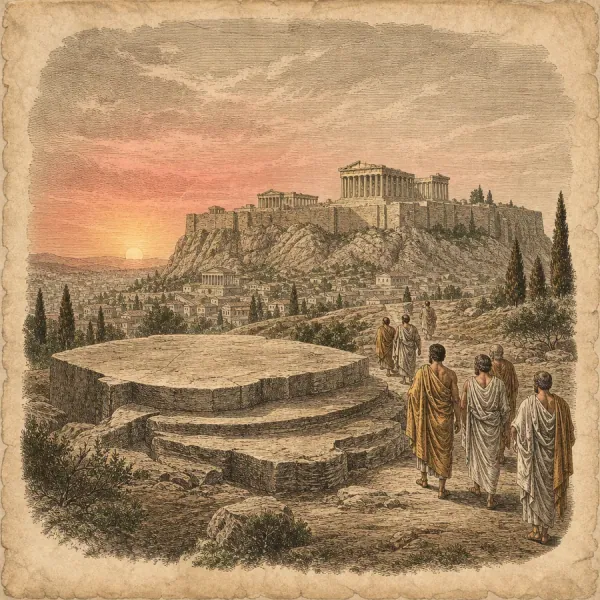
- The Ecclesia: the assembly of all citizens, meeting on the Pnyx hill. Any citizen could speak and propose a motion; votes were taken by show of hands, by simple majority. Some decisions required a quorum of 6,000 citizens.
- The Boule: 500 citizens over 30, chosen by lot for one year, no more than twice in a lifetime. It prepared the bills put to the assembly.
- The magistrates: about 700, most of them chosen by lot and scrutinized at the end of their term. Posts requiring expertise, such as those of the ten generals (strategoi) who commanded the army, were elected.
- Ostracism: once a year, citizens could banish for ten years a man considered too powerful, by writing his name on a shard of pottery, the ostracon. The aim was to prevent the return of a tyrant.
For Aristotle, selection by lot was the heart of the system: “Selection by lot is considered democratic, election oligarchic” (translated). It gave everyone an equal chance of holding office and discouraged scheming. Around 451 BC, Pericles introduced a payment, the misthos, so that the poorest could serve without losing a day's work.
🚫 A democracy of the few
This democracy was direct, but highly exclusive. Only adult men born of Athenian parents were citizens. In the 4th century BC, Attica may have had 250,000 to 300,000 inhabitants, of whom about 30,000 were citizens of voting age. Women, slaves and resident foreigners (the metics) had no political rights. The assembly sometimes made extremely brutal decisions, and it was a people's court of citizens that sentenced Socrates to death.
That trial left a deep mark on Plato, who saw democracy as the rule of passions and demagogues; he dreamed of a city governed by philosophers. Athenian democracy lasted, with interruptions, until the end of the 4th century BC, when Macedonian domination drained it of substance.
The rest of the course
This page publishes the first 2 parts. The full course has 8: here is what the next ones cover.
- 📜 The long invention of representative government
From medieval assemblies to the American and French revolutions: parliaments, Magna Carta, the Bill of Rights, Locke and the distinction between democracy and representative government.
- ✉️ The right to vote, a slow conquest
The widening of the franchise: the end of property qualifications, voting rights for minorities, women's suffrage around the world and the lowering of the voting age.
- 🌍 The forms of democracy around the world
Direct, semi-direct and representative democracy; parliamentary, presidential and semi-presidential systems; selection by lot and the Indian example.
- 📊 Measuring democracy: the indexes
The major democracy indexes (Economist Intelligence Unit, Freedom House, V-Dem), their methods, their recent results and where they disagree.
- 🌊 Waves of democratization and democratic backsliding
Huntington's three waves of democratization, the end of the Cold War, then today's democratic backsliding: coups, concentration of power, illiberal democracy.
- 🧭 Critiques and debates: the worst form of government, except for all the others?
The major critiques of democracy (the people's incompetence, tyranny of the majority, the Marxist critique, elected oligarchy, contested universalism) and today's challenges.
Study “Democracy” with flashcards and quizzes
In Oria, you read the full course, then practice on it: flashcards, multiple-choice quizzes, open questions or the Feynman method. Cards and questions then come back in your daily review, paced by spaced repetition.
Study this topic in OriaSources
These notes draw on the sources below. If a point seems doubtful, refer back to them.