Law & society
The United Nations: Summary and Study Notes
193 states around one table to prevent a third world war
Study this topic in OriaThe essentials
Born in 1945 from the ruins of World War II, the United Nations Organization now brings together almost every state on the planet. You'll discover how the San Francisco Charter set the rules of the game, why five countries hold a veto, and what the General Assembly, the Secretary-General, agencies such as WHO and UNICEF, and the blue helmets actually do. You'll also see its great successes, its tragic failures, from Rwanda to Srebrenica, and why everyone calls for a reform that almost no one manages to bring about.
Key dates and facts
- 1920
- The League of Nations begins operating
- 1942
- The Allies sign the Declaration by United Nations
- June 26, 1945
- The Charter is signed in San Francisco
- October 24, 1945
- The UN officially comes into being
- 1948
- First observer mission, in the Middle East
- 1956
- First armed force, during the Suez Crisis
- 1988
- Nobel Peace Prize for the blue helmets
- 1989 – 1994
- Twenty new operations in five years
🕊️ From the League of Nations to San Francisco
The United Nations (UN) is the largest international organization in the world. To understand why it exists and why it works the way it does, you have to go back to an earlier failure: that of the League of Nations.
💔 The first attempt: the League of Nations
After World War I, U.S. President Woodrow Wilson championed the idea of a world body to guarantee peace. The League of Nations was born with the Treaty of Versailles and began operating on January 10, 1920, in Geneva. But the United States never joined, and almost all its decisions required unanimity. When Japan invaded Manchuria, it left the League rather than withdraw. When Italy attacked Ethiopia, the appeal Emperor Haile Selassie made in Geneva in 1936 went unanswered. The war of 1939 finished paralyzing it: one of its last acts was to expel the Soviet Union after the invasion of Finland.
🤝 “United Nations”: first the name of an alliance
The phrase “United Nations” first referred to a military coalition. In August 1941, Franklin D. Roosevelt and Winston Churchill drew up the Atlantic Charter, which set out goals for the postwar world. On January 1, 1942, the United States, the United Kingdom, the Soviet Union and China signed the Declaration by United Nations, joined the very next day by twenty-two other countries: to sign it, a country had to declare war on the Axis. Roosevelt, who coined the name, is often considered the father of the organization.
In October 1943, in Moscow, the four major Allies publicly announced their intention to create a general international organization as soon as practicable. The plan was drafted at the Dumbarton Oaks conference, near Washington, in the fall of 1944, and the last disagreements, notably over voting in the Security Council, were settled at Yalta in February 1945.
🌉 The San Francisco Conference
On April 25, 1945, with the war in Europe not yet over, the United Nations Conference on International Organization opened in San Francisco, with delegations from fifty countries. For two months they negotiated the text of the Charter, which was signed on June 26, 1945; Poland, which had not attended, signed it later and became the fifty-first founding member. Churchill had pressed Roosevelt for France, liberated since the summer of 1944, to regain its status as a great power.
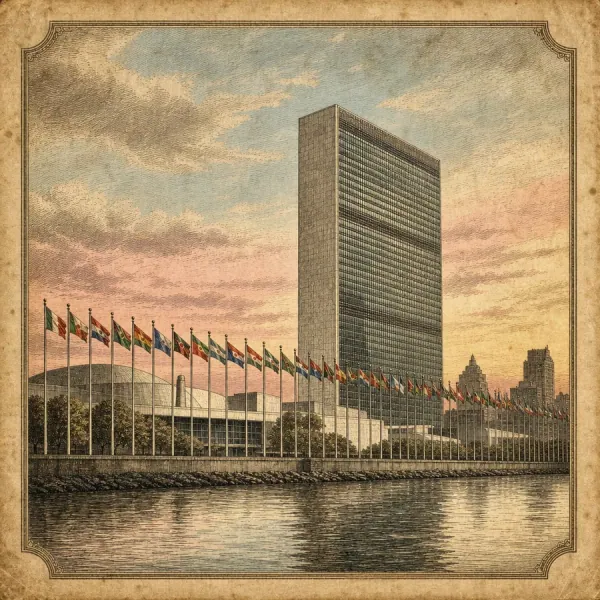
The UN officially came into existence on October 24, 1945, when the Charter was ratified by the five future permanent members of the Security Council and a majority of the other signatories. The first General Assembly met in London on January 10, 1946, with 51 countries. Norway's Trygve Lie became the first Secretary-General, and New York was chosen as headquarters: the building on the East River was completed in 1952.
📜 The Charter: the rules of the game
The Charter of the United Nations, signed in San Francisco in 1945, is the UN's founding treaty. It works a bit like a constitution for international life: all member states commit to respecting it, and it takes precedence over their other treaties in case of conflict.
🗣️ A preamble in the name of the peoples
Remarkably for a treaty between governments, the Charter opens in the name of the peoples, and its first stated aim is explicitly to prevent another world war.
“We the peoples of the United Nations determined to save succeeding generations from the scourge of war, which twice in our lifetime has brought untold sorrow to mankind…”
Preamble to the Charter of the United Nations (June 26, 1945)
🎯 Four main purposes
The Charter gives the organization several purposes: to maintain international peace and security; to develop friendly relations among nations based on equal rights and the self-determination of peoples; to cooperate in solving international problems of an economic, social, cultural or humanitarian character and to encourage respect for human rights “without distinction as to race, sex, language, or religion”; and finally, to be a center for harmonizing the actions of nations. The preamble also proclaims the equal rights “of men and women and of nations large and small.”
⚖️ The principles that bind states
- Sovereign equality: every state, whatever its size, is legally the equal of the others.
- Peaceful settlement of disputes: states must resolve their conflicts through negotiation, mediation or the courts (Chapter VI).
- The ban on the use of force (Article 2, paragraph 4): members refrain from the threat or use of force against the territorial integrity or independence of another state. This is the Charter's most revolutionary rule, because wars of conquest become illegal.
- Non-interference (Article 2, paragraph 7): the UN does not intervene in matters “essentially” within a state's domestic jurisdiction, except for measures decided by the Security Council.
🛡️ Two exceptions to the ban on force
The Charter allows only two cases in which the use of force is lawful. The first is self-defense, individual or collective, in response to an armed attack, recognized by Article 51 until the Security Council acts. The second is action decided by the Council itself under Chapter VII, in the event of a threat to the peace, a breach of the peace or an act of aggression: economic sanctions, embargoes and, as a last resort, authorization of a military operation.
The founders had even envisioned a standing army at the Council's disposal, with a Military Staff Committee. The Cold War kept this system from ever seeing the light of day: the UN has never had forces of its own, which explains the later invention of the blue helmets.
🗂️ Six principal organs
The Charter creates six principal organs: the General Assembly, the Security Council, the Economic and Social Council, the International Court of Justice, the Secretariat and the Trusteeship Council. The last of these, tasked with guiding territories toward independence, suspended its operations on November 1, 1994, after the independence of Palau, the last trust territory. The UN has six official languages: Arabic, Chinese, English, French, Russian and Spanish.
The Charter has been amended only very rarely. The most important amendments, which came into force in 1965, enlarged the Security Council and the Economic and Social Council. Any revision requires two-thirds of member states… and the agreement of the five permanent members.
The rest of the course
This page publishes the first 2 parts. The full course has 8: here is what the next ones cover.
- 🛡️ The Security Council and the veto
The composition and powers of the Security Council, the origins of the five permanent members' veto, how it has been used and the ways to get around it.
- 🏛️ The General Assembly, the Secretary-General and the Court
The role of the General Assembly, the Secretariat and the Secretary-General, the International Court of Justice and the Economic and Social Council.
- 🏥 The UN family: agencies, funds and programs
The “UN system”: specialized agencies such as WHO, FAO and UNESCO, funds such as UNICEF and WFP, humanitarian aid, development and climate.
- 🪖 The blue helmets
UN peacekeeping: its improvised birth in 1948 and 1956, its principles, major operations, troop numbers, losses and effectiveness according to researchers.
- ⚖️ Successes and failures
The UN's record: decolonization, health, ending conflicts and successful major operations, but also Cold War paralysis, Rwanda, Srebrenica, Somalia, Iraq, cholera in Haiti and sexual abuse.
- 🔧 Criticism, reform and the future
The main criticisms of the UN, proposals to reform the Security Council, funding problems and the succession to António Guterres in 2026.
Study “The United Nations” with flashcards and quizzes
In Oria, you read the full course, then practice on it: flashcards, multiple-choice quizzes, open questions or the Feynman method. Cards and questions then come back in your daily review, paced by spaced repetition.
Study this topic in OriaSources
These notes draw on the sources below. If a point seems doubtful, refer back to them.