Philosophy
Descartes: Biography and Study Notes
The philosopher of doubt who made “I think” the starting point of everything
Study this topic in OriaThe essentials
Born in Touraine in 1596 and educated by the Jesuits at La Flèche, René Descartes was a soldier before discovering his calling during a night of dreams on November 10, 1619. You'll follow his life as a voluntary exile in the Netherlands, his two great books, the Discourse on the Method and the Meditations, and his mysterious death during a Stockholm winter. You'll come to understand his four rules of method, his radical doubt, the cogito, his separation of soul and body, and his invention of analytic geometry, before seeing why he is considered the father of modern philosophy.
Key dates and facts
- 1596
- Born in La Haye-en-Touraine, March 31
- 1597
- Death of his mother
- 1599
- His father remarries
- 1607
- Enters the college at La Flèche
- 1618
- Enlists at Breda, meets Beeckman
- November 10, 1619
- The night of the three dreams
- 1622
- Sells his mother's inheritance
- 1627
- Bérulle urges him toward philosophy
- 1629
- Settles in the United Provinces
- 1633
- Galileo condemned; Descartes abandons the Treatise on the World
🏡 A childhood in Touraine
René Descartes was born on March 31, 1596, in La Haye-en-Touraine, a small town in the Indre-et-Loire region that today bears his name: it is now called Descartes. He was most likely born at his maternal grandparents' house, where his mother came to give birth to all her children; his father was away at the time, held in Rennes by work. He was baptized on April 3 at the church of Saint-Georges.
👨👩👧 A family of minor nobility
He was the third child of Joachim Descartes, a councillor in the parliament of Brittany, in Rennes, and of Jeanne Brochard. The family was Catholic, in a region with many Protestants: the parish that covered his grandmother's house had, in fact, been handed over to Protestant worship.
🕯️ An early loss
On May 13, 1597, when René was just thirteen months old, his mother died, a few days after giving birth to another boy who did not survive. The child was raised by his maternal grandmother, Jeanne Sain, by his father, and by a wet nurse. In 1599, Joachim Descartes remarried, to a woman from Nantes named Jeanne Morin. René learned to read and write at his grandmother's house, with a tutor, alongside his older sister Jeanne.
❓ “My little philosopher”
Frail in health, René was a child curious about everything. His father nicknamed him his “little philosopher,” so relentless was he in asking questions. This frailty had a concrete consequence: his entry into school was delayed. He would not start until age eleven, in 1607, and even then he was granted special treatment.
Little is known of these early years, yet they already show traits that would stay with him for life: a delicate constitution that forced him to pace himself, a taste for solitude and reflection, and a determination to understand everything for himself. As a young man he would adopt the motto “He who lived hidden lived well,” and he liked to say that in all things he preferred to “advance masked.”
📐 La Flèche and Poitiers
In 1607, at age eleven, René Descartes entered the Collège Royal Henri-le-Grand de La Flèche, founded three years earlier and run by the Jesuits. The school later became the Prytanée National Militaire. He stayed there until 1614.
🛏️ An unusual pupil
His status was somewhat special: because of his frail health, but also his precocious gifts and love of reflection, he was excused from morning classes. There he studied the classics, physics, and scholastic philosophy — that is, Aristotle's philosophy as it was then taught, reconciled with Christianity. Father Jean François spent a year introducing him to mathematics.
➗ A love of mathematics
In the Discourse on the Method, published thirty years later, Descartes would look back on these years. He admitted having studied at “one of the most famous schools in Europe,” yet he came away disappointed: all that learning seemed to him uncertain and poorly connected, so much so that the one thing he claimed to have gained was to have “discovered more and more [his] own ignorance.” Only one subject found favor in his eyes:
“What pleased me most in it was mathematics, because of the certainty and self-evidence of its reasoning; but I did not yet see its true use.”
René Descartes, Discourse on the Method, part one (1637) (translated)
He marveled that on foundations “so firm and so solid,” nothing grander had ever been built. That remark already contained the seed of his whole project: to extend the certainty of mathematics to all of human knowledge.
⚖️ A law degree
In keeping with his father's wish that he become a lawyer, he went on to study law at the University of Poitiers, earning his bachelor's and license in civil and canon law there in November 1616. But he would never practice. He left for Paris, where for a time he led a retired life devoted to study.
The young graduate had already made a decision he would later recount in the Discourse: since books had not brought him certainty, he would seek the truth in himself or in “the great book of the world,” by traveling, by seeing “courts and armies,” and by mixing with people of every condition.
The rest of the course
This page publishes the first 2 parts. The full course has 9: here is what the next ones cover.
- ⚔️ The soldier and the night of November 10, 1619
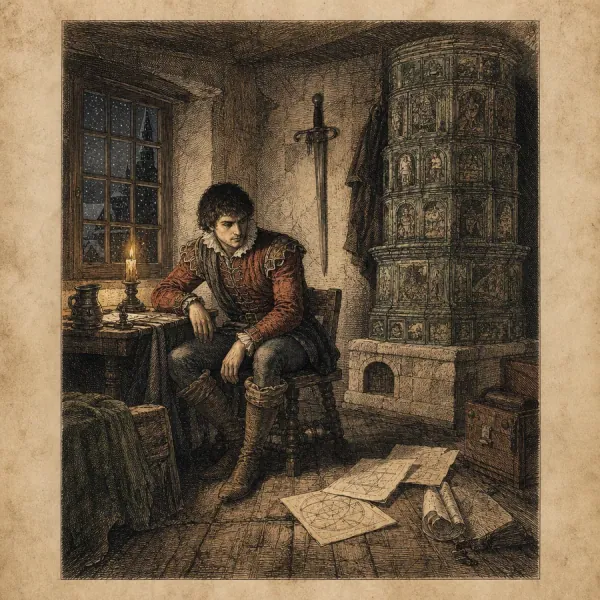
Descartes as a soldier in Holland and then Bavaria, his meeting with Isaac Beeckman, the night of the three dreams on November 10, 1619, in a German stove-room, then his travels and years in Paris until 1628.
- 🌷 Twenty years in the Netherlands
Descartes's life in the United Provinces (1629–1649): solitude and frequent moves, dissections and scientific work, abandoning the Treatise on the World after Galileo's condemnation, his daughter Francine, the Utrecht quarrel, and his correspondence with Elisabeth of Bohemia.
- 📜 The Discourse on the Method and its four rules
The Discourse on the Method (1637): a book written in French for everyone, good sense as "the most fairly distributed thing in the world," the four rules of method (evidence, analysis, order, enumeration), and the provisional morality.
- 🧠 The Meditations: from doubt to the cogito
The Meditations on First Philosophy (1641): methodic doubt (senses, dreams, the evil genius), the cogito, the piece of wax, the proofs of God's existence, the dualism of soul and body, and its difficulties.
- 📊 Physics and mathematics
Descartes's scientific contributions: analytic geometry and Cartesian coordinates, modern algebraic notation, optics and the law of refraction, the principle of inertia, a mechanistic view of the world, and the tree of philosophy.
- ❄️ Sweden and death
Queen Christina's invitation, lessons at five in the morning during a Stockholm winter, Descartes's death on February 11, 1650, the poisoning theory, and the strange fate of his remains and his skull.
- 🌍 Legacy: the father of modern philosophy
Descartes's legacy: the condemnations and successes of Cartesianism in the 17th century, disciples and opponents (Spinoza, Malebranche, Leibniz, Pascal), his place in French identity, the mind-body problem, and today's ecological criticisms.
Study “Descartes” with flashcards and quizzes
In Oria, you read the full course, then practice on it: flashcards, multiple-choice quizzes, open questions or the Feynman method. Cards and questions then come back in your daily review, paced by spaced repetition.
Study this topic in OriaSources
These notes draw on the sources below. If a point seems doubtful, refer back to them.