Philosophy
Kant: Biography and Study Notes
The philosopher who set the limits of reason
Study this topic in OriaThe essentials
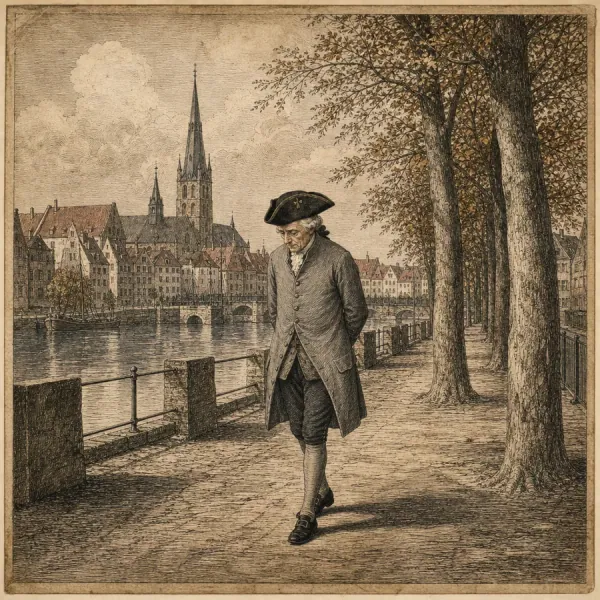
The son of a saddler from Königsberg, raised in a strict pietism, Immanuel Kant became a professor and at fifty-seven published the Critique of Pure Reason, which upended philosophy. In it he carried out a "Copernican revolution": it is the mind that imposes its forms on the objects it comes to know. You will discover his life run like clockwork, his years of silence, his ethics of duty and the categorical imperative, his Enlightenment call "Sapere aude", his project for perpetual peace, and the immense legacy of a thinker who shaped all of modern philosophy.
Key dates and facts
- 1755
- Nebular hypothesis and start of teaching
- 1756
- Writings on the Lisbon earthquake
- 1764
- Observations on the beautiful and the sublime
- 1770
- Appointed professor of logic and metaphysics
- 1781
- First edition of the Critique of Pure Reason
- 1783
- Prolegomena to Any Future Metaphysics
- 1786
- Reinhold's letters: Kant becomes famous
- 1787
- Revised second edition of the Critique
- 1784
- What Is Enlightenment?
- 1785
- Groundwork of the Metaphysics of Morals
🏠 A pietist childhood in Königsberg
Immanuel Kant was born on April 22, 1724, in Königsberg, in East Prussia. The city is known today as Kaliningrad and belongs to Russia. He was baptized Emanuel and later changed the spelling of his first name to Immanuel, after learning Hebrew.
👨👩👦 A family of craftsmen
His father, Johann Georg Kant, was a saddler, a craftsman who made harnesses for horses; he came from Memel, a Prussian town now in Lithuania. Kant believed his family was of Scottish descent, but genealogical research has not confirmed this. His mother, Anna Regina Reuter, was born in Königsberg. Immanuel was the fourth child in a large family: sources mention nine or eleven children, several of whom died young. The household was modest.
🙏 Pietism
The family was Lutheran and deeply marked by pietism, a Protestant movement that stressed inner devotion, humility, and reading the Bible. Kant would later describe his mother as highly intelligent and deeply pious. She died in 1737, when he was thirteen.
📖 The Collegium Fridericianum
For seven years, the boy studied at the Collegium Fridericianum, run by the pietist pastor Franz Albert Schultz, for whom piety of the soul mattered more than reasoning. Teaching there was strict, disciplinarian, sometimes punitive. Students mainly learned Latin and religion; mathematics and science had little place. The young Kant proved a very gifted student. He finished his schooling at the end of summer 1740, at sixteen.
🎓 Student, then private tutor
In 1740, at sixteen, Kant entered the University of Königsberg, to which he would remain attached for the rest of his life. He enrolled first to study theology, but it was philosophy and the sciences that captivated him.
🍎 Discovering Newton
His most influential teacher was Martin Knutzen, who taught logic, metaphysics, and mathematics. Knutzen was a rationalist, a follower of the German philosophers Leibniz and Wolff, whose disciple Kant would long remain, but he also knew English science and philosophy. It was Knutzen who introduced Kant to the mathematical physics of Isaac Newton. For the young student, it was a revelation: Newton proved that a rigorous science of nature, grounded in mathematics, was possible. All of Kant's later philosophy would try to understand how such certain knowledge could exist.
✍️ A first work
Between 1745 and 1747, Kant wrote his first book, Thoughts on the True Estimation of Living Forces, devoted to a physics controversy of his time. It was published in 1749.
🏡 Nine years as a tutor
In 1746, his father died after a stroke. Kant had to interrupt his studies to earn a living. He left Königsberg around 1748 and became a private tutor, teaching the children of well-off families in the surrounding countryside. This work lasted about nine years. He nonetheless continued his research. He returned to Königsberg in 1754, ready to begin an academic career.
📌 What he took from it
This formative period left him with two heritages that would clash in his mind: the rationalists' confidence in reason, which they believed could know God, the soul, and the world through reflection alone, and Newton's model, in which knowledge always rests on observation and calculation. Reconciling the two would be the work of his entire life.
The rest of the course
This page publishes the first 2 parts. The full course has 9: here is what the next ones cover.
- 🔭 The young professor: the pre-critical period
Kant's beginnings as a teacher from 1755: the nebular hypothesis, earthquakes, geography, his first philosophical writings, his reading of Rousseau, and his appointment as full professor in 1770.
- 🤫 Ten years of silence and the Critique of Pure Reason
The "dogmatic slumber" from which Hume roused Kant, the eleven years of silent work, the publication of the Critique of Pure Reason in 1781, its difficult reception, the Prolegomena, and the second edition of 1787.
- 🧠 The Copernican revolution: what we can know
The key ideas of the Critique of Pure Reason: the Copernican revolution, the a priori, synthetic a priori judgments, space and time as forms of sensibility, the categories, phenomena and things in themselves, and the limits of metaphysics.
- ⚖️ The morality of duty: the categorical imperative
Kant's moral philosophy (Groundwork of the Metaphysics of Morals, 1785; Critique of Practical Reason, 1788): good will, acting from duty, the hypothetical and categorical imperatives, their formulas, autonomy, and the debate over lying.
- 💡 The Enlightenment and perpetual peace
Kant's political and historical writings: What Is Enlightenment? (1784) and his motto Sapere aude, the public use of reason, universal history, Toward Perpetual Peace (1795), and his views on the French Revolution and colonization.
- 🕰️ A regulated life, censorship, and the final years
Kant's daily life and his legend as a human clock, the third Critique (1790), his conflict with royal censorship over religion (1792-1794), his break with Fichte, his decline, and his death on February 12, 1804.
- 🌍 Legacy: a "before" and an "after" Kant
Kant's immense influence: German idealism, neo-Kantianism, phenomenology, analytic and political philosophy (Rawls, Habermas), the major critiques of his ethics (Constant, Hegel, Schopenhauer, Péguy, Nietzsche), the controversy over his racist writings, and his memory in Kaliningrad.
Study “Kant” with flashcards and quizzes
In Oria, you read the full course, then practice on it: flashcards, multiple-choice quizzes, open questions or the Feynman method. Cards and questions then come back in your daily review, paced by spaced repetition.
Study this topic in OriaSources
These notes draw on the sources below. If a point seems doubtful, refer back to them.