Philosophy
Epicurus: Biography and Study Notes
The philosopher of pleasure… and of simple living
Study this topic in OriaThe essentials
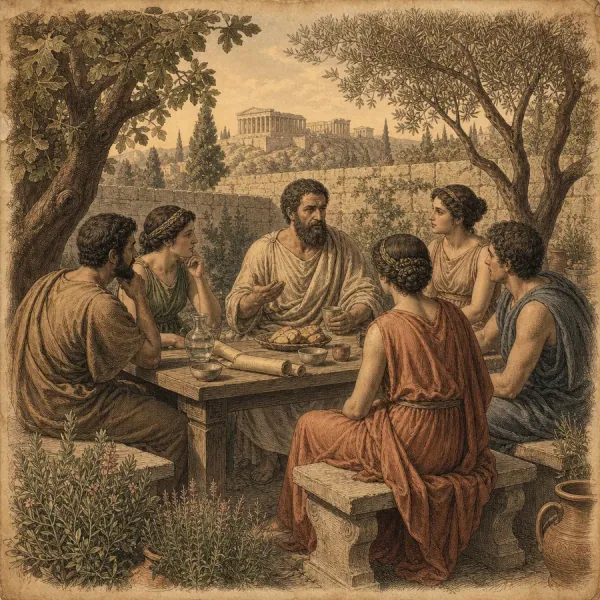
Born on Samos, Epicurus founded an unusual school in Athens in 306 BC, the Garden, open to women and slaves. There he taught that happiness is the goal of life, but that true pleasure is sober: no pain in the body, no turmoil in the soul. You'll discover his life, his physics of atoms, his classification of desires, the fourfold remedy and the Letter to Menoeceus, his serene death and the astonishing misreading that turned “epicurean” into a word for a lover of fine food and drink.
Key dates and facts
- 341 BC
- Born on Samos
- 334 BC
- Alexander sets out to conquer the Persian Empire
- c. 323 BC
- Military service in Athens
- 306 BC
- Founding of the Garden in Athens
- 296 – 295 BC
- Probable date of the Letter to Menoeceus
- 270 BC
- Epicurus dies at the Garden
- 1417
- Lucretius's poem rediscovered
- 1841
- Marx's thesis on Democritus and Epicurus
- 1888
- Vatican Sayings discovered
🏝️ A youth on Samos
Epicurus was born at the end of 342 or the beginning of 341 BC, probably in February 341, on the island of Samos, in the Aegean Sea. Some ancient notices say he was born in Athens, but he is most often said to have been born on Samos.
🏺 A family of Athenian settlers
Samos was then home to a colony of Athenians. His father, Neocles, was a cleruch, an Athenian settler who had received a small plot of land on the island; his mother was named Chaerestrate. Both were born in Athens, so Epicurus was an Athenian citizen. He had three brothers, Neocles, Chaeredemus and Aristobulus, who would later become his disciples.
The Greek world was changing fast. Plato had died seven years before Epicurus was born, and the boy was seven when Alexander the Great crossed the Hellespont to conquer the Persian Empire. Epicurus grew up at the end of the Classical age, just as the Hellenistic world was being born.
❓ A question at fourteen
According to the ancient biographer Diogenes Laertius, his calling came very early, at around fourteen. Reading the Theogony of the poet Hesiod, which says that everything came out of primordial Chaos, he asked his teacher where Chaos itself came from. Unsatisfied with the answers, he decided to search on his own. Later, Epicurus would present himself as self-taught, and he would be criticized for boasting of it, since he certainly did have teachers.
📖 First teachers
He studied, for about four years, with a Platonist philosopher on Samos named Pamphilus. His writings also show solid training in rhetoric. At around eighteen, he went to Athens to complete the ephebeia, the compulsory military service of young citizens. He may have crossed paths there with the Cynic philosopher Diogenes of Sinope, still alive at the time, but nothing proves it.
🧭 Exile, atoms and first schools
The death of Alexander the Great in 323 BC turned Epicurus's life upside down. Alexander's generals fought over his vast empire, and one of them, Perdiccas, expelled the Athenian settlers from Samos. Epicurus's family took refuge in Colophon, on the coast of present-day Turkey. His military service over, the young man joined them there.
⚛️ Meeting the atoms
In Colophon, from about 323 to 321 BC, he attended the lessons of Nausiphanes, a follower of Democritus. That 5th-century BC philosopher had argued that everything is made of tiny invisible and indivisible particles, atoms, moving through the void. Epicurus would take up this theory while changing it on essential points. Yet he always refused to acknowledge his debt: according to Diogenes Laertius, he treated his predecessors with contempt and nicknamed Democritus “Lerocritus,” a pun that can be rendered as “dealer in nonsense” or “judge of drivel.”
🌪️ Troubled times
The context matters for understanding his philosophy. The Greek world was going through decades of wars between Alexander's successors; the cities were losing their independence; the future looked uncertain. Epicurus sought a wisdom that would allow people to live without fear, especially without fear of the gods and of death.
🏫 Mytilene and Lampsacus
Around 311 BC, at about thirty, he began teaching in Mytilene, on the island of Lesbos. His ideas stirred up such hostility there that he had to leave quickly; but he had met Hermarchus, who would become his successor. He then settled in Lampsacus, on the Dardanelles strait, where he lived from 310 to 306 BC. There he won loyal disciples who would follow him to Athens: Metrodorus, his closest friend, Polyaenus, Colotes and Idomeneus.
Around the same time, about 311 BC, a young man in his twenties, Zeno of Citium, arrived in Athens. Much later he would found Stoicism, the great rival school. But this rivalry, often presented as a duel, only really took hold after Epicurus's death.
The rest of the course
This page publishes the first 2 parts. The full course has 9: here is what the next ones cover.
- 🌿 The Garden in Athens
The founding of the Garden in Athens in 306 BC: a community of friends open to women and slaves, a frugal life, festivals in Epicurus's honor and the rejection of political life.
- 📜 A body of work almost entirely lost
What remains of Epicurus's writings: three letters and forty maxims handed down by Diogenes Laertius, the Vatican Sayings, the Herculaneum papyri, the inscription of Diogenes of Oenoanda and Lucretius's poem.
- ⚛️ Atoms and void: a physics against fear
Epicurus's physics: why study nature, atoms and void, the infinity of worlds, the swerve of atoms (clinamen) and freedom, a mortal soul, indifferent gods, and his theory of knowledge.
- 🍞 Pleasure, yes, but which kind? Desires and ataraxia
Epicurus's ethics: pleasure as the good, ataraxia and aponia, the classification of desires, static pleasures, prudence, the virtues and friendship.
- 💊 The fourfold remedy and the Letter to Menoeceus
The tetrapharmakos, a four-line summary of Epicurean wisdom, and the Letter to Menoeceus: do philosophy at any age, do not fear the gods, death is nothing to us.
- 🕯️ A serene death
Epicurus's death in 270 BC after fourteen days of illness, his last letter to Idomeneus, his will and his succession at the head of the Garden.
- 🌍 From “pig” to “epicurean”: a turbulent legacy
The success of Epicureanism in Rome, Christian hostility, the medieval caricature of the pleasure-seeker, the Renaissance rediscovery, Gassendi, Marx, the utilitarians and the modern misreading of the word epicurean.
Study “Epicurus” with flashcards and quizzes
In Oria, you read the full course, then practice on it: flashcards, multiple-choice quizzes, open questions or the Feynman method. Cards and questions then come back in your daily review, paced by spaced repetition.
Study this topic in OriaSources
These notes draw on the sources below. If a point seems doubtful, refer back to them.