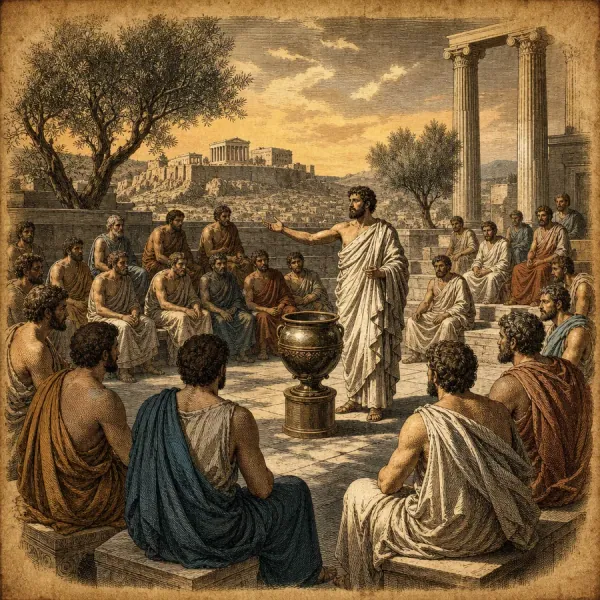
Philosophy
Justice: Summary and Study Notes
Law, equality, fairness, revenge: what makes a society just?
Study this topic in OriaThe essentials
Is something just because it's the law? Should everyone get the same thing, or each according to their merit? You'll start from Plato's thought experiment of the Ring of Gyges, then see Aristotle's distinction between distributive and corrective justice and his praise of equity. Next you'll discover the conflict between natural law and written law, from Antigone to Pascal, John Rawls's theory and his veil of ignorance, and the line between justice and revenge. To finish, typical essay questions with leads.
Key dates and facts
- c. 1750 BC
- Code of Hammurabi in Babylon
- 458 BC
- Aeschylus, The Oresteia
- 441 BC
- Sophocles, Antigone
- 1971
- John Rawls, A Theory of Justice
- c. 1750 BC
- Retaliation in the Code of Hammurabi
- 458 BC
- Aeschylus' Oresteia in Athens
- 1977
- Albert Eglash names restorative justice
⚖️ What is justice?
The sense of injustice shows up very early: a child protests the moment another child gets a bigger slice of cake. But as soon as we try to say what justice is, the questions pile up. Is something just because it's the law? Can a law be unjust? Should everyone get the same thing, or each according to what they deserve, or according to what they need? And what should you do when you have been wronged: take revenge, or leave it to a court?
🏛️ A virtue, an ideal, an institution
The word justice comes from the Latin justitia, derived from jus, law or right. It refers to at least three things.
- A virtue: the quality of a person who respects the rights of others and doesn't take more than their share. For the Greeks, justice was above all a virtue, the chief one.
- An ideal: what ought to be, the idea of a just order, in the name of which we criticize existing laws and societies.
- An institution: the courts and judges responsible for “administering justice” and stating the law. In French it is often written with a capital letter in this sense.
These three meanings don't always line up. A court can hand down a ruling that follows the law but feels unjust; a person can be just without ever setting foot in a courthouse.
What is legal conforms to the laws in force. What is legitimate conforms to what is just, to what is morally grounded. The philosophy of justice lives precisely in the possible gap between the two.
🍰 Equality or equity?
Justice seems tied to equality: treating similar cases in similar ways. But strict equality can be unjust. Giving the same ration to a baby and to a manual laborer, or the same pay to someone who works ten hours and someone who works two, offends our sense of justice. That is where equity comes in: taking into account differences between people or particular situations. An old formula, taken up by the Roman jurist Ulpian, sums up the ideal: suum cuique tribuere, “to give each their due.” The whole problem is knowing what each person is due.
The great answers in philosophy can be read as so many ways of answering that question: is justice nothing but the law of the strongest in disguise, a proportion to respect, a law higher than human laws, or the result of an impartial choice?
💍 Plato: the Ring of Gyges
Plato's Republic, a dialogue subtitled “On Justice,” opens with a simple question: what is justice? After Socrates examines some first answers, the Sophist Thrasymachus, a teacher of rhetoric, steps in with a provocative thesis.
“I say that justice is nothing other than the advantage of the stronger.”
Plato, Republic, Book I (translated)
His reasoning goes like this: in every city, those who govern make laws to their own advantage, then call obedience to those laws “just” and punish those who break them. Justice would therefore be an instrument of domination. Socrates refutes Thrasymachus, but Plato's two brothers, Glaucon and Adeimantus, are not convinced.
🤝 Justice, a mere convention?
In Book II, Glaucon takes up Thrasymachus's position, without endorsing it, to push Socrates further. According to the common opinion he lays out, doing injustice is naturally good and suffering it is bad. But since everyone has tasted both, the weaker found it useful to agree not to wrong one another any more: that is how laws and conventions were born. Justice would then be loved only for lack of anything better, by those who lack the power to be unjust with impunity.
💍 The thought experiment
To prove it, Glaucon tells a story. Gyges, a shepherd in the service of the king of Lydia, discovers an opening in the earth after a storm. Inside he finds a gold ring. One day, while idly turning the ring's setting toward the inside of his hand, he becomes invisible; turning it outward, he reappears. With this power, he gets himself sent to the palace, seduces the queen, kills the king with her help and seizes the throne.
Glaucon then asks us to imagine two rings, one given to a just man, the other to an unjust one. In his view, no one would stay faithful to justice if he could take whatever he wanted without ever being seen. That would prove that “no one is just willingly, but only under compulsion.” He adds that the masterpiece of injustice is to seem just without being so.
A thought experiment from Book II of the Republic: a ring that makes you invisible raises the question of whether we act justly out of conviction or only out of fear of being seen and punished.
🎼 Plato's answer: harmony
The whole rest of the Republic is a long answer to this challenge. For Plato, justice is not first and foremost an external rule: it is a harmony. In the ideal city, everyone holds the place that suits them: philosophers govern, guardians defend, producers ensure prosperity. In the same way, in the just soul, the different parts of the soul live in harmony. There is no just city without just people. Socrates compares justice to medicine: it is to the soul and the city what health is to the body. Being just, then, means first being in tune with yourself, not just avoiding punishment.
The Gyges story has had an enormous afterlife. Cicero takes it up, Rousseau wonders what he would do with the ring in his Reveries of the Solitary Walker, and many see it as an ancestor of Tolkien's One Ring. It remains the best way to ask a question everyone can answer for themselves: would I be just if no one could see me?
The rest of the course
This page publishes the first 2 parts. The full course has 7: here is what the next ones cover.
- 📐 Aristotle: distributing, correcting, and equity
In Book V of the Nicomachean Ethics, Aristotle distinguishes distributive justice (geometric proportion according to merit) from corrective justice (arithmetic equality in exchanges and reparations), then praises equity, which corrects the generality of the law.
- 📜 Justice and law: natural law versus positive law
The conflict between written and unwritten laws in Sophocles' Antigone, natural law and the rights of man of 1789, legal positivism from Hobbes to Kelsen, and Pascal's critique of the diversity of laws and of the relationship between justice and might.
- 🎭 Rawls and the veil of ignorance
John Rawls's A Theory of Justice (1971): the original position and the veil of ignorance, the two principles of justice (equal liberties, the difference principle), and the criticisms of Nozick, Sandel, Okin, Sen and Harsanyi.
- 🔥 Justice and revenge
From the lex talionis of the Code of Hammurabi to Athena's court in Aeschylus' Oresteia, justice as a way beyond revenge; theories of punishment (retributive, utilitarian) and restorative justice.
- ✍️ Essay questions and leads
Six typical essay questions about justice, each with the problem to bring out and leads on authors and examples, without writing the essay for you.
Study “Justice” with flashcards and quizzes
In Oria, you read the full course, then practice on it: flashcards, multiple-choice quizzes, open questions or the Feynman method. Cards and questions then come back in your daily review, paced by spaced repetition.
Study this topic in OriaSources
These notes draw on the sources below. If a point seems doubtful, refer back to them.