Geography & countries
Iran: Summary and Study Notes
Heir to Persia, an Islamic Republic in turmoil
Study this topic in OriaThe essentials
Iran, long known in the West as Persia, is heir to one of the oldest civilizations in the world. Persian dynasties, the Arab conquest, the Mongols, the Shiite Safavids, modernizing shahs, and then the Islamic revolution of 1979: its history is that of a pivot country between East and West. You'll discover its landscapes, its people and culture, its economy built on oil and gas, its unique institutions, its regional role, and the crises that have shaken it since 2025, from mass protests to war with the United States and Israel.
Key dates and facts
- 224
- Founding of the Sasanian Empire
- 632 – 654
- Arab conquest and fall of the Sasanians
- 1501
- The Safavids make Shiism the official religion
- 1796
- Coronation of the first Qajar shah
- 1953
- Coup against Mossadegh (August 19)
- 1979
- Referendum creating the Islamic Republic (March 31)
- 1980 – 1988
- Iran-Iraq War
- 2022
- “Woman, Life, Freedom” movement
- 2025
- Twelve-Day War with Israel (June 13 – 24)
- 2026
- U.S.-Israeli strikes, death of Ali Khamenei (February 28)
🏔️ A high plateau between two seas
Iran is a large country in Western Asia, in the Middle East. At 1,648,195 km², it is almost as big as Alaska, about three times the size of metropolitan France, and ranks 17th in the world by area. It borders seven countries: Iraq and Turkey to the west, Armenia and Azerbaijan to the northwest, Turkmenistan to the northeast, and Afghanistan and Pakistan to the east. To the north lies the Caspian Sea; to the south, the Persian Gulf and the Gulf of Oman, linked by the Strait of Hormuz.
⛰️ A land of mountains
Iran is one of the most mountainous countries in the world: nearly 60% of its territory is high ground. Most of it is the Iranian Plateau, ringed by mountain ranges. In the west, the Zagros stretches from the northwest down to the Persian Gulf; in the north, the Alborz towers over Tehran and the Caspian. That is where Damavand (5,610 m) rises, the country's highest point and the tallest volcano in Asia. For centuries, these mountains have shaped the country's political and economic life.
🏜️ From scorching deserts to Caspian forests
The center and east are occupied by vast desert basins, such as the Dasht-e Kavir, the country's largest desert, and the Dasht-e Lut, where a ground surface temperature of 70.7°C was recorded in 2005, the highest ever measured on Earth. By contrast, the Caspian coast is green and humid, covered by the Hyrcanian forests, a World Heritage Site. The climate thus ranges from arid to subtropical: less than 200 mm of rain a year in the central basins, harsh, snowy winters in the Zagros, and stifling summers on the Gulf coast.
💧 Water, a vital challenge
The country lies in a highly active seismic zone: on average, an earthquake of magnitude 7 or more strikes every ten years, like the one that destroyed the city of Bam in 2003. But the most pressing danger is the water shortage. The UN resident coordinator in Iran has called it the country's most serious human security challenge: in January 2026, the international press showed how fear of a “day zero,” when running water would run out, was fueling social anger.
🐆 Threatened wildlife
Iran is home to leopards, bears, wolves, striped hyenas, gazelles, and more than 570 bird species. It is the last refuge of the Asiatic cheetah, which is critically endangered. The Asiatic lion and the Caspian tiger, however, vanished from the country in the early 20th century.
📜 From ancient Persia to the Qajars
The territory of present-day Iran is home to one of the oldest continuous civilizations in the world. It was first unified by the Medes in the 7th century BC, then reached its height in the 6th century when Cyrus the Great founded the Achaemenid Persian Empire, the largest of its time, conquered by Alexander the Great in the 4th century BC. This founding period, from Persepolis to the Greco-Persian Wars, has a chapter of its own (“The Persian Empire”). The word “Persia” comes from the Greek Persis, the name of Cyrus's tribe and region, today's Fars; the inhabitants themselves have used the name “Iran,” the “land of the Aryans,” since Sasanian times.
🏛️ Parthians and Sasanians, rivals of Rome
After the rule of Alexander's successors, the Parthians, from the steppes of the northeast, took back control of the country and founded an empire that lasted nearly five centuries and stood up to Rome. In 224, Ardashir I overthrew them and founded the Sasanian Empire, which stretched from Iraq to Central Asia. The Sasanians built a centralized state, made Zoroastrianism, the religion founded on the worship of Ahura Mazda, the cement of their power, and waged endless wars with the Byzantine Empire. Exhausted by these wars, the empire fell to the Arab Muslim armies between 632 and 654.
📖 Islamized, but still Persian
Conversion to Islam was slow: Muslims are estimated to have gone from about 40% of the population in the mid-9th century to nearly 90% by the end of the 11th. But Iranians kept their language and much of their culture. The caliphs adopted Persian administrative practices, and Persians became the scribes, scholars, and poets of the empire. From the 9th century, Iranian dynasties such as the Samanids gradually drove out the Arab governors and revived the Persian language: it was in this surge that Ferdowsi composed the Shahnameh, the “Book of Kings,” the great national epic.
🐎 Turks, Mongols, and Timur
In the 11th century, the Seljuk Turks seized the country, and then, from 1220, Genghis Khan's Mongols ravaged the cities of the east and massacred their inhabitants. Their successors, the Ilkhanids, nevertheless converted to Islam and fostered a cultural renaissance. At the end of the 14th century, the conquests of Timur (Tamerlane) were extremely brutal: in 1387, he had some 70,000 inhabitants of Isfahan massacred.
🕌 The Safavids and the birth of Shiite Iran
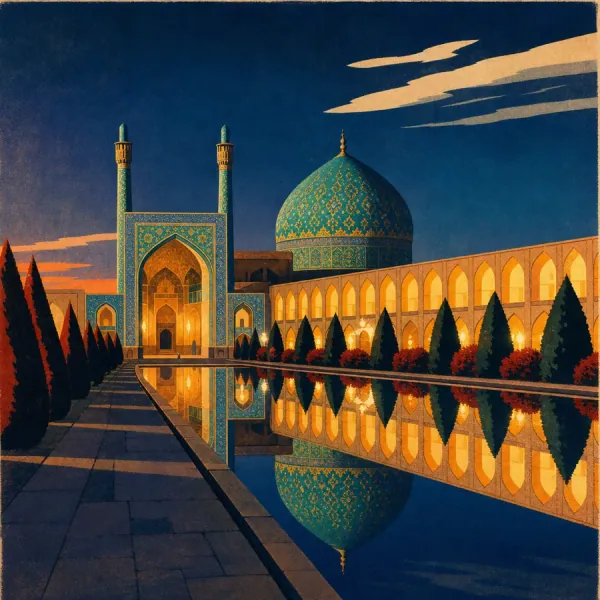
In 1501, Ismail I founded the Safavid dynasty, often seen as the starting point of modern Iran. It reunified the country under a local dynasty and made Twelver Shiism the official religion, which has set Iran apart from its mostly Sunni neighbors ever since. Isfahan, their third capital, filled with mosques, palaces, and gardens, and Persian art enjoyed its golden age. The empire collapsed in 1722 after an Afghan invasion. In the 18th century, Nader Shah, sometimes compared to Napoleon, built a huge but short-lived empire that reached as far as India.
👑 The Qajars and foreign interference
The Qajar dynasty, crowned in 1796, reigned over a weakened country. In the 19th century, Iran lost its Caucasus territories to the Russian Empire, while Britain extended its influence in the south to protect the route to India. Drought and mismanagement caused the great famine of 1870–1871, whose death toll is unknown: estimates range from a few hundred thousand to several million.
The rest of the course
This page publishes the first 2 parts. The full course has 8: here is what the next ones cover.
- ✊ From the shahs to the Islamic revolution
Iran in the 20th century: the Constitutional Revolution, the Pahlavi dynasty, oil nationalization and the 1953 coup, the 1979 revolution, the hostage crisis, the Iran-Iraq War, and the Khamenei era.
- 🪶 A people of poets
Iran's population: demographics, peoples and languages, religions, and an exceptional culture (Persian poetry, carpets, architecture, cinema, sport).
- 🛢️ An energy superpower under sanctions
The Iranian economy: oil and gas reserves, the weight of the state, agriculture and industry, international sanctions, and the economic crisis of 2026.
- 🕌 A theocracy with elected and unelected institutions
The political system of the Islamic Republic: the Supreme Leader, the president, the Guardian Council, Parliament, the Assembly of Experts, the Revolutionary Guards, human rights, and international indices.
- 🌐 Regional power and nuclear program
Iran's place in the world: the “axis of resistance,” rivalries with Israel, Saudi Arabia, and the United States, the nuclear program, the Strait of Hormuz, alliances with Russia and China, and the June 2025 war.
- 🔭 2025–2026: revolt, war, and uncertainty
Iran's recent crises: the December 2025–January 2026 protests and their repression, the war launched by the United States and Israel on February 28, 2026, the death of Ali Khamenei, the new Leader, the ceasefire, the Hormuz blockade, and the situation in October 2026.
Study “Iran” with flashcards and quizzes
In Oria, you read the full course, then practice on it: flashcards, multiple-choice quizzes, open questions or the Feynman method. Cards and questions then come back in your daily review, paced by spaced repetition.
Study this topic in OriaSources
These notes draw on the sources below. If a point seems doubtful, refer back to them.