Geography & countries
Indonesia: Summary and Study Notes
The largest archipelago in the world
Study this topic in OriaThe essentials
Indonesia stretches more than 5,000 km between the Indian Ocean and the Pacific and ranks among the most populous countries in the world. Hindu and Buddhist kingdoms, sultanates, a Dutch spice colony, then a republic born in 1945: its history is that of a maritime crossroads. You'll discover its volcanoes and biodiversity, its people of a thousand cultures, the country with the most Muslims in the world, its economy as a Southeast Asian giant, its still-young democracy, and the challenges of the Prabowo era.
Key dates and facts
- 8th – 10th c.
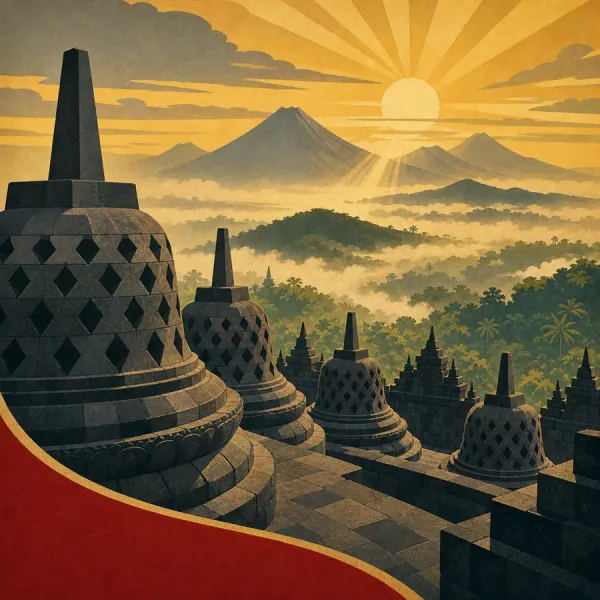
- Borobudur and Prambanan are built
- 1350 – 1389
- Majapahit at its height under Hayam Wuruk
- 1602
- The Dutch VOC is founded
- 1619
- The VOC founds Batavia, the future Jakarta
- 1928
- Youth Pledge
- 1945
- Proclamation of independence (August 17)
- 1965 – 1966
- Massacres and Suharto's seizure of power
- 1998
- Suharto resigns, Reformasi begins
- 2024
- Prabowo elected president (February), sworn in in October
- 2025
- Protests against lawmakers' privileges (August)
🌋 An archipelago of fire and forests
Indonesia is the largest archipelagic state in the world. Located in Southeast Asia, between the Indian Ocean and the Pacific Ocean, it stretches about 5,120 km from west to east, more than the distance from Lisbon to Moscow, and 1,760 km from north to south. With about 1.9 million km² of land, it is the 14th-largest country in the world. The number of its islands depends on how you count: from 13,466 named islands to more than 17,500, of which about 922 are permanently inhabited.
🏝️ Five large islands and thousands of small ones
The five main islands are Sumatra, Java, Sulawesi (formerly called Celebes), Borneo, and New Guinea. Indonesia occupies most of Borneo, which it calls Kalimantan and shares with Malaysia and Brunei, as well as the western half of New Guinea, Papua, next to Papua New Guinea. Java makes up less than 7% of the territory but is home to more than half the population: it is the most populous island on the planet. The highest point, Puncak Jaya (4,884 m), rises in New Guinea, and Lake Toba, in Sumatra, is the country's largest lake. Between the islands run strategic straits, such as the Strait of Malacca, through which a large share of the oil and goods traded between the Indian Ocean and the Pacific passes.
🔥 On the Ring of Fire
The archipelago sits where three tectonic plates meet: the Eurasian, Indo-Australian, and Pacific plates. Subduction zones there cause frequent earthquakes and intense volcanism: there are about 400 volcanoes, some 130 of which are considered active. The country has seen some of the most spectacular disasters in Earth's history. The Toba supereruption, about 74,000 years ago, is one of the largest known. The eruption of Tambora in 1815 cooled the global climate so much that 1816 went down as “the Year Without a Summer” in Europe and North America. In 2004, a magnitude 9.1 earthquake off Sumatra triggered a tsunami that killed about 230,000 people in a dozen countries, a large share of them in the province of Aceh.
🌧️ An equatorial climate set by the monsoon
Straddling the equator, Indonesia has a hot, humid tropical climate all year round, cooler at altitude. The monsoon winds generally bring a wetter season from November to April and a drier season from May to October, with large regional differences: western Sumatra and Java get heavy rain, while the islands near Australia, such as the Lesser Sunda Islands in the east, are much drier. The El Niño phenomenon can prolong the dry season and promote droughts and fires.
🦧 One of the most species-rich countries
Indonesia is one of the 17 so-called “megadiverse” countries. The west of the archipelago is home to Asian wildlife (orangutans, elephants), the east to wildlife close to Australia's, and in between lies Wallacea, a transition zone named after the British naturalist Alfred Russel Wallace, one of the world's great hotspots of endemic species. The country also has vast coral reefs and mangroves. But this wealth is shrinking: large oil palm and timber plantations are thought to have caused more than 40% of deforestation between 2001 and 2016, and drained peatlands catch fire easily. The country has designated 554 protected areas, about 14% of its land.
🛕 From spice kingdoms to Dutch colony
The Indonesian archipelago is one of the cradles of human history in Asia. It was at Trinil, on the island of Java, that the Dutchman Eugène Dubois discovered the fossils of “Java Man,” a Homo erectus, at the end of the 19th century. Tools show that hominins were present on the island of Flores at least 1.02 million years ago, and the same island has yielded the remains of Homo floresiensis, a small-bodied human species. In Sulawesi, a cave painting depicting a scene has been dated to at least 51,200 years ago, one of the oldest in the world. From the 3rd millennium BC, peoples speaking Austronesian languages, coming from Taiwan by way of the Philippines, spread across most of the islands.
🙏 The age of Hindu and Buddhist kingdoms
From the 1st millennium BC, the archipelago was linked to the great trade networks of the Indian Ocean and the South China Sea. Merchants and religious figures from India brought Sanskrit writing, Hinduism, Buddhism, and models of kingship that local princes adopted. At the end of the 7th century, Srivijaya arose in Sumatra, a maritime power that controlled the Strait of Malacca and became a center of Buddhism. In central Java, thanks to thriving rice farming, rulers built two masterpieces between the 8th and 10th centuries: the Buddhist temple of Borobudur and the Hindu complex of Prambanan. At the end of the 13th century, the kingdom of Majapahit, in eastern Java, took advantage of a Mongol expedition to crush its rivals, then forced the Mongols to leave. Under King Hayam Wuruk (1350–1389), it dominated a vast network of ports, often through ties of tribute and trade rather than direct occupation: this was Java's “golden age.”
☪️ Islam arrives by sea
Islam spread the way trade did: through the ports. Marco Polo noted in 1292 that the town of Perlak, in northern Sumatra, was Muslim, and a royal tomb dated 1297 at Pasai attests to a Muslim ruler. The sultanate of Samudra Pasai became a major pepper port and a center of Islamic learning. In the 15th century, Majapahit declined while the sultanates of Java's north coast, such as Demak, rose. Tradition credits the conversion of Java to the Wali Sanga, the “nine saints.” Javanese Islam absorbed many elements of the older culture.
⛵ The Europeans and the VOC
The Moluccas produced spices prized all over the world: cloves and nutmeg. The Portuguese took Malacca in 1511 and reached the Moluccas the following year. The Dutch arrived in the 1590s and in 1602 founded the Dutch East India Company (VOC), a company authorized to wage war, build forts, and sign treaties. In 1619, it seized Jayakarta, renamed it Batavia (today's Jakarta), and made it its headquarters. Little by little, it took control of the spice trade and exploited the succession disputes of the Javanese kingdom of Mataram.
⛓️ The Dutch East Indies
The bankrupt VOC was dissolved in 1800 and its possessions passed to the Dutch state. From 1825 to 1830, the Java War pitted the colonizers against part of the Javanese aristocracy led by Prince Diponegoro. After his defeat, the Dutch imposed the cultuurstelsel, or Cultivation System, a system of forced export crops that greatly enriched the Netherlands: peasants had to devote part of their labor to cash crops. The system was abolished in 1870. Conquests continued against fierce resistance, in Sumatra, in Bali, and above all in Aceh. The end of the Aceh War and of the conquest of Bali, around 1908, completed the formation of the Dutch East Indies, whose borders are roughly those of present-day Indonesia.
The rest of the course
This page publishes the first 2 parts. The full course has 8: here is what the next ones cover.
- 🇮🇩 From independence to democracy
Indonesia's history since the national movement: Japanese occupation, the 1945 proclamation, the war of independence, Sukarno, the 1965–1966 massacres, Suharto's New Order, and Reformasi.
- 🎭 One people, hundreds of cultures
Indonesia's population: demographics, ethnic groups, languages, religions and Pancasila, and a rich culture (wayang, gamelan, batik, food, sport).
- 💰 Southeast Asia's largest economy
The Indonesian economy: GDP, growth, the role of Java, natural resources (nickel, coal, palm oil), tourism, inequality, and the free meals program.
- 🗳️ A still-young presidential republic
Indonesia's institutions: the revised 1945 Constitution, the president, Parliament (MPR, DPR, DPD), the courts, provinces and special autonomy, the 2024 elections, and democracy indices.
- 🌏 A middle power that refuses to pick sides
Indonesia's foreign policy: the “free and active” doctrine, non-alignment, ASEAN, the G20, BRICS, and relations with China, the United States, and its neighbors.
- 🔭 The challenges of the Prabowo era
Contemporary Indonesia: the military's return to civilian life, the August 2025 protests, Suharto declared a national hero, the new capital Nusantara, natural disasters, and the 2026 fires.
Study “Indonesia” with flashcards and quizzes
In Oria, you read the full course, then practice on it: flashcards, multiple-choice quizzes, open questions or the Feynman method. Cards and questions then come back in your daily review, paced by spaced repetition.
Study this topic in OriaSources
These notes draw on the sources below. If a point seems doubtful, refer back to them.