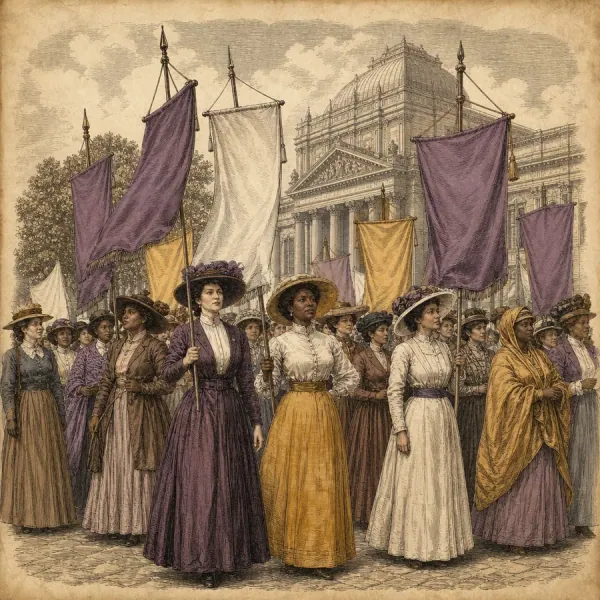
Law & society
Feminism: Summary and Study Notes
A global history of the fight for equality
Study this topic in OriaThe essentials
Feminism refers to the whole range of ideas and movements that champion equality between women and men. Born as an organized movement in the 19th century, it has far older forerunners and has developed on every continent, from Seneca Falls to Cairo, from Tokyo to Buenos Aires. You'll discover the great “waves” of feminism, its leading figures in several countries, the rights it won, and the debates running through a diverse movement today, presented with their different points of view.
Key dates and facts
- 1949
- Beauvoir's The Second Sex
- 1963
- Friedan's The Feminine Mystique
- 1971
- Manifesto of the 343
- 1975
- Veil law in France
- 1989
- Crenshaw coins the term “intersectionality”
- 2015
- First Ni una menos marches
- 2017
- #MeToo goes global
- 2024
- Abortion enshrined in the French Constitution
💡 What is feminism?
Feminism refers to the whole range of ideas and movements that seek to achieve equality between women and men: first in law (the right to vote, study, work, own property, divorce), then in everyday life, the family, work, sexuality and political representation. There isn't a single feminism but a large family of currents, sometimes at odds with one another.
🔤 A word born in the 19th century
The word first appeared in France. In 1872, the writer Alexandre Dumas fils used it mockingly in a pamphlet to describe those who demanded for women “the same education and the same rights as men.” In 1882, the activist Hubertine Auclert, who was fighting for women's suffrage, gave it a positive meaning: the struggle to improve women's condition. The term spread thanks to a “feminist” congress held in Paris in May 1892, then reached the Netherlands, Britain in 1894 and the United States in 1904.
Long before the word existed, however, thinkers both female and male had criticized the place assigned to women. Historians sometimes call them “proto-feminists,” a term that is itself debated, because it suggests a linear history.
🌊 The waves metaphor
The history of feminism is often told in waves. The expression comes from the American journalist Martha Weinman Lear, who wrote of a “second wave” in 1968: the activists of the previous century thus became, retroactively, the “first wave.”
First wave (mid-19th to early 20th century): the vote, education, civil rights. Second wave (1960s–1980s): the body, sexuality, family, work, violence. Third wave (1990s): the diversity of women and intersectionality. Fourth wave (since roughly the 2010s): online mobilization against harassment and violence.
This division is convenient but criticized. The American scholar Linda Nicholson argues that it creates the illusion of a single movement that rises and falls, whereas the struggles have always been multiple; she proposes the image of a kaleidoscope instead. Above all, it was conceived from the vantage point of the United States and Europe: in Egypt, Japan, India or West Africa, women's movements followed other rhythms, often tied to struggles for independence.
🖋️ The forerunners: from Christine de Pizan to the Enlightenment
Before feminism became an organized movement in the 19th century, women and a few men, in Europe and the Americas, had already challenged the idea that women were naturally inferior, almost always starting with one demand: the right to learn.
🏰 The City of Ladies
An Italian-born writer who settled in France, Christine de Pizan (1364 – c. 1430) published The Book of the City of Ladies around 1405, in which she imagines a city built to defend women against misogynist attacks. Simone de Beauvoir described her as the first woman to have written about the relationship between the sexes and to have denounced misogyny.
In the 16th and 17th centuries, other voices followed: the Italian Moderata Fonte, the Frenchwoman Marie de Gournay, the philosopher François Poullain de La Barre, the Mexican Juana Inés de la Cruz and the Englishwoman Margaret Cavendish. All of them demanded, first and foremost, girls' access to knowledge. In England, Mary Astell (1666 – 1731) answered the philosopher John Locke: if he defended individual liberty, why exclude women from it?
💡 The Enlightenment, limited progress
The Enlightenment attacked prejudice, but few philosophers imagined equality between the sexes. Rousseau thus wrote in Emile that to maintain the equality of the two sexes was to lose oneself in empty declamation. A few thinkers nonetheless went further. In France, the philosopher and mathematician Condorcet defended women's rights of citizenship in 1790. In England, Mary Wollstonecraft published A Vindication of the Rights of Woman in 1792, which called for girls' education, economic independence and even political rights; the book would become a cornerstone of feminist thought.
📜 Olympe de Gouges
In 1791, in the midst of the French Revolution, the writer Olympe de Gouges drafted a Declaration of the Rights of Woman and of the Female Citizen that mirrored the 1789 Declaration article by article, adding women to it. She also championed marriage conceived as a contract between equals. Close to the Girondins, she was guillotined in 1793.
“Woman has the right to mount the scaffold; she must equally have the right to mount the rostrum.”
Olympe de Gouges, Declaration of the Rights of Woman and of the Female Citizen, Article X (1791) (translated)
⛓️ The step backward
The Revolution granted a few civil rights, such as divorce in 1792 and equal inheritance, but refused women any political rights and shut down their clubs as early as 1793. The Civil Code of 1804, known as the Napoleonic Code, enshrined the wife's subordination to her husband; copied in many European countries, it would weigh on women's rights for more than a century.
The rest of the course
This page publishes the first 2 parts. The full course has 8: here is what the next ones cover.
- 🗳️ The first wave: the fight for the vote
First-wave feminism in the United States, the United Kingdom, New Zealand, France and elsewhere: Seneca Falls, suffragists and suffragettes, the first electoral victories, education and international organizations.
- 🌍 Feminisms on every continent
Women's movements outside Europe and North America: Egypt, Tunisia, Iran, Japan, China, India, West Africa and Latin America, often tied to national and anticolonial struggles.
- ✊ The second wave: body, work and family
Second-wave feminism in the 1960s and 1970s: The Second Sex, Betty Friedan and NOW in the United States, British and German movements, the MLF and the Manifesto of the 343 in France, the Veil law, Black feminism and feminist theory.
- 📊 What the struggles changed: rights and figures
The rights won by women around the world: a timeline of women's suffrage by country, the UN and the world conferences on women, the 1979 CEDAW convention, and the state of political inequality today.
- 🌐 Third and fourth waves: intersectionality and #MeToo
The third wave of the 1990s (intersectionality, Rebecca Walker, riot grrrl) and the digital fourth wave: Everyday Sexism, Ni una menos, #MeToo, feminist strikes, Iran, Afghanistan and abortion rights.
- ⚖️ Debates and criticisms: a diverse movement
Debates within feminism (equality or difference, prostitution and pornography, the place of trans people, universalism and intersectionality, non-Western feminisms) and criticisms from outside, presented with their arguments.
Study “Feminism” with flashcards and quizzes
In Oria, you read the full course, then practice on it: flashcards, multiple-choice quizzes, open questions or the Feynman method. Cards and questions then come back in your daily review, paced by spaced repetition.
Study this topic in OriaSources
These notes draw on the sources below. If a point seems doubtful, refer back to them.