History
Gandhi: Biography and Study Notes
The shy lawyer who defied the British Empire without a weapon
Study this topic in OriaThe essentials
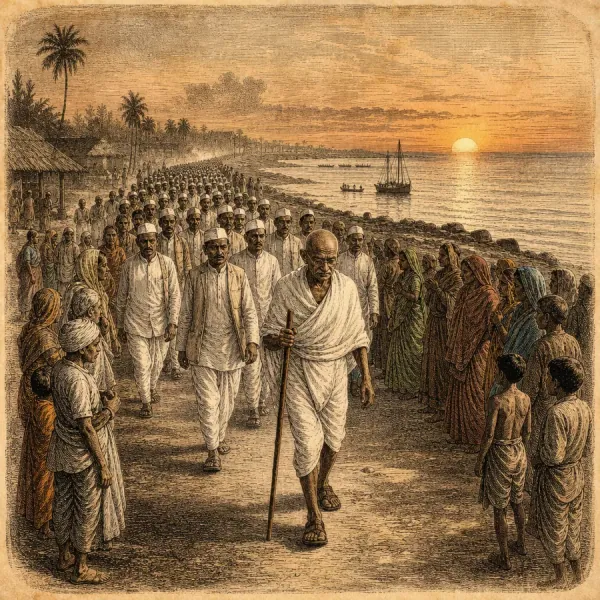
Born in Gujarat in 1869, Mohandas Gandhi is a shy young lawyer trained in London when he discovers racial discrimination in South Africa. There he invents satyagraha, a mass non-violent resistance, which he later puts to work for India's independence: non-cooperation, the salt march, Quit India. You will follow his life through to independence torn apart by the 1947 partition and his assassination in 1948, then his worldwide legacy and the criticism he draws.
Key dates and facts
- 1869
- Born in Porbandar on October 2
- 1883
- Marries Kasturba
- 1885
- His father dies
- 1888
- Birth of Harilal, departure for London
- 1893
- Arrives in Natal, the night at Pietermaritzburg
- 1894
- Founds the Natal Indian Congress
- 1897
- Attacked by a mob in Durban
- 1903
- Launches the newspaper Indian Opinion
- March 12, 1930
- The salt march begins
- April 6, 1930
- Gandhi picks up salt at Dandi
🌅 A childhood in Gujarat
Mohandas Karamchand Gandhi was born on October 2, 1869 in Porbandar, a small coastal town on the Kathiawar peninsula, in what is now the state of Gujarat, in western India. The region was then part of British India, but Porbandar was a princely state ruled by an Indian prince under British oversight.
🏛️ A family of state servants
His father, Karamchand Gandhi, was the dewan, or prime minister, of the princely state of Porbandar, then of Rajkot, where the family settled. He had little schooling but was known for his skill. The family belonged to the Modh Bania caste, merchants, within the vaishya category of Hindu society. It was well-off and open to the region's other religious communities: Jains, Muslims, Parsis.
His mother, Putlibai, his father's fourth wife, left a deep mark on him. Deeply devout, she never ate without having prayed and readily kept several days of fasting in a row. Gandhi would later adopt fasting as a spiritual and political tool. As a child, he was deeply moved by classic Indian stories, especially that of King Harishchandra, who sacrifices everything rather than ever lie. In his autobiography, he recounts replaying this story to himself countless times.
🎒 A shy pupil
Young Mohandas was an average student. His sister described him as a restless child, but at school he was mostly very shy, little interested in games, with no companions but his books and lessons.
💍 Married at thirteen
In May 1883, at 13, he was married according to local custom to Kasturba, a girl about his own age. He later said that for them, marriage mainly meant new clothes, sweets, and games with cousins. This marriage cost him a year of school, which he later made up. As an adult, he would recall with regret the possessive jealousy he showed toward his young wife.
At the end of 1885, his father died. Gandhi had left his bedside a few minutes earlier to join his wife, and he would carry a lasting shame over it. Shortly after, their first child survived only a few days. The couple would go on to have four sons: Harilal (1888), Manilal (1892), Ramdas (1897), and Devdas (1900).
In 1887, Gandhi finished secondary school. In January 1888, he entered Samaldas College in Bhavnagar, the only institution of higher education in the region, but felt out of his depth there and dropped out. A family friend, a Brahmin priest, then suggested another path: going to study law in London.
🎩 Law student in London
Going to England was no small matter for an eighteen-year-old Hindu. His mother feared he would lose his way there. To reassure her, Gandhi took, in front of her and in the presence of a Jain monk, a vow not to touch meat, alcohol, or women. In Bombay, the elders of his caste forbade him to go, fearing that in England he would abandon his religion and Hindu customs. He refused to back down and was cast out of his caste. On September 4, 1888, he sailed for London.
🕴️ Playing the gentleman
In London, he attended classes at University College and enrolled at the Inner Temple, one of the schools that train lawyers, called barristers. He first tried to imitate the English: elegant suits, dancing lessons. But he was often hungry, since his landlady's vegetarian cooking was bland, until the day he found one of the city's rare vegetarian restaurants.
🥦 Vegetarianism, a first school
What had been merely a promise became a conviction. Gandhi joined the London Vegetarian Society and sat on its executive committee. There he had his first experience of organizing. There too he showed a character trait: when the committee wanted to expel a member who supported contraception, Gandhi, who disapproved of those ideas himself, defended the member's right not to think like everyone else. But he was so shy that he could not bring himself to read his own statement to the committee.
📖 Discovering the Bhagavad Gita
Among the vegetarians, he met members of the Theosophical Society, who took an interest in the religions of India. They invited him to read the Bhagavad Gita, a great Hindu sacred text he barely knew. He was deeply struck by it. He also opened himself to Christianity, and especially remembered Jesus's call to turn the other cheek.
⚖️ A lawyer who cannot plead
Called to the bar in June 1891, at 22, he returned to India at once. There he learned that his mother had died while he was away: his family had kept it from him. His start as a lawyer in Bombay was a failure: too shy, he was unable to cross-examine witnesses in court. He went back to Rajkot to draft petitions. There he also ran into a British official who curtly dismissed him when he came to plead his brother's case. Gandhi would later admit he had been wrong to press the matter, but the humiliation left him disgusted with life in Rajkot.
In 1893, a wealthy Muslim merchant from Kathiawar, Dada Abdullah, who owned a shipping company in South Africa, offered him a one-year contract to assist in a lawsuit. Gandhi accepted. In April 1893, at 23, he sailed for the British colony of Natal. He thought he was leaving for a year; he would stay more than twenty.
The rest of the course
This page publishes the first 2 parts. The full course has 9: here is what the next ones cover.
- 🚂 South Africa: the shock of discrimination
The racial humiliations Gandhi suffers in South Africa, his campaign for Indian rights, the founding of the Natal Indian Congress, and his controversial views on Black Africans.
- ✊ The birth of satyagraha
The struggle against the Transvaal registration law from 1906, the birth of satyagraha, Tolstoy's influence, communal living, and the 1914 victory before returning to India.
- 🧵 Back in India: from Champaran to non-cooperation
Gandhi's first campaigns in India, Champaran and Kheda, the Amritsar massacre, the non-cooperation movement, the spinning wheel, and his 1922 trial.
- 🧂 The salt march and negotiations
The 1930 salt march, the crackdown, the Gandhi-Irwin Pact, the London conference, the fight for the untouchables, and the tensions of the 1930s.
- 🚩 Quit India, prison, and partition
The Second World War, the 1942 Quit India call, imprisonment and the death of Kasturba, then independence in 1947 and the partition between India and Pakistan.
- 🕊️ The last fast and the assassination
Gandhi's last fast for peace between Hindus and Muslims in January 1948, his assassination by Nathuram Godse on January 30, 1948, and his funeral.
- 🌍 Legacy and criticism
Gandhi's place in India and the world, his influence on Martin Luther King and Mandela, his writings, and the criticism leveled at him over caste, racism, or his private life.
Study “Gandhi” with flashcards and quizzes
In Oria, you read the full course, then practice on it: flashcards, multiple-choice quizzes, open questions or the Feynman method. Cards and questions then come back in your daily review, paced by spaced repetition.
Study this topic in OriaSources
These notes draw on the sources below. If a point seems doubtful, refer back to them.