Geography & countries
Japan: Summary and Study Notes
The archipelago that blends tradition and high technology
Study this topic in OriaThe essentials
Japan is a mountainous, earthquake-prone archipelago home to nearly 123 million people, almost all of them in cities. A former conquering empire that became a pacifist democracy after 1945, it went through an “economic miracle” and then thirty years of slow growth. You'll discover its geography, its history in brief, its society, its world-famous culture, its economy, its political system, its place between the United States and China, and the challenges of a country that is aging faster than any other.
Key dates and facts
- 552
- Buddhism arrives from Korea
- 794
- Founding of Heian-kyō (Kyoto)
- 1603
- Start of the Tokugawa shogunate
- 1868
- Meiji Restoration
- 1945
- Japan surrenders
- 1947
- The pacifist Constitution takes effect
- 1956
- Japan joins the UN
- 1964
- Tokyo Olympics and first Shinkansen
- 2011
- Earthquake, tsunami, and the Fukushima accident
- 2019
- Naruhito becomes emperor, the Reiwa era begins
🗾 An archipelago on the Ring of Fire
Japan is an island country in East Asia, set between the Pacific Ocean and the Sea of Japan, facing Korea, China, and Russia. Its Japanese name, Nihon or Nippon, is written with two characters meaning “origin of the sun”: hence its nickname, the Land of the Rising Sun.
🏝️ Thousands of islands, four giants
Depending on the counting method, the archipelago has from 6,852 to 14,125 islands, stretched over more than 3,000 kilometers, from the latitude of Quebec to that of Cuba. Four of them make up most of the territory (about 95%): from north to south, Hokkaidō, Honshū (the largest and most populous), Shikoku, and Kyūshū. Farther south, the Ryūkyū Islands, including Okinawa, reach toward Taiwan. In all, the country covers about 378,000 km², a little more than Germany, but its remote islands give it one of the largest exclusive economic zones in the world, about 4.5 million km².
⛰️ A land of mountains
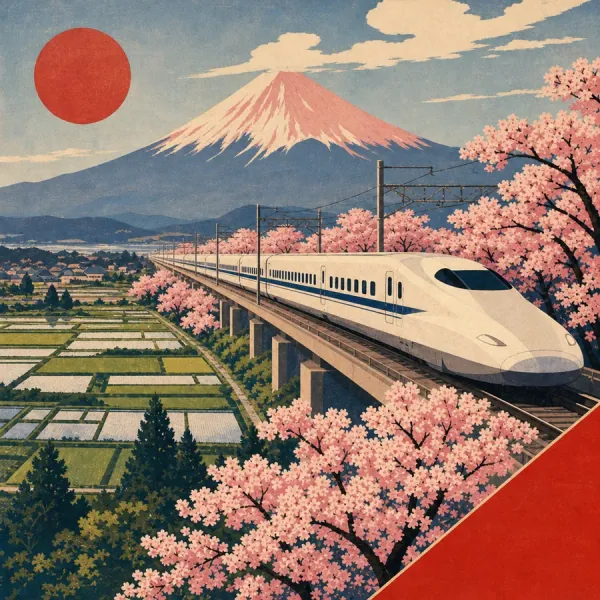
Mountains and hills cover about three-quarters of the territory, often forested (67% of the land). Plains are rare and narrow: the largest, the Kantō Plain around Tokyo, is no more than 15,000 km². The highest point is Mount Fuji (3,776 m), a volcano that last erupted in 1707. Rivers are short and fast, and hardly navigable. Since the slopes are barely habitable, the population crowds onto the coasts: an almost continuous belt of cities, from Tokyo to northern Kyūshū, is home to more than a hundred million people. According to the World Bank, more than 92% of Japanese people live in cities (2025), and Greater Tokyo is one of the largest metropolitan areas on the planet.
🌋 Volcanoes, earthquakes, and tsunamis
Japan lies on the Pacific Ring of Fire, where four tectonic plates meet (the Pacific, North American, Philippine Sea, and Eurasian plates). It has 111 active volcanoes and experiences about a fifth of the world's recorded earthquakes of magnitude 6 or more. Some have made history: the Great Kantō earthquake of 1923 (about 140,000 dead), the Kobe earthquake of 1995 (6,437 dead), and above all the Tōhoku earthquake of March 11, 2011, magnitude 9.0, followed by a tsunami that left about 20,000 people dead or missing and caused the Fukushima nuclear accident. The country is also one of the best prepared: earthquake-resistant building codes, seawalls, automatic alerts, and regular drills are part of everyday life. Volcanic activity has one upside: the hot springs, or onsen, which are hugely popular.
❄️ From blizzards to the tropics
Stretched far from north to south, the archipelago has varied climates. Hokkaidō has long, snowy winters; Tokyo, Osaka, and Kyoto have a humid subtropical climate, with hot, sticky summers and a rainy season, the tsuyu, from June to mid-July; Okinawa is nearly tropical. In winter, winds from Siberia dump heavy snow on the Sea of Japan coast, while the Pacific coast stays dry and sunny. From late summer into fall, typhoons bring rain and violent winds.
📜 From the first inhabitants to the Empire of Japan
Japan has been inhabited for about 38,000 years. Around 14,500 BC began the Jōmon period, a culture of semi-sedentary hunter-gatherers whose pottery is among the oldest in the world. Then the Yayoi peoples, coming from the Korean Peninsula, brought wet-rice farming and metalworking. According to legend, Emperor Jimmu, a descendant of the sun goddess Amaterasu, founded the imperial line in 660 BC; historians see this as a founding myth, not a dated fact.
🏯 A state on the Chinese model
Japan appears in Chinese texts in the 1st century. Between the 4th and 6th centuries, kingdoms unified around the Yamato clan. Buddhism arrived from the Korean kingdom of Baekje in 552; in 645, the Taika reforms reorganized the state on the Chinese model. The court settled in Nara (710 – 784), then in Heian-kyō, today's Kyoto, in 794. The Heian period (794 – 1185) saw the birth of a distinctly Japanese culture, with kana writing and Murasaki Shikibu's The Tale of Genji.
⚔️ The age of the warriors
From 1185, real power passed to military leaders, the shoguns, while the emperor kept a religious and symbolic role. This long period, with its samurai, the Mongol invasions it fought off (1274 and 1281), and its century of civil wars, is told in Explorer's chapter “The Japan of the Samurai.” The key points: in 1603, Tokugawa Ieyasu founded a shogunate based in Edo (Tokyo), and in 1639 the country closed itself almost entirely to foreigners: only Dutch merchants were tolerated, at a trading post in Nagasaki. Two and a half centuries of peace fostered cities, commerce, and the arts.
🚢 Forced opening and the Meiji era
In July 1853, the “Black Ships” of the American Commodore Matthew Perry demanded that the ports be opened; the Convention of Kanagawa (1854) began a series of unequal treaties. The shogunate collapsed, and in 1868 power was returned to the emperor: this was the Meiji Restoration. Within a generation, the country abolished the samurai class and created prefectures, an army and a justice system modeled on the West, a modern school system (1872), and a constitution (promulgated in 1889). Japan became Asia's leading industrial power.
🔥 From expansion to catastrophe
Victorious over China (1894 – 1895) and then Russia (1904 – 1905), Japan seized Taiwan and annexed Korea in 1910. After a more democratic interlude, Taishō democracy (universal male suffrage in 1925), the military gained the upper hand in the 1930s. Japan occupied Manchuria in 1931, invaded China in 1937, then attacked the U.S. base at Pearl Harbor and the European colonies in Asia in December 1941. The Imperial Army committed numerous war crimes, including the Nanjing Massacre and the system of sexual slavery of the so-called “comfort women.” After the atomic bombings of Hiroshima and Nagasaki in August 1945, Japan surrendered on August 15, 1945. World War II has its own chapter in Explorer.
The rest of the course
This page publishes the first 2 parts. The full course has 9: here is what the next ones cover.
- 🕊️ Since 1945: from miracle to “lost decades”
Japan after 1945: the American occupation, the pacifist Constitution, the economic miracle, the bursting of the bubble, the 2011 disaster, and the Reiwa era.
- 👘 One people, one language, several faiths
Japanese society: population, minorities, language and writing systems, religions (Shinto and Buddhism), education, and the status of women.
- 🎎 From Noh theater to manga: a cultural powerhouse
Japanese culture: traditional arts, literature, woodblock prints and Japonisme, cinema, manga, anime, video games, food, and sports.
- 🏭 A major industrial power
The Japanese economy: global rank, the auto and robotics industries, keiretsu, agriculture, energy, public debt, and employment.
- 🏛️ A parliamentary monarchy
Japan's political system: a symbolic emperor, the Diet, the prime minister, LDP dominance, recent elections, and freedom indices.
- 🌏 A pacifist power between two giants
Japan in the world: the alliance with the United States, the G7, development aid, Article 9 and the Self-Defense Forces, and territorial disputes with Russia, South Korea, and China.
- ⏳ The challenges of an aging society
Japan's major challenges today: aging and population decline, labor and immigration, debt, work, energy, and natural disasters.
Study “Japan” with flashcards and quizzes
In Oria, you read the full course, then practice on it: flashcards, multiple-choice quizzes, open questions or the Feynman method. Cards and questions then come back in your daily review, paced by spaced repetition.
Study this topic in OriaSources
These notes draw on the sources below. If a point seems doubtful, refer back to them.