Geography & countries
Kenya: Summary and Study Notes
Savannas, runners and mobile money: the crossroads of East Africa
Study this topic in OriaThe essentials
Kenya stretches across both sides of the equator, from the beaches of the Indian Ocean to highlands split by the Rift Valley. Land of the first humans and of the Swahili city-states, a British colony shaken by the Mau Mau uprising, it has become a lively democracy and the largest economy in East Africa. You'll discover its geography and wildlife, its history, its peoples and culture, an economy driven by tea, flowers and M-Pesa, a political system jolted by its young people, its place in the world and its challenges.
Key dates and facts
- 1895
- British East Africa Protectorate
- 1920
- Colony of Kenya established
- 1952
- State of emergency against the Mau Mau
- 1963
- Independence, on December 12
- 1964
- Proclamation of the republic
- 1991
- Return of multiparty politics
- 2002
- First peaceful transfer of power
- 2010
- New constitution
- 2022
- Election of William Ruto
🏔️ From Mount Kenya to the Indian Ocean
Kenya, officially the Republic of Kenya, is an East African country cut in two by the equator. It is bordered by South Sudan and Ethiopia to the north, Somalia to the east, the Indian Ocean to the southeast, Tanzania to the southwest, and Uganda and Lake Victoria to the west. Covering about 580,000 km², it is the world's 47th-largest country by area. Its capital and largest city is Nairobi; Mombasa, a port on the Indian Ocean, is the second-largest and the oldest city.
🌋 From coastal plains to highlands
From the coast, low plains rise toward fertile highlands, cut from south to north by the Great Rift Valley, an immense fracture where the Nubian and Somali plates are pulling apart. The floor of the Rift holds a string of lakes: Magadi, Naivasha, Nakuru, Bogoria, Baringo and, in the north, the great Lake Turkana. The highest point is Mount Kenya (5,199 m), Africa's second-highest peak, which still has glaciers; it is the mountain that gave the country its name. In the 19th century, the German missionary Johann Ludwig Krapf recorded the name his Kamba guides used for it, perhaps because its black rocks and white snow recalled the plumage of a male ostrich. From the south of the country you can see Kilimanjaro, which lies in Tanzania. The north and northeast, by contrast, are arid, with true deserts such as the Chalbi.
🌦️ Two rainy seasons
The climate ranges from humid tropical on the coast to temperate in the highlands, which are cool at night, and arid in the north. Because the country sits on the equator, temperatures vary little; the year is shaped by rain: the “long rains” from March–April to May–June and the “short rains” from October to November–December. Climate change is disrupting this calendar: the short rains are lasting longer and causing floods, while droughts, which once came about once a decade, are becoming almost yearly.
🦁 Safari country
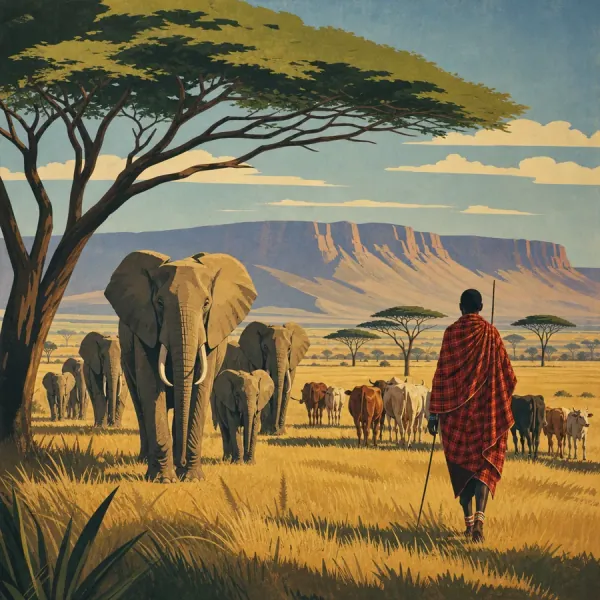
Kenya sets aside vast areas for wildlife, in some sixty parks and reserves such as Tsavo and the Masai Mara. Here you find the savanna's “Big Five”: lion, leopard, buffalo, rhinoceros and elephant. Every year, roughly between June and September, the great migration brings more than a million wildebeest (up to two million by some estimates) and some 200,000 zebras up from Tanzania's Serengeti; searching for grass and water, they cross the Mara River. The Lake Turkana parks have been a UNESCO World Heritage Site since 1997.
🐚 From the first humans to the Swahili cities
Kenya is one of the regions with the longest human history. Its later past is the story of encounters between peoples from all over eastern Africa and the merchants of the Indian Ocean.
🦴 At the origins of humankind
Ancient human species such as Homo habilis and Homo erectus lived on what is now Kenyan territory. The site of Koobi Fora, on the shores of Lake Turkana, has yielded a great many fossils. In 1984, a team led by the paleoanthropologist Richard Leakey, with Kamoya Kimeu, discovered the “Turkana Boy,” a Homo erectus skeleton about 1.6 million years old. Studies published in 2018 show that about 320,000 years ago, humans were already trading obsidian over long distances and using pigments.
🐄 Three great families of peoples
The first known inhabitants were hunter-gatherers. According to archaeology, herders speaking Cushitic languages, from the Horn of Africa, settled in the lowlands between 3200 and 1300 BC. Pastoralists speaking Nilotic languages, ancestors of the Kalenjin, Luo and Maasai, then arrived from the north in several waves, whose dating varies from study to study. Finally, between 250 BC and AD 500, Bantu farmers, ancestors of the Kikuyu, Luhya and Kamba, settled on the coast and then inland, bringing new farming techniques and ironworking. In the 18th and 19th centuries, the Maasai spread across the plains of the Rift.
⛵ The Swahili cities
On the coast, communities of fishermen, farmers and blacksmiths formed city-states such as Mombasa, Malindi and Lamu, which traded with Arabia, Persia and India. This trade brought Islam and enriched the Swahili language, a Bantu language nourished by Arabic and Persian words that became the common language of trade. For a long time, people believed these cities had been founded by Arab or Persian merchants; archaeology has shown that they were an African development with a Bantu cultural core. The oldest local inscriptions, in Arabic, date from the 14th century, such as the one at the Pwani Mosque in Lamu (1370 or 1371).
⚓ Portuguese, Omanis and the slave trade
In 1498, the Portuguese navigator Vasco da Gama was welcomed at Malindi, a port traditionally open to foreigners; the Portuguese then imposed themselves on part of the coast. In the 17th century, the coast was conquered by the Omanis, who expanded the slave trade to the plantations of Oman and Zanzibar. In the 19th century, the German missionaries Krapf and Rebmann were the first Europeans to see Mount Kenya.
The rest of the course
This page publishes the first 2 parts. The full course has 9: here is what the next ones cover.
- 🚂 The British colony and the Mau Mau uprising
Colonial Kenya from 1885 to 1963: division between Germany and the United Kingdom, the Uganda Railway, Nandi resistance, white settlers and land seizures, the Mau Mau uprising and the road to independence.
- 🗳️ From Kenyatta to Ruto
Independent Kenya: the presidency of Jomo Kenyatta, one-party rule under Moi, the return of multiparty politics, the 2002 transfer of power, the 2007–2008 violence, the 2010 Constitution, the annulled 2017 election and the election of William Ruto.
- 🗣️ Some forty peoples, two official languages
Kenya's population and culture: its youth, its peoples, English and Swahili, religions, refugees, literature, music, food and dominance in distance running.
- 📱 Tea, flowers and M-Pesa: the engine of East Africa
Kenya's economy: the largest in East Africa, agriculture (tea, flowers, coffee), tourism, finance and M-Pesa mobile money, geothermal energy, the Mombasa–Nairobi railway, debt and poverty.
- 🏛️ A lively democracy, shaken by its young people
Kenya's political system: the presidential system of the 2010 Constitution, Parliament, counties, the Supreme Court, the “Gen Z” protests of 2024 and 2025, the death of Raila Odinga, and what freedom indexes say.
- 🌍 A regional hub open to the world
Kenya in the world: headquarters of UNEP, the East African Community, partnerships with the United States, the United Kingdom and China, intervention in Somalia, the police mission in Haiti and the hosting of refugees.
- ⏳ The challenges: jobs, debt and climate
Kenya's major challenges today: youth employment, debt and taxes, trust in the police and institutions, regional inequality, health, droughts and forests.
Study “Kenya” with flashcards and quizzes
In Oria, you read the full course, then practice on it: flashcards, multiple-choice quizzes, open questions or the Feynman method. Cards and questions then come back in your daily review, paced by spaced repetition.
Study this topic in OriaSources
These notes draw on the sources below. If a point seems doubtful, refer back to them.