The essentials
In the early 20th century, in the streets of New Orleans, African American musicians blended blues, ragtime and brass bands to create a new kind of music. You'll follow jazz from Louis Armstrong to the swing big bands, from the bebop revolution of Charlie Parker and Dizzy Gillespie to the legendary records of Miles Davis and John Coltrane, not forgetting Django Reinhardt's Gypsy jazz. Above all, you'll understand how improvisation works, the beating heart of this music.
Key dates and facts
- 1917
- First jazz record, made on February 26
- 1920
- Prohibition and the “Jazz Age” begin
- 1925
- First session of Louis Armstrong's Hot Five
- 1927
- Duke Ellington debuts at the Cotton Club
- 1945
- First bebop recordings by Parker and Gillespie
- 1949
- Miles Davis's nonet sessions, the birth of cool
- 1959
- Miles Davis's Kind of Blue
- 1970
- Bitches Brew and the rise of jazz fusion
- 1917
- James Reese Europe and his musicians arrive in France
- 1932
- The Hot Club de France is founded
🌱 The roots: blues, ragtime and brass bands
Jazz is a musical genre born in the late 19th and early 20th centuries within the African American communities of the southern United States, and first of all in New Orleans, Louisiana. It grew out of an encounter: between the musical traditions of West Africa and the harmonies of European music.
🥁 The African heritage
The Atlantic slave trade forcibly brought nearly 400,000 Africans to North America, most of them before the United States banned the importation of enslaved people in 1808; they came mainly from West Africa and the Congo River basin. They brought their music with them: complex rhythms and a call-and-response structure, in which a singer launches a phrase and the group answers, as in work songs. In New Orleans, one place mattered in particular: Congo Square. Until 1843, enslaved people gathered there on Sundays to sing and dance to the sound of drums, a spectacle that struck visitors at the time.
In church, African Americans learned the harmonies of Protestant hymns and added their own inflections: this gave rise to spirituals, and later gospel. The city, a former French colony, added quadrilles from France and Caribbean rhythms to the mix, notably a three-beat pattern called the tresillo.
🎸 Blues and ragtime
In the early 20th century, the blues developed in the Mississippi Delta. Born from work songs and plantation laments, it leaves plenty of room for improvisation and uses blue notes, slightly flattened notes that give it its melancholy color. At the same time, ragtime, a highly syncopated piano style embodied by Scott Joplin, became all the rage.
A rhythmic device that consists of accenting a weak beat or an offbeat rather than the expected strong beat. Syncopation gives ragtime, and later jazz, its bouncing character.
🎺 The brass bands of New Orleans
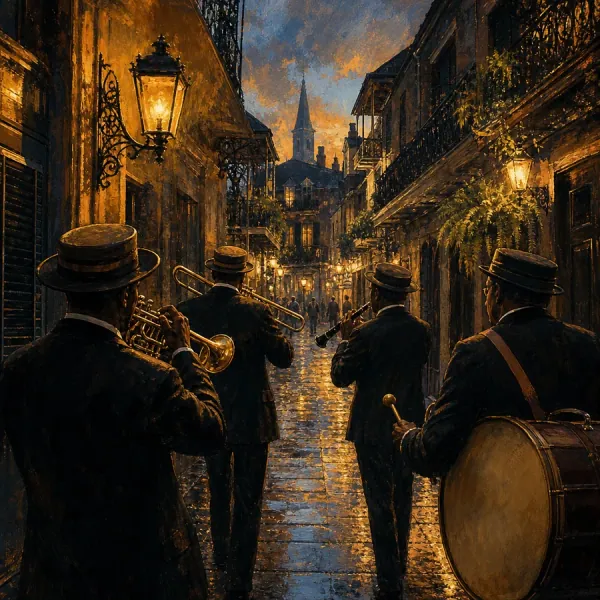
The city had many brass bands that played for parades and grand funerals. Their instruments, brass, clarinets and drums, would become the instruments of jazz. The cornetist Buddy Bolden, active from 1895 to 1906, is often cited as one of the pioneers of this new music; he left no recordings. Many young musicians played in the bars and brothels of Storyville, the red-light district frequented by tourists visiting this great port.
🎺 New Orleans and Louis Armstrong
In the 1910s, New Orleans jazz took shape. A small band brought together a trumpet or cornet for the melody, a clarinet weaving around it, a trombone handling the low notes, and a rhythm section. Everyone improvised at the same time: this was collective improvisation. The Creole pianist Jelly Roll Morton, who proclaimed himself the inventor of jazz, bridged ragtime and jazz; his Jelly Roll Blues, published in 1915, was the first jazz arrangement in print.
💿 1917: the first record
The word “jazz,” first spelled “jass,” is of uncertain origin; it appeared in the American press in the early 1910s, first in baseball slang, then as the name of this music from 1915 on. On February 26, 1917, in New York, the Original Dixieland Jass Band, a quintet of white musicians from New Orleans, recorded what is considered the first jazz record. Released on March 7, it sold more than a million copies. That same year, the authorities shut down Storyville. Like thousands of African Americans from the South, many musicians headed north, to Chicago and New York.
🌟 Louis Armstrong
Born in New Orleans in 1901 into a very poor family, Louis Armstrong learned the cornet in a children's home where he had been placed. In 1922, he joined King Oliver's band in Chicago, then played in New York with Fletcher Henderson's big band. On November 12, 1925, he recorded the first session with his own group, the Hot Five. On these records, Armstrong turned the trumpet into a solo instrument: instead of simply varying the melody, he improvised on the chords, with a virtuosity and a sense of swing that stunned his contemporaries. He also popularized scat, improvised singing made of invented syllables, which he used in Heebie Jeebies. According to historians, his solos made jazz a true musical language of the 20th century.
Nicknamed “Satchmo,” Armstrong became the greatest ambassador of jazz for more than forty years, sometimes giving more than 300 concerts a year and singing hits like Hello, Dolly! and What a Wonderful World. He died in New York on July 6, 1971.
🍸 The Jazz Age
From 1920 to 1933, Prohibition banned the sale of alcohol in the United States. In speakeasies, people danced to jazz, and the 1920s became known as the “Jazz Age.” Part of society considered this music immoral. White bands such as Paul Whiteman's enjoyed great success; in 1924, Whiteman premiered George Gershwin's Rhapsody in Blue, which helped get jazz recognized as a musical form in its own right.
The rest of the course
This page publishes the first 2 parts. The full course has 8: here is what the next ones cover.
- 🕺 The swing era and the big bands
The 1930s, the golden age of swing: the big bands of Duke Ellington, Count Basie and Benny Goodman, the 1938 Carnegie Hall concert, standards and great soloists.
- ⚡ Bebop, cool, hard bop and free: modern jazz
The bebop revolution of Charlie Parker and Dizzy Gillespie in the 1940s, followed by cool jazz, hard bop, modal jazz, free jazz and jazz fusion.
- 💿 Three recordings that changed everything
Three works explained: Louis Armstrong's West End Blues (1928), Miles Davis's Kind of Blue (1959) and John Coltrane's A Love Supreme (1964).
- 🎼 Improvisation explained
How a jazz tune works: the head, the chord changes, choruses, the rhythm section, swing, blue notes, and how improvisation evolved from style to style.
- 🇫🇷 Jazz in France: Django, Bechet and Saint-Germain
The arrival of jazz in France with World War I, the Hot Club de France, Django Reinhardt and Gypsy jazz, Sidney Bechet, Miles Davis in Paris and the clubs of Saint-Germain-des-Prés.
- 🌐 The legacy and jazz today
The influence of jazz on other kinds of music, its diversity since the 1970s, festivals, International Jazz Day and new scenes in the internet age.
Study “Jazz” with flashcards and quizzes
In Oria, you read the full course, then practice on it: flashcards, multiple-choice quizzes, open questions or the Feynman method. Cards and questions then come back in your daily review, paced by spaced repetition.
Study this topic in OriaSources
These notes draw on the sources below. If a point seems doubtful, refer back to them.