Psychology & decisions
Jean Piaget: Biography and Study Notes
The scientist who took children's mistakes seriously
Study this topic in OriaThe essentials
A biologist turned psychologist, the Swiss scientist Jean Piaget spent sixty years observing how children reason, starting with his own three children. You'll follow his life, from the mollusks of Neuchâtel to the laboratories of Paris and Geneva, then his key ideas: schemes, assimilation and accommodation, the four major stages of development, and his famous experiments, like the glasses of water and the three mountains. Finally, you'll see his enormous influence on schools, and what today's research has confirmed or corrected.
Key dates and facts
- 1896
- Born in Neuchâtel
- 1918
- Doctorate in science on the mollusks of the Valais
- 1919
- Works at the Alfred Binet laboratory in Paris
- 1921
- Arrives at the Jean-Jacques Rousseau Institute in Geneva
- 1929
- Director of the International Bureau of Education
- 1955
- Founds the International Center for Genetic Epistemology
- 1980
- Dies in Geneva, on September 16
🐚 A young naturalist in Neuchâtel
Jean Piaget was born on August 9, 1896, in Neuchâtel, in French-speaking Switzerland. He was the eldest son of Arthur Piaget, a professor of medieval literature at the city's university, and Rebecca Jackson, a Frenchwoman from a family of steel industrialists. The boy was precocious and passionate about nature.
🐦 An albino sparrow
At eleven, as a pupil at the Latin high school in Neuchâtel, he published a short note about an albino sparrow he had spotted in a park. This little text is considered the starting point of his scientific career, which would go on to include some sixty books and several hundred articles. He also gave talks at the Club of Young Friends of Nature, a student society.
🐌 The mollusk specialist
As a teenager, he became fascinated by mollusks: snails and shellfish. He published articles on the subject so early that by fifteen he was already known to specialists, and he became a recognized malacologist by the end of high school. He kept this interest all his life. This training as a biologist is essential to understanding what came next: Piaget would always see intelligence as a form of adaptation of a living being to its environment.
🍼 A memory of something that never happened
When Jean was fifteen, his former nanny wrote to his parents to apologize: years earlier, she had lied when she claimed to have fought off a man trying to snatch the baby from his stroller. There had never been a kidnapper. Yet Piaget “remembered” the scene. He remained fascinated by this false memory, which persisted even though he knew it had been made up.
🤔 From biology to philosophy
Encouraged by his godfather, he also took an interest in philosophy and logic. While studying at the University of Neuchâtel, he published two philosophical books, La Mission de l'idée (The Mission of the Idea) and Recherche (Research), which he would later call the writings of an adolescent, but which already carried his great question: how is knowledge formed? In 1918, he earned a doctorate in science on the mollusks of the Valais region.
🧪 Zurich and Paris: discovering “good” mistakes
Doctorate in hand, the young biologist wanted to understand the mind. He spent a semester in Zurich, where he discovered psychoanalysis, then booming. He even underwent analysis with Sabina Spielrein, a former patient and student of Carl Gustav Jung who had become a psychoanalyst herself. In the end, though, he rejected psychoanalysis, which he considered insufficiently empirical.
📝 In Binet's laboratory
He then moved to Paris, where from 1919 he worked at the Alfred Binet laboratory, named after the psychologist who, with Théodore Simon, had designed the famous Binet-Simon intelligence test. At Simon's request, he helped correct and expand these tests with schoolchildren. The work was repetitive: right and wrong answers had to be recorded. But Piaget was interested in something else.
💡 Mistakes with a logic of their own
He noticed that children of the same age often made the same mistakes, while older children avoided them. These mistakes were therefore not accidents: they revealed a way of reasoning specific to each age. Piaget drew from this the idea that would guide his entire body of work: a child's intelligence differs from an adult's not in quantity, as a test score suggests, but in quality. The child is not a miniature adult who simply knows fewer things; the child thinks differently.
🎙️ A new method: getting children to talk
Rather than counting correct answers, Piaget wanted to understand how a child arrives at an answer. Gradually he invented a flexible kind of interview: he asked a question, listened, then followed up based on what the child said, pushing them to justify their view. He was looking for “spontaneous convictions,” the ones the child had not learned ready-made. He called this approach the clinical method, and later the “critical method.”
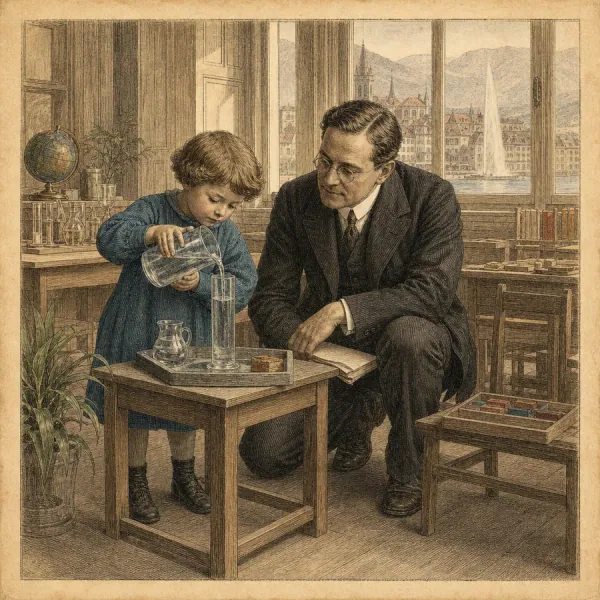
A guided but flexible one-on-one interview, built around small test situations (pouring water, moving counters), in which the child is asked to predict, explain and justify, in order to bring to light the logic of their reasoning.
His questions became famous: “What makes the clouds move?”, “Why do rivers flow?”, or “Can you see a thought?” The answers of young children, who often explain that clouds move to do people a favor, open a window onto a way of thinking very different from ours.
The rest of the course
This page publishes the first 2 parts. The full course has 8: here is what the next ones cover.
- 🏛️ Geneva, his children and the “Piaget factory”
Arrival at the Jean-Jacques Rousseau Institute in 1921, marriage and the observation of his three children, a career spanning Geneva, Lausanne and Paris, leadership of the International Bureau of Education, the founding of the Center for Genetic Epistemology, honors, and his death in 1980.
- 🧱 Building knowledge: schemes, assimilation, accommodation
The heart of the theory: genetic epistemology, intelligence as adaptation, schemes, assimilation, accommodation and equilibration, and the idea that children actively build their own knowledge.
- 🪜 The four major stages of development
The four periods described by Piaget, from the sensorimotor intelligence of babies to the formal thinking of adolescents, with their characteristic milestones: object permanence, the symbolic function, concrete operations, hypothetico-deductive reasoning.
- 🥛 The famous experiments: glasses of water, counters and mountains
The tasks invented by Piaget and his collaborators to reveal children's thinking: conservation of liquids and number, the three mountains, class inclusion, the A-not-B error, and the balance scale.
- 🏫 Morality, school and computers: Piaget's influence
The 1932 theory of moral judgment, the idea of the active child and student-centered teaching, the role of play, the influence on Kohlberg and on computing (Logo, graphical interfaces), and the criticisms raised by education research.
- 🔍 What research has confirmed or corrected
The limits of Piaget's methods, discoveries about babies' early abilities, Vygotsky's cultural critique, neo-Piagetian theories, and Piaget's legacy as the founder of developmental psychology.
Study “Jean Piaget” with flashcards and quizzes
In Oria, you read the full course, then practice on it: flashcards, multiple-choice quizzes, open questions or the Feynman method. Cards and questions then come back in your daily review, paced by spaced repetition.
Study this topic in OriaSources
These notes draw on the sources below. If a point seems doubtful, refer back to them.