Psychology & decisions
Nudge by Richard Thaler and Cass Sunstein: Summary and Study Notes
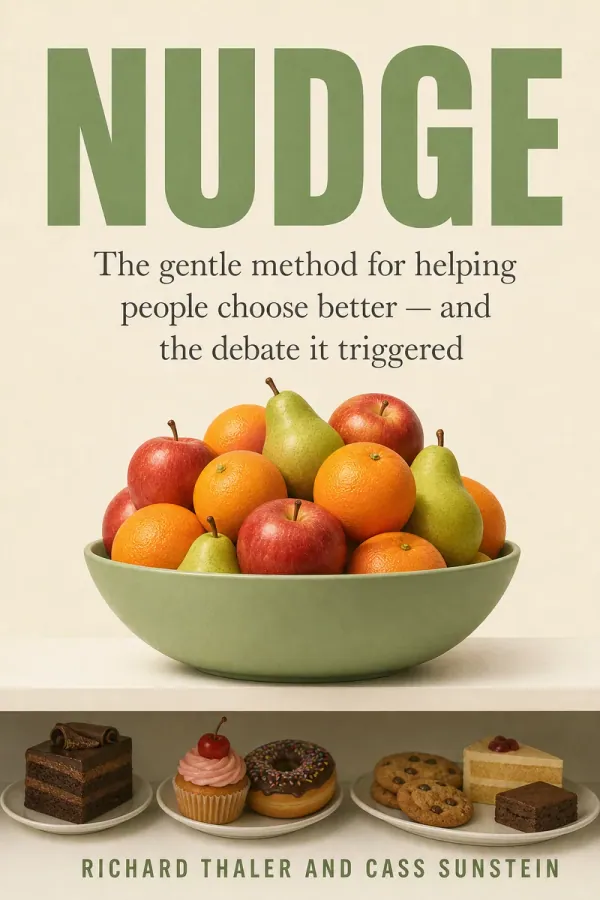
The gentle method for helping people choose better — and the debate it triggered
Study this topic in OriaThe essentials
Published in 2008 by economist Richard Thaler, a future Nobel laureate, and legal scholar Cass Sunstein, Nudge makes a simple case: since our decisions are shaped by how choices are presented to us, that presentation might as well be designed to help us, without banning anything. You'll discover our decision-making biases, the definition of a nudge, libertarian paternalism, the power of default options, and the “nudge units” set up by governments. You'll also see the ethical criticisms and the recent debates over how effective nudges really are.
Key dates and facts
- 2003
- First articles on libertarian paternalism
- 2008
- Nudge published by Yale University Press
- 2010
- French translation published by Vuibert
- 2017
- Nobel Prize in Economics for Richard Thaler
- 2021
- Revised and expanded final edition
- 3.5%
- Average starting savings rate of participants
- 13.6%
- Rate reached after 40 months
- 80%
- Of enrollees still in the program by the fourth pay raise
- 2006
- Elements of the program written into US law
- 2009
- Sunstein takes charge of the OIRA in Washington
📙 A 2008 book that became doctrine
Nudge, whose full title is Nudge: Improving Decisions about Health, Wealth, and Happiness, was published on April 8, 2008 by Yale University Press. Its authors are two University of Chicago professors: the economist Richard Thaler, a leading figure in behavioral economics, and the legal scholar Cass Sunstein, who joined Harvard that same year.
A gentle push, or a small poke with the elbow. It describes a soft way of steering a choice without forcing or forbidding anything.
🍽️ Born over lunch
Thaler coined the phrase “libertarian paternalism” during a discussion with economist Casey Mulligan, then debated it further with Sunstein over their weekly lunches. In 2003, the two men published two articles on the idea, in the American Economic Review and in the University of Chicago law review. The book develops these ideas for a general audience. It draws mostly on Thaler's research, which is why his name comes first, and every chapter is written in his voice; royalties are split evenly. Thaler reportedly wanted a different subtitle: “the gentle power of choice architecture.”
📰 A warm reception
The book received largely positive reviews. The Guardian described it as never intimidating, always amusing and illuminating — a cheerful economic stroll carrying serious lessons. The Economist ranked it among the best books of 2008. In France, it was published in March 2010 by Vuibert under the title Nudge : la méthode douce pour inspirer la bonne décision.
🔄 The 2021 final edition
In 2021, Thaler and Sunstein published a fully revised version, subtitled The Final Edition (translated into French in 2022). They dropped some chapters, such as the one on the legal framework for same-sex couples, and added new ones, including one devoted to sludge, the dark side of the nudge. In the meantime, the book had become far more than a bestseller: a doctrine applied by dozens of governments, and the center of a debate that still continues today over the limits of public influence.
🧠 Homo sapiens, not Homo economicus
All the reasoning in Nudge, by Richard Thaler and Cass Sunstein, starts from a critique of traditional economics and its central character.
🤖 Economic man does not exist
The imaginary creature of economics textbooks, who always thinks and chooses perfectly, calculates like a computer, and never struggles with willpower.
The authors draw on decades of research in psychology and behavioral economics, especially the work of Daniel Kahneman and Amos Tversky. It shows that real humans, Homo sapiens, make mistakes often, and above all in predictable ways: they rely on mental shortcuts and let themselves be swayed by context and by other people.
⚡ Two systems of thinking
The book distinguishes two ways of thinking, which Kahneman would later develop in detail in Thinking, Fast and Slow (2011):
- the automatic system, fast and instinctive: smiling at the sight of a puppy, feeling afraid during airplane turbulence, ducking when a ball flies toward you;
- the reflective system, slow and deliberate: the one we rely on to choose a university, a travel destination, or, in general, to decide whether to get married.
The automatic system does us enormous service, but it also leads us into traps.
🪤 The traps of decision-making
| Bias | Example from the book |
|---|---|
| Anchoring | Asked to guess the population of Milwaukee, a resident of big Chicago starts from their own city and guesses too high; a resident of small Green Bay starts from theirs and guesses too low. |
| Availability | People believe homicides are more common than suicides, because they come to mind more easily. |
| Representativeness | In basketball, people believe a player who has just scored several baskets in a row has a “hot hand.” |
| Status quo | After a free trial subscription to a magazine, many people keep paying without reading it, simply because they never cancel. |
| Conformity | In Solomon Asch's experiments, participants give an obviously wrong answer just to match the group. |
The authors also discuss loss aversion (losing hurts more than gaining pleases), excessive optimism, present bias, and the framing effect: the same information presented differently produces different choices. Their conclusion is decisive for everything that follows. Since these errors are systematic, they can be anticipated — and environments can therefore be designed to help people avoid them.
The rest of the course
This page publishes the first 2 parts. The full course has 9: here is what the next ones cover.
- 👉 What is a nudge?
Thaler and Sunstein's definition of a nudge, the idea of choice architecture, and the famous cafeteria and Schiphol airport urinal-fly examples.
- ⚖️ Libertarian paternalism: a contradiction in terms?
The book's political philosophy: reconciling freedom of choice with benevolent influence, by steering people toward what they themselves judge to be good for them.
- 🛠️ The choice architect's toolkit
The main levers proposed by Thaler and Sunstein: default options, anticipating errors, feedback, simplifying complex choices, and social norms.
- 💰 Savings, health, organ donation: the book's proposals
Nudge's concrete applications: the Save More Tomorrow savings plan, the critique of the Medicare Part D drug insurance program, and mandated choice for organ donation.
- 🏛️ “Nudge units” around the world
The conquest of governments: Cass Sunstein at the White House, the creation of the British Behavioural Insights Team in 2010, and the spread of behavioral units worldwide.
- ✍️ Richard Thaler and Cass Sunstein
The two authors: Richard Thaler, a pioneer of behavioral economics and 2017 Nobel laureate, and Cass Sunstein, one of the most cited legal scholars in the United States and a former Obama adviser.
- 🔍 Criticism and the debate over effectiveness
The objections raised against Nudge: manipulation, the risk to autonomy, a concept stretched too thin, fragile evidence, and the recent meta-analyses that temper the average effect of nudges.
Study “Nudge” with flashcards and quizzes
In Oria, you read the full course, then practice on it: flashcards, multiple-choice quizzes, open questions or the Feynman method. Cards and questions then come back in your daily review, paced by spaced repetition.
Study this topic in OriaSources
These notes draw on the sources below. If a point seems doubtful, refer back to them.