History
Martin Luther King: Biography and Study Notes
The pastor who rolled back segregation through nonviolence
Study this topic in OriaThe essentials
The son of a pastor, born in Atlanta in the segregated South, Martin Luther King became, at 26, the face of the Montgomery bus boycott. Faithful to the nonviolence inspired by Gandhi, he led the great campaigns of the civil rights movement, from Birmingham to Selma, and delivered "I Have a Dream" in 1963. You'll follow his life, from his studies to his Nobel Prize, from the landmark laws of 1964 and 1965 to his final battles against poverty and the Vietnam War, up to his assassination in Memphis in 1968.
Key dates and facts
- 1955
- Rosa Parks is arrested on December 1
- 1956
- King's house is bombed
- 1956
- The boycott ends in victory in December
- 1963
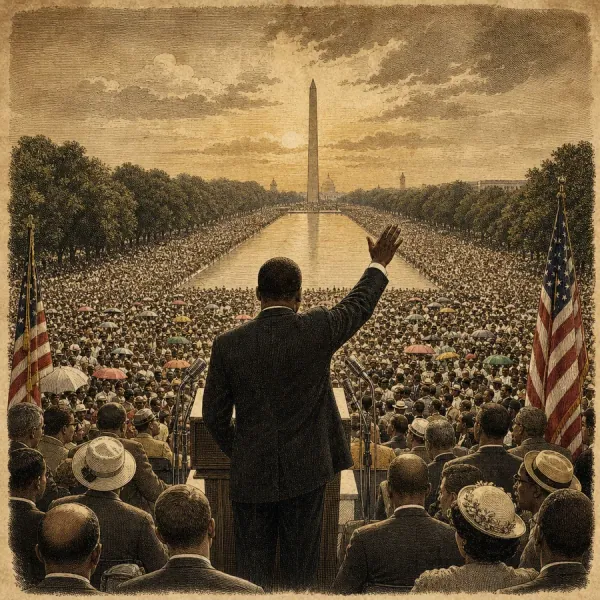
- March on Washington
- 1964
- Civil Rights Act and the Nobel Prize
- 1965
- Selma and the Voting Rights Act
- 1968
- Assassinated in Memphis on April 4
- 1983
- Martin Luther King Day is created
- 2011
- His memorial is dedicated in Washington
🏠 A childhood in Atlanta
Martin Luther King Jr. was born on January 15, 1929, in Atlanta, Georgia, in the American South. At birth, he was actually named Michael King Jr. He was the second of three children of Michael King, a Baptist pastor, and Alberta Williams, daughter of the pastor of Ebenezer Baptist Church. He had an older sister, Christine, and a younger brother, Alfred Daniel.
✝️ A family of pastors
In 1931, his father succeeded his own father-in-law as head of Ebenezer Church, growing its congregation from six hundred to several thousand members. In 1934, he traveled to Europe and attended a world Baptist congress in Berlin; he also visited sites linked to the German reformer Martin Luther. On his return, he changed his own name to Martin Luther King, and his five-year-old son's name to Martin Luther King Jr.
At home, the children read the Bible aloud. Young Martin knew hymns and verses by heart by age five. He sang in the church choir, played piano, and devoured dictionaries, which gave him an impressive vocabulary.
🚧 Discovering segregation
The South at the time lived under racial segregation. Around age six, Martin had a young white boy as a playmate. When it came time to start school, each boy entered a separate school, and the other boy's parents soon forbade him from playing with Martin. His parents explained to him the history of slavery and racism. He would later say that he was then "determined to hate every white person," but his parents taught him that his Christian duty was to love everyone.
His father served as his model. One day, a shoe salesman asked them to move to the back of the store; Martin Sr. refused and walked out with his son. He later told him he would never accept that system, even if he had to live with it his whole life. In 1936, he led hundreds of African Americans to Atlanta's city hall to demand the right to vote.
🎤 A first speech and an anger
A brilliant student, Martin skipped a grade and entered Booker T. Washington High School, the only one in the city for Black students. His baritone voice and talent for public speaking drew attention. On April 13, 1944, he won an oratory contest. On the bus ride home, the driver insulted him and forced him and his teacher to give up their seats to white passengers. They rode standing all the way to Atlanta. He would later say he had never been so angry in his life, and that the memory of that night never left him.
🎓 Morehouse, Crozer, Boston: becoming a pastor
In 1944, at fifteen, Martin Luther King passed the entrance exam for Morehouse College, a university for Black men in Atlanta where his father and grandfather had both studied. During the war, the school admitted high schoolers to keep up its enrollment.
🌾 A summer without segregation
In the summer of 1944, before starting classes, he went to work on a tobacco farm in Connecticut, in the North. For the first time, he discovered a world without official segregation. He wrote to his parents, amazed, that Black and white people there went to the same church and could sit wherever they liked.
✝️ Choosing the pulpit
As a teenager, he had doubted the overly literal teachings of his father's church. At Morehouse, the university's president, the pastor Benjamin Mays, became his "spiritual mentor." In 1947, at eighteen, King decided to become a pastor: the Church seemed to him the best way to answer his desire to serve humanity. In 1948, he earned a bachelor's degree in sociology.
It was also at Morehouse that he read the essay Civil Disobedience by the American Henry David Thoreau, who had chosen prison over paying a tax rather than support a war that favored slavery. There, King discovered the idea of refusing to cooperate with an unjust system.
📖 Crozer and the discovery of Gandhi
He continued his theological studies at Crozer Seminary, in Pennsylvania, where he became student body president, graduating in 1951. In 1950, a lecture on Gandhi, the hero of Indian independence, thrilled him: he discovered how nonviolent resistance could become a political force. He also took an interest in the "social gospel" of the theologian Walter Rauschenbusch.
In 1951, he began a doctorate in theology at Boston University. He received his doctorate in 1955. In 1991, a university inquiry would conclude that passages of this dissertation had been plagiarized, while declining to revoke his degree.
💍 Coretta and Montgomery
In Boston, he met Coretta Scott, a student at the music conservatory. They married on June 18, 1953, and would have four children. In 1954, at twenty-five, King became pastor of the Dexter Avenue Baptist Church, in Montgomery, Alabama. His sermons quickly built his reputation there.
The name given to local laws in Southern states that enforced racial segregation: separate schools, buses, restaurants, restrooms, or churches for white and Black people, along with barriers that kept Black citizens from voting.
The rest of the course
This page publishes the first 2 parts. The full course has 9: here is what the next ones cover.
- 🚌 The Montgomery bus boycott
The Montgomery bus boycott, from December 1955 to December 1956: Rosa Parks's arrest, Martin Luther King's role leading the movement, carpooling, the bombing of his house, his arrest, and the legal victory against bus segregation.
- ☮️ Nonviolence and the SCLC
Martin Luther King's years from 1957 to 1962: founding the SCLC, the philosophy of nonviolence, a 1958 stabbing, a trip to India, return to Atlanta, a 1960 imprisonment and Kennedy's intervention, and the failure in Albany.
- 🐕 Birmingham and the jail letter
The Birmingham, Alabama campaign of spring 1963: the strategy of crisis, King's arrest and the Letter from Birmingham Jail, the Children's Crusade, Bull Connor's dogs and fire hoses, victory, and the bombing of the 16th Street church.
- 🗽 The March on Washington and "I Have a Dream"
The March on Washington for Jobs and Freedom of August 28, 1963: its organization, demands, a crowd of more than 250,000 people before the Lincoln Memorial, and Martin Luther King's "I Have a Dream" speech.
- 🏅 The Nobel Prize, Selma, and the landmark laws
The victories of 1964 and 1965: the Civil Rights Act of July 2, 1964, the Nobel Peace Prize of October 1964, the Selma marches, Bloody Sunday on March 7, 1965, the march to Montgomery, and the Voting Rights Act of August 6, 1965.
- 🔥 Chicago, Vietnam, and poverty
Martin Luther King's final battles from 1966 to 1968: the Chicago housing campaign, his public opposition to the Vietnam War in 1967, the criticism he faced, democratic socialism, and preparations for the Poor People's Campaign.
- 🕯️ Memphis, the assassination, and the legacy
Martin Luther King's support for the striking Memphis sanitation workers, his last speech on April 3, 1968, his assassination on April 4 at the Lorraine Motel, the trial of James Earl Ray, the riots, and then his legacy: laws, a national holiday, a memorial, and debates.
Study “Martin Luther King” with flashcards and quizzes
In Oria, you read the full course, then practice on it: flashcards, multiple-choice quizzes, open questions or the Feynman method. Cards and questions then come back in your daily review, paced by spaced repetition.
Study this topic in OriaSources
These notes draw on the sources below. If a point seems doubtful, refer back to them.