History
Nelson Mandela: Biography and Study Notes
From prisoner on Robben Island to president of the rainbow nation
Study this topic in OriaThe essentials
Born into a Thembu royal family in the Transkei, Nelson Mandela became a lawyer in Johannesburg and one of the leaders of the ANC's fight against apartheid. Sentenced to life in prison at the Rivonia Trial in 1964, he spent twenty-seven years behind bars before being released in 1990. You will follow his life, from civil disobedience to armed struggle, from Robben Island to the negotiations with Frederik de Klerk, through his presidency from 1994 to 1999 and the reconciliation he sought to embody.
Key dates and facts
- 1952
- Defiance Campaign
- 1955
- Freedom Charter adopted at Kliptown
- 1956
- Arrested for high treason
- 1960
- Sharpeville massacre
- 1961
- Founding of Umkhonto we Sizwe
- 1962
- Arrested near Howick
- 1964
- Sentenced to life imprisonment
- 1982
- Transferred to Pollsmoor
- 1985
- Refuses conditional release
- 1988
- Transferred to Victor Verster
🌄 A Royal Childhood in the Transkei
Nelson Mandela was born on July 18, 1918, in Mvezo, a village on the banks of the Mbashe River, in the Transkei region, then part of the Cape Province, South Africa. His parents gave him the Xhosa name Rolihlahla, informally meaning "troublemaker." Later, South Africans would affectionately call him Madiba, the name of his clan.
👑 A junior branch of the royal family
Mandela belonged to the Xhosa people. His great-grandfather, Ngubengcuka, had ruled the Thembu kingdom. But his grandfather, a son of that king named Mandela, was born to a wife of secondary rank: his descendants could not inherit the throne, but they served as hereditary advisers to the royal family. His father, Gadla Henry Mphakanyiswa, was a village chief and adviser to the king; he had four wives. Nelson's mother, Nosekeni Fanny, was the third.
His father lost his chieftaincy after a conflict with the white colonial administration, and the family moved to Qunu. Rolihlahla grew up in his mother's kraal, herding cattle and spending his days outdoors with the other boys. His parents could not read, but his mother, a devout Christian, sent him to the Methodist school. He was the first in his family to attend school.
✏️ "Your name is Nelson"
On his first day, his teacher, Miss Mdingane, gave every pupil an English name, as was the custom of the time. Little Rolihlahla became Nelson. He would later say he had no idea why that particular name was chosen.
Around the age of nine, he lost his father to what Mandela believed was a lung illness. His mother then entrusted him to the regent of the Thembu kingdom, Jongintaba Dalindyebo, whom Gadla had helped bring to power. At the "Great Place" of Mqhekezweni, the regent and his wife raised him as their own son. Nelson listened to the elders' stories about African history. At sixteen, he underwent the traditional initiation that marked his passage into manhood.
🎓 From Methodist schools to Fort Hare
Groomed to become an adviser to the royal house, he continued his studies at the Methodist college of Clarkebury, where he earned his Junior Certificate in two years instead of three, then at Healdtown, in Fort Beaufort, attended by most members of the royal family. There he took up long-distance running and boxing.
In 1939, he enrolled at the University of Fort Hare, an elite institution for Black students with about 150 pupils. There he met Oliver Tambo, who would become his friend and fellow fighter for decades. At the time, he was not yet politically engaged. But he took part in a student council boycott protesting the quality of the food. He refused to back down and had to leave the university, never to return.
🏙️ Johannesburg, the Law, and the ANC
Back at the royal residence at the end of 1940, Nelson Mandela learned that regent Jongintaba had arranged a marriage for him and for his cousin Justice. The two young men refused and ran away. In April 1941, they arrived in Johannesburg, the great mining city of the Transvaal. Mandela would later explain that he was rebelling then less against white people than against the customs of his own people.
⛏️ Starting out in the big city
He first found work as a night watchman at a mine, but was dismissed when it was discovered he was the regent's runaway adopted son. A cousin introduced him to Walter Sisulu, an estate agent and activist in the African National Congress. Sisulu got him a position as a clerk at a law firm run by Lazar Sidelsky, who was sympathetic to the cause of Black South Africans. Mandela rented a room in the poor and violent township of Alexandra, which would remain a place apart for him. He completed his bachelor's degree by correspondence and earned it in early 1943.
He then began law studies at the University of the Witwatersrand, where he was the only Black African student and faced racism. There he befriended white, Jewish, and Indian students, liberal or communist, several of whom would become leading figures in the struggle.
🌱 The ANC and its Youth League
In 1943, Mandela joined the African National Congress (ANC), which championed the rights of Black South Africans. With Sisulu, Oliver Tambo, and Anton Lembede, he wanted a more combative movement, capable of mobilizing the masses. The ANC Youth League was founded on Easter Sunday 1944, with Lembede as president and Mandela on its executive committee. Around this time, he married Evelyn Mase, a trainee nurse and ANC activist.
🚫 1948: apartheid becomes law
In the 1948 election, in which only white people could vote, the National Party of Daniel François Malan, dominated by Afrikaners, came to power. It codified and hardened racial segregation through a series of laws.
An Afrikaans word meaning "separateness." It was the system put in place from 1948 onward in South Africa: where people could live, their citizenship, and their rights all depended on their racial classification. Mixed marriages were banned, and the Black majority was stripped of political rights for the benefit of the white minority.
Facing this crackdown, Mandela and his allies in the Youth League pushed the ANC toward direct action: boycotts, strikes, defiance. The ANC's president, seen as too moderate, was replaced. Mandela would later say they had steered the ANC onto a more radical, revolutionary path. Absorbed in politics, he failed his final year of law three times: in December 1949, the university denied him his degree.
The rest of the course
This page publishes the first 2 parts. The full course has 9: here is what the next ones cover.
- ✊ Civil Disobedience, from the Defiance Campaign to Sharpeville
Mandela's years of nonviolent struggle against apartheid: the 1952 Defiance Campaign, the Mandela & Tambo law firm, the 1955 Freedom Charter, the 1956-1961 Treason Trial, his marriage to Winnie and the 1960 Sharpeville massacre.
- 💥 The Armed Struggle and the Rivonia Trial
Mandela's turn to armed struggle with Umkhonto we Sizwe in 1961, his life underground, his tour of Africa, his 1962 arrest, then the Rivonia Trial, his April 20, 1964 speech and his sentencing to life in prison.
- 🏝️ Eighteen Years on Robben Island
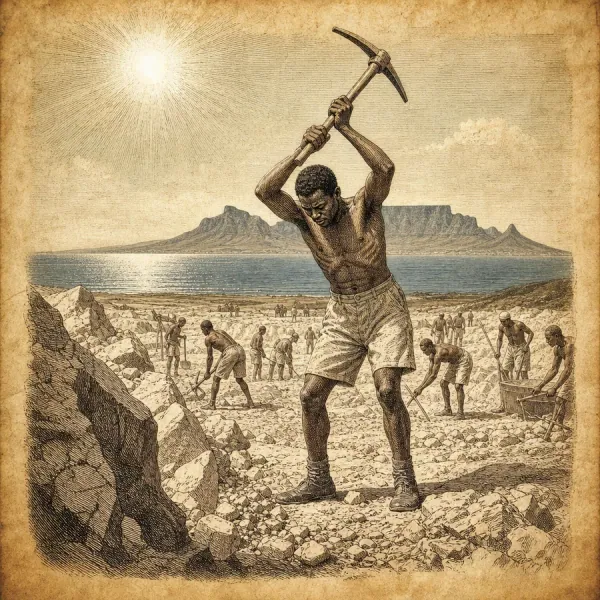
Mandela's imprisonment on Robben Island from 1964 to 1982: a tiny cell, the lime quarry, censored letters, forbidden mourning, the "University of Robben Island," learning Afrikaans and the birth of the international "Free Mandela" campaign.
- 🔓 From Pollsmoor to Freedom
Mandela's final years of detention at Pollsmoor and then Victor Verster, his refusal of a conditional release in 1985, secret meetings with the government, the arrival of Frederik de Klerk and his release on February 11, 1990.
- 🤝 Negotiating the End of Apartheid
Negotiations between Mandela and Frederik de Klerk from 1990 to 1994: the end of the armed struggle, his ANC presidency, violence between the ANC and Inkatha, CODESA, the assassination of Chris Hani, the 1993 Nobel Peace Prize and the first multiracial elections of April 1994.
- 🌈 President of the Rainbow Nation
Mandela's presidency from 1994 to 1999: his inauguration on May 10, 1994, the government of national unity, the 1995 Rugby World Cup, the Truth and Reconciliation Commission, the 1996 constitution, social and economic policy, criticism and his stepping aside for Thabo Mbeki.
- 🕊️ Final Years and Legacy
Mandela's final years from 1999 to 2013: the Nelson Mandela Foundation, the fight against HIV/AIDS, the founding of the Elders, the 2010 World Cup, his death on December 5, 2013, Nelson Mandela International Day and debates over his legacy.
Study “Nelson Mandela” with flashcards and quizzes
In Oria, you read the full course, then practice on it: flashcards, multiple-choice quizzes, open questions or the Feynman method. Cards and questions then come back in your daily review, paced by spaced repetition.
Study this topic in OriaSources
These notes draw on the sources below. If a point seems doubtful, refer back to them.