Civilizations
The Islamic Golden Age: Summary and Study Notes
Baghdad, Córdoba, Cairo: five centuries of shared knowledge
Study this topic in OriaThe essentials
Between the 8th and 13th centuries, from Baghdad to Córdoba, Muslim, Christian, Jewish and Persian scholars translated Greek, Indian and Persian books, then went beyond them. They invented algebra, transformed optics and medicine, founded hospitals and wrote commentaries on Aristotle. You'll discover how this world came into being, what it really contributed, what historians still debate (the House of Wisdom, the “decline”), and how this knowledge reached Europe.
Key dates and facts
- 750
- The Abbasids take power
- 762
- Al-Mansur founds Baghdad
- 929
- Abd al-Rahman III proclaims himself caliph in Córdoba
- 1258
- The Mongols capture and sack Baghdad
- 756
- Umayyad Emirate of Córdoba
- 785 – 786
- Work begins on the Great Mosque of Córdoba
- 929
- Proclamation of the Caliphate of Córdoba
- 1031
- The caliphate breaks up into taifa kingdoms
🌙 What do we mean by the “Islamic Golden Age”?
The Islamic Golden Age is a period of exceptional flourishing in the sciences, philosophy, the arts and trade in the medieval Muslim world. According to the most common dating, it began in the mid-8th century, with the rise to power of the Abbasid dynasty and the founding of Baghdad, and ended in 1258, when the Mongols took the city. Some historians extend it into the 14th or 15th century, including, for example, Nasrid Granada.
🗺️ A world spanning three continents
By the 8th century, the Muslim world stretched from Spain to Central Asia. It brought together very different peoples (Arabs, Persians, Berbers, Turks, Copts, Arameans…) but shared a common language of learning, Arabic, trade routes and a majority religion. A book written in Baghdad could be read in Córdoba or Samarkand. Baghdad was not the only major center: there were also Damascus, Cairo, Kairouan, Fez, Córdoba, Nishapur, Bukhara and Samarkand.
🏷️ A term born in the 19th century
The expression “golden age of Islam” is not medieval. It appeared in the 19th century, in the context of Orientalism, the European fascination with the East. In 1868, a travel guide to Syria and Palestine was already presenting the mosques of Damascus as relics of a vanished golden age. The term only became common in the second half of the 20th century, mainly to describe the flowering of the sciences between the 9th and 11th centuries. Its limits vary: the historian cited as Khan (2003), for example, restricts it to the two centuries between 750 and 950.
🤝 “Islamic” or “Arabic”?
Historians also debate the adjective. Many scholars of the period were neither Arab nor Muslim: the great translator Hunayn ibn Ishaq was a Christian, the mathematician Thabit ibn Qurra belonged to the pagan Sabian community of Harran, the philosopher Maimonides was Jewish, and a considerable share of the scholars were Persian. The Iranian historian Shodja-e-din Shafa therefore challenges the expression “Islamic science”: no one, he notes, attributes the sciences of Byzantium or Christian Europe to Christianity. Scholars thus often speak of Islamic civilization in the sense of a world ruled by Muslim sovereigns, and of “Arabic science” in the sense of science written in Arabic.
🏙️ Baghdad, the Abbasids' Round City
In 750, the Abbasid dynasty overthrew the Umayyads, who had ruled from Damascus. The new regime wanted a capital of its own, closer to its supporters in Persia. The caliph al-Mansur chose a site on the Tigris, at the crossroads of the routes to Persia, Syria and India, some thirty kilometers from the old Persian capital of Ctesiphon.
⭕ A city shaped like a circle
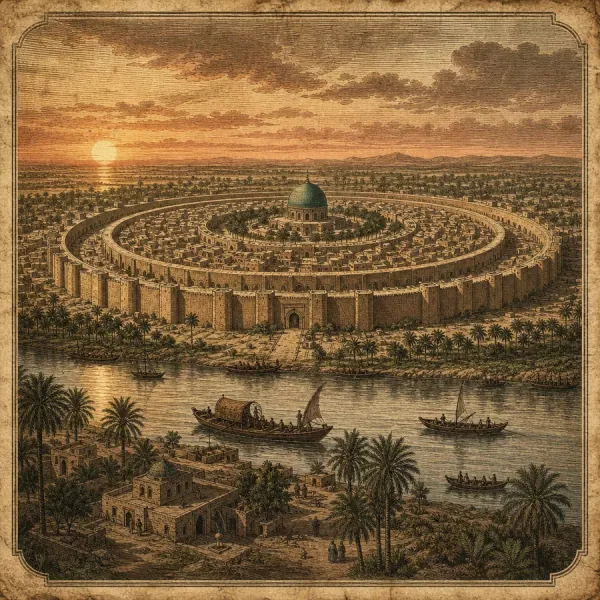
According to the chronicler al-Yaqubi, construction began on August 2, 762. Arab chroniclers speak of 100,000 workers and craftsmen. The city was completed around 766. Its official name was Madinat al-Salam, the “City of Peace,” but everyone called it Baghdad. It formed an almost perfect circle about 2 to 2.5 kilometers across, depending on the estimate, surrounded by a moat and ramparts. Four gates opened toward Kufa, Basra, Syria and Khorasan. At the center stood the caliph's palace, crowned with a green dome, and the great mosque.
This plan did not come out of nowhere: it followed the model of the round cities of Sasanian Persia, such as Gur (Firuzabad). The two designers chosen by al-Mansur were, moreover, Naubakht, a former Zoroastrian, and Mashallah, a Persian Jewish astrologer. No building of the Round City has survived: everything we know comes from texts.
🌍 A world city
Baghdad quickly attracted soldiers from Khorasan, merchants, and Persian, Arab, Christian and Jewish men of letters. Under the caliph Harun al-Rashid (786 – 809), it became one of the largest cities in the world. Between 1000 and 1200, only Kaifeng and Hangzhou, in China, rivaled it in surpassing a million inhabitants.
📄 Paper changes everything
A technique from China sped everything up: paper. It was being made in Samarkand by around 751 at the latest, then in Baghdad from 793 – 794. A legend has it that Chinese prisoners captured at the Battle of Talas, in 751, brought the secret; the art historian Jonathan Bloom considers this unlikely, since paper was already in use in Samarkand decades earlier. Easier to produce than parchment and less fragile than papyrus, it absorbs ink and is hard to scrape clean, which made it the ideal medium for records. In Baghdad, the stationers' market (Suq al-Warraqin) lined up more than a hundred shops selling paper and books. For perhaps the first time, people could make a living copying and selling books.
The rest of the course
This page publishes the first 2 parts. The full course has 9: here is what the next ones cover.
- 📜 The great translation movement and the House of Wisdom
How, in the 8th to 10th centuries, the Abbasids had Greek, Persian and Indian knowledge translated into Arabic, and what historians really know about Baghdad's House of Wisdom.
- 🔢 Algebra, numerals and stars
The great advances in mathematics and astronomy: al-Khwarizmi and algebra, the spread of Indian numerals, Omar Khayyam, the astrolabe, al-Biruni and the astronomers of Maragha.
- 🩺 Hospitals, physicians and the science of light
Hospitals (bimaristans), the great physicians al-Razi, Avicenna, al-Zahrawi and Ibn al-Nafis, and Ibn al-Haytham, pioneer of optics and of the experimental method.
- 🦉 Philosophers and theologians: Aristotle in Arabic
The philosophy (falsafa) of al-Kindi, al-Farabi, Avicenna and Averroes, the debate with theology (the Mu'tazilites, al-Ghazali), and the contribution of Jewish thinkers such as Maimonides.
- 🕌 Córdoba, Cairo, Fez: the other capitals of learning
Al-Andalus and the Umayyad Caliphate of Córdoba (the mosque, Madinat al-Zahra, al-Hakam II's library), then Fatimid Cairo, Kairouan and Fez, and the debate over the myth of “convivencia.”
- 🎨 Calligraphy, geometry and the Thousand and One Nights
The arts and culture of the golden age: calligraphy, geometric patterns and girih, architecture (Samarra, the Alhambra), literature and poetry, and the question of depicting living beings.
- 🌉 To Europe, the fall of Baghdad and the debate over decline
The transmission of knowledge to Latin Europe in the 12th century (Toledo, Sicily, Fibonacci), the Mongol sack of Baghdad in 1258, and the debated explanations for the “decline.”
Study “The Islamic Golden Age” with flashcards and quizzes
In Oria, you read the full course, then practice on it: flashcards, multiple-choice quizzes, open questions or the Feynman method. Cards and questions then come back in your daily review, paced by spaced repetition.
Study this topic in OriaSources
These notes draw on the sources below. If a point seems doubtful, refer back to them.