Economics
Money and Inflation: Summary and Study Notes
Why money is worth what it's worth, and why prices rise
Study this topic in OriaThe essentials
From seashells to bank transfers, money has changed shape but kept the same functions. You'll learn who really creates it, how inflation is measured, and why prices rise. We'll travel through history's wildest hyperinflations, from 1923 Germany to Venezuela, the trap of deflation, then the role of central banks and their 2% target, up to the great return of inflation in 2021-2023.
Key dates and facts
- c. 3000 BC
- The shekel, a unit of weight, in Mesopotamia
- c. 650–600 BC
- First coins struck in Lydia
- 1661
- First European banknotes, in Sweden
- 1971
- End of the dollar's convertibility into gold
- Nov. 1923
- Germany: 1 dollar = 4.21 trillion marks
- 1946
- Hungary: 1 forint = 400,000 quadrillion pengős
- Nov. 2008
- Zimbabwe: tens of billions of percent per month
- 2018
- Venezuela: 130,060% for the year, according to the central bank
- 1990
- First inflation targeting, in New Zealand
- June 1, 1998
- ECB founded in Frankfurt
🪙 What is money for?
We often just say "money," but economists use the word more precisely. It's defined less by its form (coin, note, a figure on an account) than by what it lets us do. Since the nineteenth century, four functions were traditionally recognized; modern textbooks now keep only three, the fourth (settling debts later) being folded into the others.
🧮 Three functions
- Unit of account: money serves as a common yardstick for expressing the value of everything. A $300 bike, a $15 meal: thanks to money, we instantly compare goods that have nothing in common.
- Medium of exchange: you sell what you have for money, then buy what you want with it. The exchange is split into two separate transactions.
- Store of value: money lets you carry purchasing power through time. You can earn today and spend six months from now.
These three functions are linked. If prices rise very fast, money holds its value poorly: it does a worse job as a store of value, and people try to get rid of it.
🔄 The problem with barter
Without money, you have to trade one good directly for another: that's barter. For two people to trade, each must have exactly what the other wants. Economists call this condition the double coincidence of wants. A baker who wants shoes has to find a cobbler who happens to want bread: that's rare, and it's slow.
A necessary condition for barter: whoever holds good X must want good Y, and whoever holds Y must want X. Money removes this constraint, since everyone accepts it as payment.
The classic story, popularized since Adam Smith, holds that societies moved from barter to money to solve this problem. Anthropologists sharply qualify this account: no society is known whose economy relied mainly on barter. Moneyless societies instead ran on gift-giving and debt, and barter mostly appeared between strangers, or during shortages of money. This was seen, for example, in Argentina during the 2001 crisis, where cars were sometimes traded for grain.
🤝 A matter of trust
Today, a $50 bill is worth almost nothing as an object. Its value comes from everyone being certain they can use it to pay. That's why we speak of fiat money, from the Latin fiat, "let it be done." The state reinforces this trust by giving its currency legal tender status: within its territory, it cannot be refused as payment for a debt.
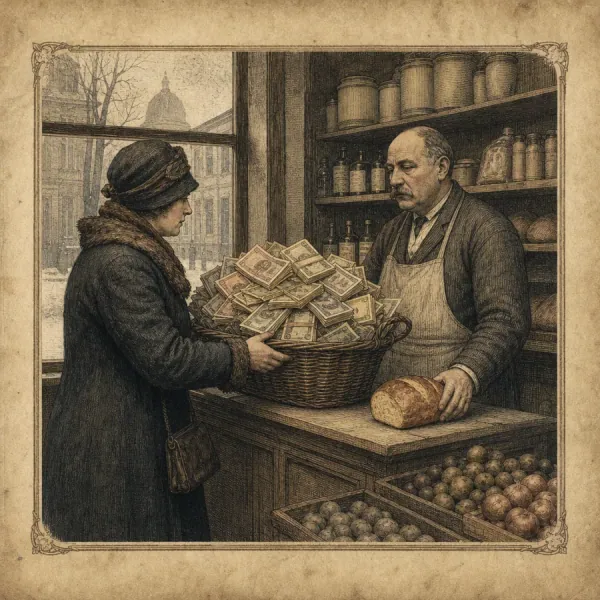
When this trust breaks down, in wartime or a severe crisis, the official currency can be abandoned in favor of other means of payment: foreign currencies, gold, or even cigarettes, as in Germany in 1923. The whole history of inflation is, at bottom, the history of this trust.
📜 From seashells to bank-ledger money
Over the course of history, money has taken many different forms: cattle, salt, barley, shells, metal, paper, and now simple computer entries. Its history is one of gradual dematerialization.
🐚 Commodity money
The earliest forms of money are objects that have value in themselves. In Mesopotamia, the shekel was first a unit of weight, equal to about 160 grains of barley; the term appears around 3000 BC. In Africa, Asia, Oceania, and the Americas, people used shells, notably cowries. These objects share the traits of being rare, durable, and easy to count.
🔶 The first coins
According to the Greek historian Herodotus, the Lydians, a people of Asia Minor (modern-day Turkey), were the first to strike coins of gold and silver. Researchers date these first stamped coins to around 650–600 BC. They were made of electrum, a natural alloy of gold and silver, and bore a mark that guaranteed their weight. The idea was revolutionary: metal no longer had to be weighed at every exchange.
📃 Paper money
Paper money was born in China. Under the Song dynasty (960–1279), deposit receipts issued by merchants evolved into true banknotes, called jiaozi. In the thirteenth century, travelers such as Marco Polo introduced paper money to Europeans: Marco Polo devotes an entire chapter of his account to tree bark turned into a kind of paper that the Great Khan circulated as money. In Europe, the first banknotes were issued in Sweden by Stockholms Banco, in 1661.
🏅 From the gold standard to money on faith
In the eighteenth and nineteenth centuries, banknotes were convertible into gold: the gold standard. By the early twentieth century, almost every country had adopted it. Wars shook it, and after the Second World War, the Bretton Woods agreements set up a system in which currencies were pegged to the dollar, itself convertible into gold. In 1971, the United States suspended this convertibility. Since then, no currency in the world is backed by a metal: their value rests on law and on trust.
💳 Bank-ledger money
Today, most money exists neither as coins nor as notes. It is bank-ledger money, the sums recorded in bank accounts, moved by card, transfer, or check. In the eurozone, it made up 91% of the money supply in 2017. Notes and coins are now only a small share of it.
To measure the amount of money, central banks use monetary aggregates, from most to least liquid: M1 (notes, coins, and demand deposits), M2 (M1 plus certain savings accounts), and M3 (M2 plus investments very close to cash). In 2008, Bitcoin opened another chapter: digital currencies with no bank or state behind them, whose status remains hotly debated.
The rest of the course
This page publishes the first 2 parts. The full course has 9: here is what the next ones cover.
- 🏦 Who creates money?
The two tiers of money creation: central-bank money issued by the central bank, and bank-ledger money created by commercial banks when they grant loans.
- 📈 Inflation: definition and measurement
What inflation is (a general, lasting rise in prices), how it's measured with the consumer price index and its basket, and related concepts: disinflation, deflation, stagflation.
- 🔥 Why do prices rise?
The main causes of inflation (too much money, excess demand, rising costs, imported inflation, expectations, and the wage-price spiral) and its effects on creditors, debtors, and workers.
- 💸 When money collapses: hyperinflations
Historical hyperinflations and their mechanics, through three examples: Weimar Germany in 1923, Zimbabwe in 2008, and Venezuela since 2016.
- 🧊 The opposite danger: deflation
Deflation (a general, lasting fall in prices), the deflationary spiral, the increased weight of debt, and two examples: the Great Depression of the 1930s and Japan from the 1990s onward.
- 🏛️ Central banks and the 2% target
The role of central banks in fighting inflation: inflation targeting, the 2% goal, how policy rates work, independence, and the mandate of the European Central Bank.
- ⚡ The great return of inflation, 2021-2023
The global inflation wave of 2021-2023: causes (the Covid rebound, supply chains, government support, energy, and the war in Ukraine), peaks in the United States and the eurozone, rate hikes, and debates.
Study “Money and Inflation” with flashcards and quizzes
In Oria, you read the full course, then practice on it: flashcards, multiple-choice quizzes, open questions or the Feynman method. Cards and questions then come back in your daily review, paced by spaced repetition.
Study this topic in OriaSources
These notes draw on the sources below. If a point seems doubtful, refer back to them.