Great discoveries & mysteries
Ötzi the Iceman: Summary and Study Notes
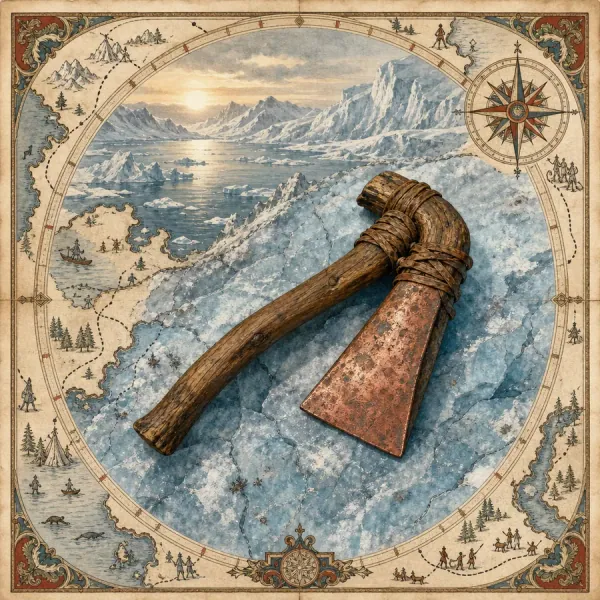
A Copper Age traveler emerging from an Alpine glacier
Study this topic in OriaThe essentials
In September 1991, two hikers found a body in a glacier in the Alps, on the border between Austria and Italy, that everyone assumed was recent: it turned out to be a man who had died more than 5,000 years earlier, still with his clothes and equipment. You'll follow the discovery, the border dispute, and then everything science has learned from this unique witness of the Copper Age: his axe, his clothes, his tattoos, his last meal, his DNA. You'll see how an arrowhead spotted in 2001 turned the case into a criminal investigation, what remains hypothetical, and why the “curse of Ötzi” doesn't hold up.
Key dates and facts
- Sept. 19, 1991
- Helmut and Erika Simon spot the body
- Sept. 23, 1991
- The body is freed from the ice
- Sept. 24, 1991
- Konrad Spindler: “at least 4,000 years old”
- Summer 1992
- First systematic archaeological excavation of the site
- c. 4000 BC
- Copper metallurgy reaches central Europe
- 3359 – 3105 BC
- The period when Ötzi lived, according to dating
- c. 3230 BC
- Ötzi dies at the Tisenjoch
- 1991
- Hypothesis of death from cold
- 2001
- The arrowhead is discovered
- 2003
- Traces of other people's blood reported on his equipment
🏔️ September 19, 1991: a body in the ice
Ötzi, nicknamed “the Iceman,” is the natural mummy of a man who lived more than 5,000 years ago in the Alps. He is the oldest known natural human mummy in Europe. Yet his discovery was entirely down to chance.
🥾 A hike cut short
On September 19, 1991, a couple of German hikers from Nuremberg, Helmut and Erika Simon, were walking near the Tisenjoch pass (Giogo di Tisa in Italian), at an altitude of 3,210 meters (10,530 feet), in the Ötztal Alps, on the border between Austria and Italy. In a small gully, they spotted the upper part of a human body sticking out of the melting ice. The summer had been hot and the glacier had retreated a long way. They told the warden of the Similaun hut, who alerted both the Austrian police and the Italian Carabinieri, since the spot was so close to the border. Everyone assumed it was a climber who had died in an accident, perhaps a few years earlier.
⛏️ A clumsy recovery
The next day, a first attempt to free the body failed because of bad weather; only an axe was brought down to the valley. On September 21, with no helicopter available, another attempt failed. That day, two famous South Tyrolean mountaineers, Reinhold Messner and Hans Kammerlander, passed by the site and examined the leather clothing and some birch-bark containers. Seeing a sketch of the axe, Messner was the first to suspect that the dead man was very old.
The body was not freed until September 23, in front of a television crew, with ice axes and without a single archaeologist present. In the preceding days, onlookers had trampled fragile objects and carried others away without noting where they lay. A jackhammer even damaged the mummy's hip, his left arm was broken during handling and his bow snapped. A dagger was found next to the body, along with a long stick that would later be identified as a bow. The body was flown by helicopter to Vent, in Austria, then taken to the Institute of Forensic Medicine in Innsbruck.
🔎 “At least 4,000 years old”
On September 24, archaeologist Konrad Spindler of the University of Innsbruck examined the objects. Based on the shape of the axe, he immediately estimated that the dead man was “at least 4,000 years old.” A news item became a worldwide archaeological sensation. As the body was beginning to decompose, it was placed in a cold cell that mimicked the conditions of the glacier. The Austrian journalist Karl Wendl, looking for a catchy name, christened him Ötzi, after the Ötztal Alps. In French-language media, he was also sometimes called “Hibernatus,” after the French film of the same name.
In the summer of 1992, archaeologists finally excavated the site methodically, melting the snow and ice with steam. Among other things, they found a bearskin cap. The body had been protected from the moving glacier because it lay at the bottom of a gully about 3 meters by 7, an exceptional stroke of luck.
🧭 Austria or Italy? A disputed mummy
Ötzi, the Iceman discovered in September 1991, was found just a few steps from the border between Austria and Italy. Such an archaeological treasure belongs to the state on whose territory it is found. So it was essential to know exactly which side he was on.
📐 A poorly drawn border
The border was set after World War I, when southern Tyrol passed from Austria to Italy (Treaty of Saint-Germain-en-Laye, 1919). It was supposed to follow the Alpine watershed, but snow and ice made surveying it difficult, and the line remained approximate. On October 2, 1991, thirteen days after the discovery, an official survey established that the body had lain 92.56 meters (about 100 yards) inside Italian territory, in the autonomous province of Bolzano, South Tyrol (Alto Adige). Even if “misplaced,” the line remains valid under international law.
South Tyrol therefore claimed Ötzi, but agreed to let him stay temporarily in Innsbruck, Austria, for the first scientific studies. Since 1998, the mummy and his belongings have been on display at the South Tyrol Museum of Archaeology in Bolzano, Italy.
⚖️ Seventeen years in court
The discovery also led to a legal battle. Other people claimed to have seen the body before the Simons. Italian law grants the finder a reward of 25% of the value of the find, a value that is very hard to estimate for a prehistoric man. In 1994, the province of South Tyrol offered the Simons 10 million lire (about 5,200 euros), which they turned down.
- 2003: a court in Bolzano recognized Helmut and Erika Simon as the official finders.
- 2004: Helmut Simon died before the case was over.
- 2006: an appeals court confirmed that they were entitled to a reward.
- 2008: in September, seventeen years after the discovery, Erika Simon and the province agreed on a payment of 150,000 euros.
🧊 Why so many “coincidences”
The Bolzano museum stresses that Ötzi is the result of a series of highly improbable coincidences: a man who died in a sheltered gully, was covered by snow and then by ice, was spared by the glacier for millennia, then was uncovered by an exceptionally hot summer just as two hikers passed by. Without this chain of circumstances, neither the body nor his fragile objects of leather, grass and bark would have reached us.
A body preserved without human intervention, by cold, dryness or lack of oxygen, unlike Egyptian mummies, which were deliberately prepared by embalming. Ötzi is a “wet” mummy: he was preserved by the ice after losing much of his body fluids.
The rest of the course
This page publishes the first 2 parts. The full course has 9: here is what the next ones cover.
- ⏳ A man of the Copper Age
Dating Ötzi (c. 3300–3100 BC), the era he lived in, the Chalcolithic, and his origins in the valleys of South Tyrol.
- 🧥 A 5,300-year-old wardrobe
Ötzi's clothing (a coat of goat and sheep hides, leggings, loincloth, belt, shoes, bearskin cap) and what the DNA of the leathers reveals about livestock in his time.
- 🪓 A copper axe and a real survival kit
Ötzi's equipment: the one-of-a-kind copper axe, the unfinished bow and arrows, the flint dagger, the retoucher, the ember containers and the fire-making kit.
- 🔬 What his body and DNA reveal
A physical portrait of Ötzi: age, height, illnesses, tattoos, last meal, and what the genetic analyses of 2012 and 2023 revealed about his ancestors.
- 🏹 A 5,300-year-old criminal investigation
How the cause of Ötzi's death was discovered in 2001 (an arrow in the shoulder), what is established, the hypotheses about the circumstances of the murder and those that have been abandoned.
- 🚫 The “curse of Ötzi” and other myths
Why the so-called curse of Ötzi is just a series of coincidences amplified by the media, and what other ideas about the Iceman science has corrected.
- 🏛️ Ötzi today, between museum and laboratory
How Ötzi is preserved and displayed in Bolzano, the ethical questions this raises, the replicas and the Iceman's place in research and culture.
Study “Ötzi the Iceman” with flashcards and quizzes
In Oria, you read the full course, then practice on it: flashcards, multiple-choice quizzes, open questions or the Feynman method. Cards and questions then come back in your daily review, paced by spaced repetition.
Study this topic in OriaSources
These notes draw on the sources below. If a point seems doubtful, refer back to them.