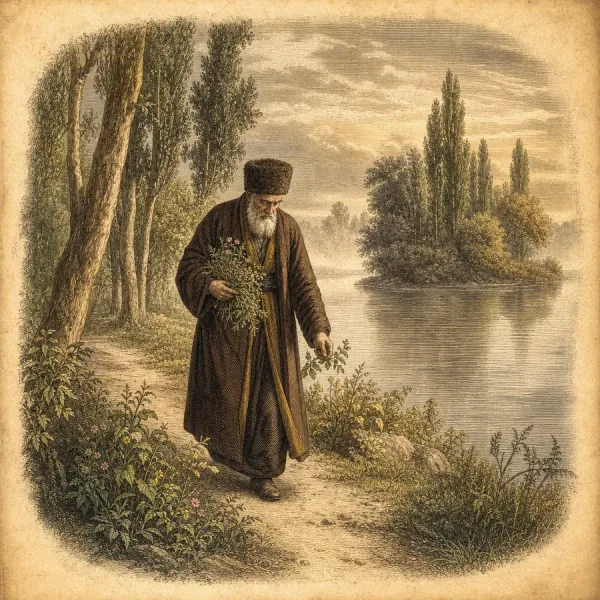
Philosophy
Rousseau: Biography and Study Notes
The solitary walker who set out to found the sovereignty of the people
Study this topic in OriaThe essentials
Motherless from birth, a runaway at fifteen, self-taught under the guidance of Mme de Warens, Jean-Jacques Rousseau became, within a few years, one of the most widely read writers in Europe. His Discourses accuse society of corrupting a naturally good man; The Social Contract grounds the sovereignty of the people in the general will; and Emile invents an education guided by nature. You'll follow his life of wandering and persecution, his great ideas, and the immense legacy of the man the French Revolution took as its master.
Key dates and facts
- 1712
- Born in Geneva, his mother dies
- 1722
- His father goes into exile, boarding at Bossey
- 1725
- Apprenticed to an engraver
- 1728
- Flees Geneva
- 1750
- Prize from the Academy of Dijon
- 1755
- Discourse on Inequality
- 1761
- Julie, or the New Heloise
- 1762
- The Social Contract and Emile
- 1762
- Emile condemned, flight to Switzerland
- 1766
- Exile in England
🕰️ A Geneva childhood
Jean-Jacques Rousseau was born on June 28, 1712, in Geneva, a small independent Protestant republic, into a family of watchmakers. His ancestors were French Protestants: in the 16th century, one of them had left the region of Montlhéry, south of Paris, to escape religious persecution and settle in Geneva. From his very first Discourse onward, he would proudly claim the title of “citizen of Geneva.”
💔 A birth marked by grief
His mother, Suzanne Bernard, died of puerperal fever on July 7, 1712, nine days after giving birth. The child was raised by his father, Isaac Rousseau, a watchmaker, and by an aunt. From the age of seven, Jean-Jacques read with his father from the family library, including Tacitus, Plutarch, and Grotius. His father passed on to him a lifelong passion for reading.
In 1717, short of money, the family had to sell their house in the upper town and move to the working-class district of Saint-Gervais, a neighborhood of craftsmen attached to their political rights. Geneva at the time was dominated by a small aristocracy of wealthy families, who worked to keep a divide between craftsmen holding the status of “citizens” and mere “residents.”
🌄 Bossey, then the workshop
In 1722, after an altercation, Isaac Rousseau left Geneva for Nyon to escape the law. Ten-year-old Jean-Jacques was placed in the care of his uncle Gabriel Bernard, who sent him and his cousin Abraham to board with Pastor Lambercier, in Bossey, at the foot of the Salève mountain. He spent two happy years there, which ended badly: accused of breaking a comb, he was sent away with a lasting sense of having been unjustly punished.
His uncle first placed him with a clerk, then, on April 26, 1725, apprenticed him for five years to a master engraver, Abel Ducommun. The master was brutal; the apprentice stole alongside his fellow workers and buried himself in books whenever he could.
🚪 The escape of March 14, 1728
One evening in March 1728, returning from a walk, he found the city gates already closed. Fearing another beating, he decided not to go back. He was not yet sixteen. There began a life of wandering that would almost never stop.
🌿 Wandering and self-education under Mme de Warens
After a few days of wandering, the young Rousseau was taken in by a Savoyard priest, Benoît de Pontverre, who sent him to Annecy to stay with the baroness Françoise-Louise de Warens, a cultivated Vaudoise woman, separated from her husband and converted to Catholicism, who looked after candidates for conversion. For the teenager, it was a decisive encounter.
⛪ Turin and conversion
Mme de Warens sent him to Turin, to the hospice for catechumens, where he arrived on April 12, 1728; there he renounced Protestantism and was baptized a Catholic on April 23. He then scraped by as a footman or secretary. It was there that an episode took place which he would later recount with shame in the Confessions: having stolen a small ribbon from the Countess de Vercellis, he accused a young kitchen maid, Marion, who was dismissed.
🏡 “Maman” and Les Charmettes
In 1729, he found Mme de Warens again in Annecy. He became her protégé: he called her “Maman,” she called him “little one.” She encouraged him to study music, which would long remain his main trade. After another year of wandering adventures in Switzerland, where he gave his first music lessons in Neuchâtel, he rejoined her in Chambéry in 1731. She also became his lover, in a strange ménage à trois with her steward, Claude Anet.
After Claude Anet's death in 1734, they spent the summer and autumn at the house of Les Charmettes, near Chambéry. These years, which the Confessions would describe as idyllic, were a period of entirely self-directed education: Rousseau never took a single philosophy course, but he read enormously, including Descartes, Locke, Malebranche, Leibniz, and the Port-Royal Logic, building up what he called “a storehouse of ideas.” An avid walker, he also discovered the joy of reverie in nature.
🎓 A first attempt at teaching
Returning from a trip to Montpellier in 1738, he found that Mme de Warens had taken a new lover. He drifted away, and in 1740 became tutor to the two sons of M. de Mably in Lyon, brother of the philosophers Mably and Condillac. The experiment failed, but he wrote for his employer a memorandum on education in which the seeds of ideas later found in Emile are already visible, such as his rejection of corporal punishment. In 1742, he set off to try his luck in Paris with a plan for a new system of musical notation.
The rest of the course
This page publishes the first 2 parts. The full course has 9: here is what the next ones cover.
- 💡 Paris, Diderot, and the two Discourses
Rousseau's early years in Paris, his friendship with Diderot, Thérèse Levasseur and the abandonment of their children, the illumination of Vincennes, and the ideas of the Discourse on the Sciences and Arts and the Discourse on Inequality.
- ✍️ The Hermitage, Montmorency, and the great works
Rousseau's reform of his way of life, his break with Diderot and the philosophes, the Letter to d'Alembert, the success of Julie, or the New Heloise, and the publication of The Social Contract and Emile in 1762.
- ⚖️ The Social Contract: the general will
The key ideas of The Social Contract (1762): inalienable freedom, the social pact, the sovereignty of the people, the general will as distinct from the will of all, the law, and government.
- 🧒 Emile: educating according to nature
The key ideas of Emile, or On Education (1762): natural goodness, negative education, the stages of childhood across five books, the Profession of Faith of the Savoyard Vicar, and its influence on pedagogy.
- 🏃 The outlaw: persecution and the Confessions
The condemnation of Emile in 1762, his flight to Switzerland, Môtiers and the Île Saint-Pierre, his falling-out with Hume in England, and the writing of the Confessions up to his return to France.
- 🍃 The solitary walker: the final years
His return to Paris in 1770, his life as a copyist and botanist, the Dialogues and the Reveries, the 1776 accident, his move to Ermenonville, and his death on July 2, 1778.
- 🏛️ Legacy: from the Revolution to today
The cult around Rousseau after his death, his influence on the French Revolution and his move to the Pantheon (1794), on Kant and philosophy, on literature and pedagogy, and the criticisms leveled against him.
Study “Rousseau” with flashcards and quizzes
In Oria, you read the full course, then practice on it: flashcards, multiple-choice quizzes, open questions or the Feynman method. Cards and questions then come back in your daily review, paced by spaced repetition.
Study this topic in OriaSources
These notes draw on the sources below. If a point seems doubtful, refer back to them.