Philosophy
Stoicism: Summary and Study Notes
The philosophy of the Porch, from Zeno to cognitive therapy
Study this topic in OriaThe essentials
Founded in Athens around 300 BC by Zeno of Citium, a shipwrecked merchant, Stoicism was for five centuries the dominant philosophy of the Greco-Roman world. You'll discover its three-part system (logic, physics, ethics), its famous distinction between what depends on us and what does not, and its theory of the passions. You'll meet its three great voices: Seneca the minister, Epictetus the former slave, and Marcus Aurelius the emperor, then see how their daily exercises inspire today's cognitive therapies and "modern Stoicism."
Key dates and facts
- c. 312 BC
- Zeno's shipwreck near Athens
- c. 301 BC
- Zeno teaches under the Stoa Poikile
- 262 BC
- Death of Zeno
- c. 206 BC
- Death of Chrysippus
- 41
- Exile in Corsica
- 49
- Tutor to the young Nero
- 54
- Nero becomes emperor
- 65
- Forced suicide on Nero's order
- 121
- Born in Rome
- 161
- Becomes emperor
🏛️ Zeno and the Porch
Stoicism is a school of philosophy born in Athens at the end of the 4th century BC. Its founder, Zeno of Citium, was not Athenian: he came from Citium, present-day Larnaca, on the island of Cyprus, where his father, a Phoenician merchant named Mnaseas, brought him books about Socrates from his business trips.
🚢 A providential shipwreck
According to the account passed down by Diogenes Laërtius, Zeno was once carrying a cargo of purple dye when his ship wrecked near Athens; according to his student Persaeus, he was 22 at the time. He saw this accident as a sign of fate and stayed in the city. He became a student of the Cynic philosopher Crates of Thebes, who nicknamed him "the little Phoenician," then spent years studying under other teachers, such as the Megarian Stilpo or the Platonists Xenocrates and Polemo. From the Cynics he kept the ideal of a life in accordance with nature and great austerity: he wore a worn cloak in every season and was content with little, though green figs and sunbathing were, it is said, his delight.
🎨 The school of the "Painted Porch"
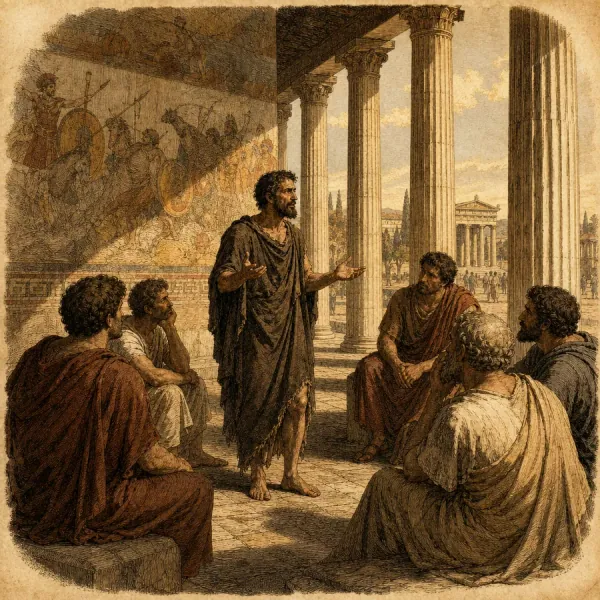
Around 301 BC, Zeno founded his own school. Unlike the Epicureans, who withdrew into a garden, he taught in open public space, under the Stoa Poikile, the "Painted Porch": a long colonnaded gallery on the north side of the Agora, decorated with frescoes showing the Trojan War, the Amazons, or the Battle of Marathon. His followers, at first called "Zenonians," soon became "those of the Porch": in Greek, the Stoikoi. The name may have changed, according to one hypothesis found in the sources, because the Stoics did not want to turn their founder into a perfect sage or an object of worship. Athens honored Zeno during his lifetime and raised a bronze statue of him after his death, in 262 BC.
📜 Cleanthes and Chrysippus
His successor, Cleanthes of Assos, is known for his Hymn to Zeus, which celebrates the order of the world. Then came Chrysippus of Soli (c. 279 – c. 206 BC), the school's third head, an immensely productive author who gave the system its final shape, especially in logic. His works are almost all lost: we know them through quotations by later authors.
🗺️ Three ages of Stoicism
Historians distinguish three periods. Early Stoicism runs from Zeno to Antipater of Tarsus. Middle Stoicism, with Panaetius of Rhodes and Posidonius of Apamea, reached Rome in the 2nd century BC and won over the Roman elite, notably Cicero. Imperial Stoicism, finally, is that of Musonius Rufus, Seneca, Epictetus and Marcus Aurelius. A paradox: of five centuries of Stoicism, only the works of these last three have survived whole. The rest exists only in fragments, reported by admirers or opponents.
🥚 Logic, physics, ethics: a system in three parts
No ancient school aimed to be as systematic as Stoicism. According to Diogenes Laërtius, it was Zeno of Citium who first divided philosophy into three parts: logic, concerning discourse, physics, which studies the world, and ethics, concerning action. The purpose of the whole remained practical: learning to "live in agreement with nature."
🌱 An egg, a field, a living being
To show how these parts fit together, the Stoics used images that also reveal internal disagreements. Philosophy is an egg: logic is the shell, ethics the white, physics the yolk. Or a fertile field: physics is the soil, ethics the fruit, logic the wall that protects it all. Posidonius preferred the image of a living being: physics is its blood and flesh, logic its bones and sinews, ethics its soul. This last comparison stresses that the three parts are inseparable.
🧩 A logic of propositions
Stoic logic, largely built by Chrysippus, analyzes whole propositions ("it is day") that are true or false, linked by connectives such as "if… then," "and," or "or." A typical argument: "If it is day, it is light; now it is day; therefore it is light." Chrysippus reduced all valid arguments to five basic forms, called "indemonstrables." The Stoics also trained on paradoxes, such as the liar paradox ("a man says he is lying: is he telling the truth?") or the paradox of the heap of wheat. For about five centuries, this logic rivaled that of Aristotle.
Their theory of knowledge starts from the impression (phantasia) that objects leave on the soul, which Zeno compared to a seal pressed into wax. The mind can give or withhold its assent to this impression: this is where truth and error are decided.
🔥 A world filled with reason
Stoic physics is materialist: only bodies truly exist, except for four "incorporeals" (the sayable, the void, place, and time). The world results from two principles: a passive matter and an active principle, divine reason or logos, conceived as an "artistic" fire or a breath (pneuma) that runs through and animates everything. God is not outside the world: he merges with the order of nature, which makes Stoicism a form of pantheism. At the end of a great cycle, the world catches fire entirely, then is reborn identical, again and again.
Everything happens according to a chain of causes: fate. The Stoics illustrated this with the image of a dog tied to a cart: it can follow the movement willingly or struggle in vain, but it moves forward regardless. All human freedom lies in this nuance. Cleanthes sums it up in a prayer quoted by Epictetus:
"Lead me, Zeus, and you, Destiny, wherever you have ordained for me. For I will follow without faltering."
Cleanthes, quoted by Epictetus, Enchiridion (translated)
The rest of the course
This page publishes the first 2 parts. The full course has 9: here is what the next ones cover.
- ⚖️ The dichotomy of control
The central idea of Stoic ethics according to Epictetus: distinguishing what is up to us (judgments, desires) from what is not (body, possessions, reputation), and the role of impressions.
- 🔥 Virtue and the passions
Virtue as the only good, the four cardinal virtues, the "indifferents," the theory of the passions as errors of judgment, the sage's good emotions, and Stoic cosmopolitanism.
- 🖋️ Seneca, Nero's minister
Seneca's life: his youth in Córdoba and Rome, exile in Corsica, tutor and then advisor to Nero, immense fortune, disgrace, and forced suicide in 65; his treatises and the Letters to Lucilius.
- ⛓️ Epictetus, the slave who became a master
Epictetus's life: a slave in Rome, student of Musonius Rufus, freedman, exiled by Domitian, schoolmaster at Nicopolis; the Discourses and Enchiridion recorded by Arrian; his three disciplines.
- 👑 Marcus Aurelius, the philosopher emperor
Marcus Aurelius's life: his education, conversion to Stoicism through Junius Rusticus, his reign from 161 to 180 marked by wars and plague, the writing of the Meditations and their later rediscovery.
- 🧘 The spiritual exercises
Stoic philosophy as a daily practice according to Pierre Hadot: the evening review, the morning preparation, training in poverty, the view from above, and the reminder of mortality.
- 🌍 Legacy: from Christianity to cognitive therapy
The decline of ancient Stoicism, its influence on Christianity, the Neostoicism of Justus Lipsius and Descartes, the rehabilitation of its logic, cognitive therapies (Ellis, Beck), and modern Stoicism.
Study “Stoicism” with flashcards and quizzes
In Oria, you read the full course, then practice on it: flashcards, multiple-choice quizzes, open questions or the Feynman method. Cards and questions then come back in your daily review, paced by spaced repetition.
Study this topic in OriaSources
These notes draw on the sources below. If a point seems doubtful, refer back to them.