Philosophy
Spinoza: Biography and Study Notes
The Philosopher Who Identified God with Nature
Study this topic in OriaThe essentials
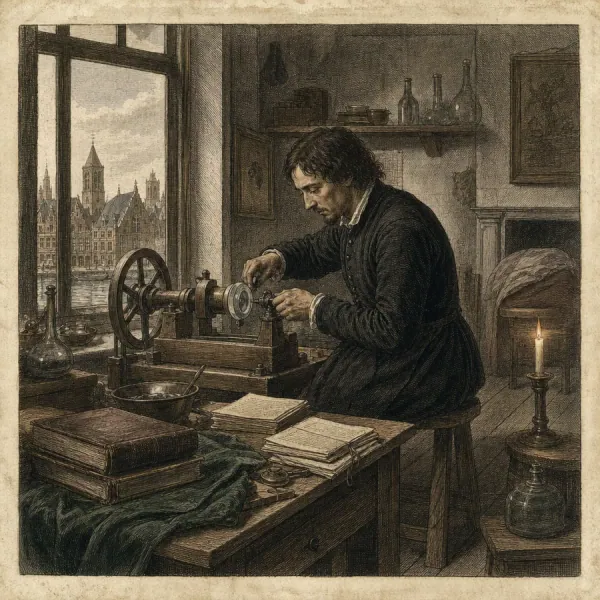
Born into Amsterdam's Portuguese Jewish community, Baruch Spinoza was cast out of it at 23 by a herem of unprecedented violence. A lens grinder by trade, he secretly wrote the Ethics, a book proved like a geometry textbook, in which God merges with Nature. You will discover his life, from excommunication to his final years in The Hague, his great ideas (substance, conatus, affects, freedom), and the immense influence of this long-maligned thinker.
Key dates and facts
- 1632
- Born in Amsterdam
- 1640
- Death of Uriel da Costa
- 1649
- Death of his brother Isaac
- 1654
- Death of his father
- 1670
- Moves to The Hague
- 1672
- Assassination of the de Witt brothers
- 1673
- Declines the Heidelberg chair
- 1676
- Visit from Leibniz
- 1677
- Death and Opera Posthuma
🏙️ A Youth in Amsterdam
Baruch Spinoza was born on November 24, 1632, in Amsterdam, into the city's Portuguese Jewish community. He bore three first names that all mean "blessed": Baruch in Hebrew, Bento in Portuguese, his mother tongue, and Benedictus in Latin, the form he would later adopt to sign his letters. According to tradition, he was named after his maternal grandfather.
🧭 A Family of Marranos
Spinoza's ancestors were Marranos: Jews of the Iberian Peninsula forcibly converted to Catholicism, many of whom continued to practice Judaism in secret. In Portugal, after 1497, King Manuel I had roughly one hundred twenty thousand Jews forcibly baptized; a few decades later, the Inquisition took hold and persecution grew harsher. At the end of the sixteenth century, the philosopher's paternal grandfather left Portugal for Nantes, where Judaism remained forbidden, then moved on to the more tolerant Dutch Republic; he died in Rotterdam in 1627.
👨👩👦 A Childhood Marked by Loss
His father, Miguel (or Michael) de Espinosa, born in 1588 in Vidigueira, in the Alentejo region, was a respected merchant who traded in dried fruit and olive oil. He was also an active member of the community, becoming one of its administrators in 1649. His mother, Ana Débora (Hannah Deborah), died when Baruch was not yet six. His father remarried Esther, who raised the boy from the age of nine. His older brother, Isaac, who was meant to take over the family business, died in 1649; his older sister, Miriam, died shortly after giving birth. Left were his younger brother, Gabriel, born in 1634, and his sister Rebecca.
The family lived in the Jewish quarter, on the island of Vlooienburg, along the Houtgracht canal, near the synagogues and just steps from the painter Rembrandt's house. Through his mother, Spinoza was related to Uriel da Costa, a thinker who had disputed the divine origin of the Law and the immortality of the soul. Publicly humiliated so that he could be readmitted to the community, da Costa died in 1640, probably by suicide, when Spinoza was eight.
📜 The Talmud Torah School
Young Baruch attended the community school, the Talmud Torah, run by Rabbi Saul Levi Morteira. There, students learned to read the prayers and the Torah in Hebrew, to translate the week's portion, and to study Rashi's commentary; Spinoza gained a solid command of Hebrew. He was a brilliant student, and his teachers may have considered training him as a rabbi. But he never reached the upper levels, devoted to the in-depth study of the Talmud: his name disappears from the school register after age fourteen, and around age seventeen he left his studies to help run the family business.
⚓ A Young Merchant in Trouble
Business was going badly. During the First Anglo-Dutch War, which ended in 1654, much of the firm's ships and cargo was seized by the English. When his father died that same year, Baruch, twenty-one years old, became head of the family: he performed the mourning rites at the synagogue and took over the business with his brother under the name "Bento e Gabriel d'Espinosa." But the company was riddled with debt, and by 1655 the family fortune had evaporated.
🕯️ The Herem: The Expulsion of 1656
On July 27, 1656, at the age of twenty-three, Baruch Spinoza was cast out of Amsterdam's Portuguese Jewish community by a herem, a Hebrew word usually translated as excommunication, banishment, or anathema. It is the harshest ever pronounced by that community, and it has never been lifted.
💸 A Break Prepared by a Crisis
After his father's death, Spinoza found himself caught in long financial, legal, and religious disputes. In March 1656, to escape his father's debts, he asked the city authorities to declare him an orphan: still a minor in the eyes of the law, he could thereby renounce the inheritance. He won his case, but in doing so broke a rule of the synagogue, which required that disputes between its members be settled within the community. Of his father's estate, he kept only his parents' large canopy bed, which he would keep until his death.
📚 Van den Enden's School
Between 1654 and 1657, he learned Latin from Franciscus van den Enden, a former Jesuit turned freethinker and radical democrat, who ran a school in Amsterdam. There he discovered Latin authors, such as the playwright Terence, but also modern philosophy and above all Descartes, who left a deep mark on him. He mixed with dissident Christians, notably the Collegiants, Protestant groups who rejected the authority of the official churches.
⚖️ The Text of the Herem
The text, written in Portuguese, was pronounced by the community's leaders, the mahamad, with the agreement of the rabbis, foremost among them the chief rabbi Isaac Aboab da Fonseca. It accused Spinoza of "horrible heresies" and "monstrous deeds," attested to by witnesses, without ever specifying what they were. Then came the curses:
"Cursed be he by day, and cursed be he by night; cursed be he when he sleeps, and cursed be he when he is awake."
Text of the herem against Spinoza (July 27, 1656), translated from the Portuguese (translated)
The curse pursues him as well when he comes in and when he goes out. The text then forbade every member of the community from having any contact with him, written or spoken, from doing him any favor, from coming within four cubits of him, from living under the same roof as him, or from reading his writings.
❓ Why Such Severity?
What exactly he was accused of is not known for certain: Spinoza had not yet published anything. One clue comes from two Spaniards who, in 1659, told the Inquisition they had heard Spinoza and his friend Juan de Prado claim that God could only be understood "philosophically," that Jewish law was not of divine origin, and that a better one ought to be sought. Prado himself would be expelled in 1657. Historians believe Spinoza was already defending the ideas of his future books, in which he denies the immortality of the soul, rejects the idea of a transcendent God watching over mankind, and asserts that the Law was not literally given by God.
🗡️ Legend and Reaction
According to legend, a fanatic tried to stab him shortly before his expulsion, and Spinoza supposedly kept the torn coat to remind himself that religious passion leads to madness; no document from the period confirms this. What is certain is that he made no attempt to seek forgiveness: he seems to have welcomed, without much regret, the chance to leave a community whose beliefs he no longer shared.
The rest of the course
This page publishes the first 2 parts. The full course has 9: here is what the next ones cover.
- 🔭 Philosopher and Lens Grinder
The years 1656–1670: circle of friends, Leiden, Rijnsburg, Voorburg, the optician's trade, Descartes' Principles, and the warning of the Koerbagh affair.
- 📚 The Works, from the Short Treatise to the Ethics
An overview of Spinoza's writings, the geometrical method and five-part structure of the Ethics, and the content and scandal of the Theological-Political Treatise.
- 🌌 God, or Nature
Spinoza's metaphysics: a single substance, attributes and modes, Deus sive Natura, the necessity of all things, the unity of body and mind, and the debate over his atheism.
- 🔥 The Conatus and the Affects
Spinoza's theory of desire and emotion: conatus, the primacy of desire over judgment, joy, sadness, the critique of free will, passions and actions.
- 🕊️ From Bondage to Freedom
Spinoza's ethics and politics: bondage, the three kinds of knowledge, freedom as understood necessity, the free man, the intellectual love of God, and freedom of thought.
- 🌒 The Final Years in The Hague
Spinoza's life in The Hague from 1670 to 1677: the year 1672 and the assassination of the de Witt brothers, the declined Heidelberg chair, Leibniz's visit, his death, and the publication of the Opera Posthuma.
- 🌍 Legacy: From Cursed Thinker to Prince of Philosophers
Spinoza's reception from 1677 to the present: bans, the pantheism controversy, the Romantics and Hegel, Einstein, the French revival, Dutch tributes, and the debate over the herem.
Study “Spinoza” with flashcards and quizzes
In Oria, you read the full course, then practice on it: flashcards, multiple-choice quizzes, open questions or the Feynman method. Cards and questions then come back in your daily review, paced by spaced repetition.
Study this topic in OriaSources
These notes draw on the sources below. If a point seems doubtful, refer back to them.