Entrepreneurs & innovators
Sam Walton: Biography and Study Notes
The Arkansas merchant who created Walmart, the global discount giant
Study this topic in OriaThe essentials
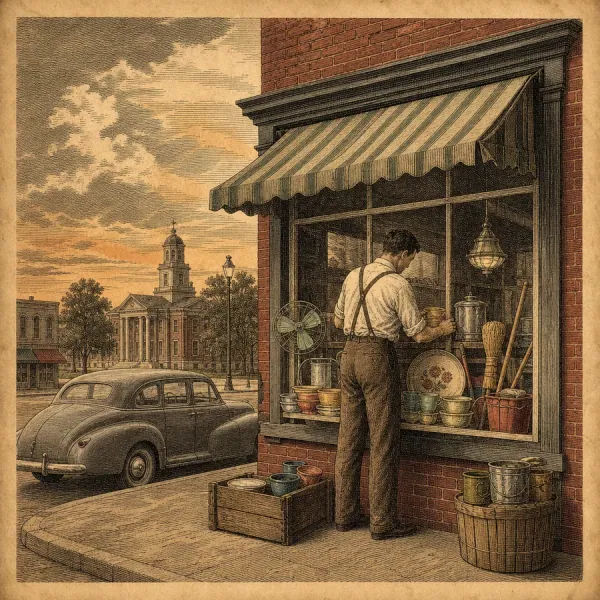
Sam Walton grew up during the Great Depression, opened his first store in 1945 in a small Arkansas town and founded Walmart in 1962, at 44. In thirty years, he made it the largest retailer in the United States thanks to a simple recipe applied with fanatical zeal: ever-lower prices, stores in small towns and cutting-edge logistics. You'll follow his life step by step, his style as a pickup-driving billionaire and his methods, but also the criticisms that cling to his model: low wages, hostility to unions, small downtown shops wiped out. Finally, you'll see what became of his empire, now the largest private employer on the planet.
Key dates and facts
- 1945
- First store, in Newport
- 1962
- First Wal-Mart, in Rogers
- 1970
- Initial public offering
- 1983
- First Sam's Club
- 1990
- Largest retailer in the United States
- 1982
- Diagnosed with leukemia
- 1988
- Hands the CEO job to David Glass
- March 1992
- Presidential Medal of Freedom
- April 5, 1992
- Dies in Little Rock, at 74
🌾 A child of the Great Depression
Samuel Moore Walton was born on March 29, 1918, in Kingfisher, Oklahoma, in the heart of America's Great Plains farm country. His parents, Thomas Gibson Walton and Nancy Lee, lived on a farm. In 1923, unable to make enough money, the family left the land. His father became a farm mortgage agent for his brother's company and, during the Great Depression, it was his job to foreclose on the farms of those who could not repay. Young Sam saw up close what it meant to be short of money.
🥛 Working from an early age
The Waltons, with Sam's little brother James, nicknamed “Bud,” born in 1921, moved from small town to small town, mostly in Missouri. In Shelbina, in eighth grade, Sam became the youngest Eagle Scout, scouting's highest rank, in the state's history. The family then settled in Columbia. Like many children of that era, Sam helped with household expenses: he milked the family cow, bottled the milk and delivered it to customers, delivered the local newspaper and sold magazine subscriptions. He would say he learned very young that it was better to give than to take.
🏈 The “Most Versatile Boy”
In high school, he shone above all in sports, especially football, and his classmates voted him “Most Versatile Boy.” He then entered the University of Missouri, where he earned a bachelor's degree in economics in 1940. To pay for his studies, he waited tables in exchange for meals, worked as a lifeguard and managed newspaper routes: in this way he earned more than $4,000 a year, according to BusinessWeek, a handsome sum at the time. Very involved in campus life, he led a large student Bible class. He dreamed of business school, but could not afford it.
🎖️ J. C. Penney, the Army and Helen
Three days after graduating, in 1940, Sam Walton joined J. C. Penney, a big chain of stores, as a management trainee in Des Moines, Iowa, for $75 a month. He saw chain retailing from the inside. In his autobiography, he gave a very down-to-earth explanation for this career choice.
“I got into retailing because I was tired, and I wanted a real job.”
Sam Walton, Made in America (1992), quoted in BusinessWeek
💍 Helen Robson
He stayed about eighteen months at Penney, then quit in 1942 while waiting to be drafted, since the United States had entered World War II. In the meantime, he worked at a DuPont munitions plant near Tulsa, Oklahoma. It was there that he met Helen Robson, a banker's daughter who herself held a business degree. They married on Valentine's Day, February 14, 1943. They had four children: Rob (1944), John (1946), Jim (1948) and Alice (1949).
Helen would play a decisive, if discreet, role in the history of Walmart. According to BusinessWeek, she refused to move to any town with more than 10,000 people. It was partly because of this condition that the Waltons settled in very small towns, which would later become one of the secrets of the company's success.
🪖 An intelligence officer
Called up, Sam Walton served in the U.S. Army intelligence corps, where he supervised security at aircraft plants. He finished the war with the rank of captain. During those years, he realized he wanted to work in retail, and above all to work for himself.
The rest of the course
This page publishes the first 2 parts. The full course has 9: here is what the next ones cover.
- 🏪 Newport, then Bentonville: learning the variety store trade
The purchase of a Ben Franklin franchise in Newport, Arkansas, in 1945, his first low-price methods, the loss of the lease, a fresh start in Bentonville in 1950 and the building of a small chain of stores with his brother Bud.
- 🛒 1962: the first Wal-Mart
The discount revolution in the United States, the opening of the first Wal-Mart Discount City in Rogers, Arkansas, on July 2, 1962, borrowing from competitors, the small-town strategy and early computerization.
- 📡 Trucks, computers and satellites: the Walmart machine
Going public in 1970, growth through regional warehouses and a truck fleet, the corporate culture (“associates,” the company cheer), the creation of Sam's Club in 1983 and Supercenters in 1988, and Walmart becoming America's largest retailer in 1990.
- 🐕 The pickup-driving billionaire
Sam Walton named the richest man in America by Forbes in the 1980s, his simple lifestyle, his Presbyterian faith and his image as a man-of-the-people merchant.
- ⚖️ Small shops, wages, unions: the dark side of low prices
The criticisms leveled at Sam Walton's model: the disappearance of downtown businesses, low wages, union-busting as early as 1970, a “Buy American” campaign contradicted by imports, and the arguments of his defenders.
- 🏅 The Medal of Freedom and his final days
Leukemia in 1982, bone cancer in 1990, the autobiography Made in America, the Presidential Medal of Freedom in March 1992 and his death on April 5, 1992, in Little Rock.
- 🌍 A global empire and a dynasty
What became of Walmart after 1992 (the world's largest private employer, successes and failures abroad), the Walton family's fortune according to Forbes, the Walton Family Foundation and the debates over this wealth.
Study “Sam Walton” with flashcards and quizzes
In Oria, you read the full course, then practice on it: flashcards, multiple-choice quizzes, open questions or the Feynman method. Cards and questions then come back in your daily review, paced by spaced repetition.
Study this topic in OriaSources
These notes draw on the sources below. If a point seems doubtful, refer back to them.