Entrepreneurs & innovators
Samsung: Summary and Study Notes
From a dried-fish trading shop to the global giant of chips and smartphones
Study this topic in OriaThe essentials
Samsung was born in 1938 in Daegu, in a Korea under Japanese rule, as a small trading house. Founded by Lee Byung-chul and transformed by his son Lee Kun-hee, the group became South Korea's largest chaebol and the world's leading maker of memory chips. You'll discover what a chaebol is, how Samsung caught up with the Japanese and then took on Apple, the Galaxy Note 7 disaster, and the corruption cases that brought its leaders before the courts.
Key dates and facts
- 1910
- Lee Byung-chul is born
- 1938
- Samsung is founded in Daegu
- 1947
- Headquarters move to Seoul
- 1950
- Korean War, retreat to Busan
- 1987
- Lee Kun-hee takes over the group
- 1993
- Frankfurt Declaration
- 1997
- Asian financial crisis
- 2006
- World's largest television maker
- ₩333.6T
- 2025 revenue
- ₩43.6T
- 2025 operating profit
🐟 Lee Byung-chul and the Daegu trading house
Samsung, today South Korea's largest conglomerate, began as a modest shop. Its founder, Lee Byung-chul, was born on February 12, 1910, in Uiryeong County, in the southeast of the Korean peninsula, then known as the Korean Empire. He was the youngest of four children in a wealthy landowning family descended from the scholar-aristocracy, the yangban.
🎓 Unfinished studies in Tokyo
After high school in Seoul, Lee enrolled in April 1930 in the political economy department of Waseda University in Tokyo, the capital of the colonial power. Health problems forced him to drop out in 1934. He returned to Korea eager to go into business.
⭐ “Three stars”
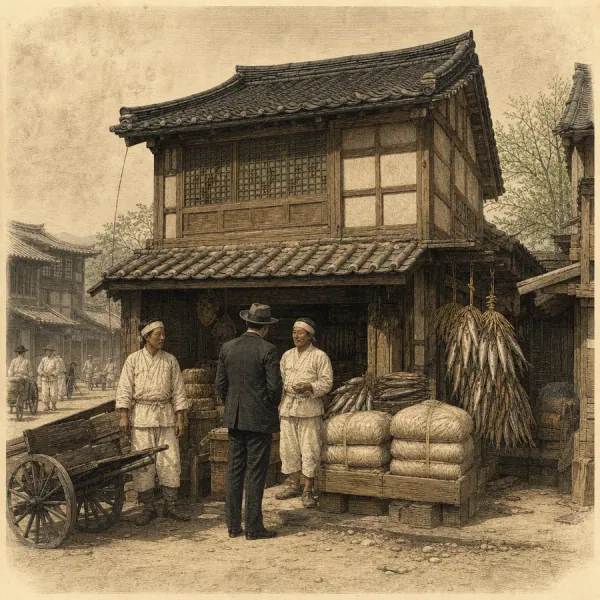
On March 1, 1938, at 28, he founded a small trading company in Daegu, Samsung Sanghoe. It employed about forty people and sold dried fish, local farm produce and noodles. According to its founder, the name Samsung (三星) means “three stars”: the number three stands for something big, numerous and powerful, and the stars for what is eternal. The business prospered, was soon shipping goods throughout Korea and abroad, and moved its headquarters to Seoul in 1947.
⚔️ The Korean War
In 1950, when the Korean War broke out, Samsung was one of the ten largest trading companies in the country. The North Korean army took Seoul, and Lee had to move his business south to Busan. The massive influx of American troops and equipment into that port proved very profitable for his company. There he started a sugar refinery, Cheil Jedang, and then in 1954, in Daegu, a textile plant, Cheil Mojik, which was at the time the country's largest wool mill. Samsung began to diversify: insurance, securities, retail.
🏭 The chaebol and the Miracle on the Han River
To understand Samsung, you have to understand the word chaebol. It comes from the Japanese term zaibatsu, which combines “wealth” and “clan,” and refers to the large family conglomerates that dominated the Japanese economy until 1945.
A large South Korean industrial group controlled by a family, made up of many companies active in very different sectors (electronics, construction, insurance, shipbuilding…). Samsung, Hyundai, SK and LG are the main examples.
🤝 A pact with the military regime
In May 1961, General Park Chung-hee seized power in a coup. Lee Byung-chul, who was in Japan at the time, was slow to return. An agreement was eventually reached: Samsung had to give up control of the banks it had acquired and follow the regime's economic directives. In exchange, the state steered credit toward the big groups charged with carrying out its five-year plans, with priority given to exports. That same year, Lee founded the association that would become the Federation of Korean Industries, which he would chair. This was the start of the “Miracle on the Han River,” the lightning industrialization that would turn South Korea, a poor agricultural country, into one of the Asian “Four Tigers.” The chaebols were its engine, at the cost of a heavy concentration of economic power and close, sometimes murky, ties with political power.
📺 1969: electronics, with Japan's help
On January 13, 1969, Samsung Electric Industries was born in Suwon, south of Seoul. Lee Byung-chul knew nothing about electronics; he sought advice from Toshio Iue, founder of Japan's Sanyo, and in December 1969 created a joint venture with Sanyo and Sumitomo. This cooperation with the former colonial power provoked strong hostility in Korea; it was accepted only when Samsung committed to producing mainly for export. Its first product was a black-and-white television; by 1981, Samsung had made more than 10 million of them. The group also moved into construction and shipbuilding in the mid-1970s.
🧩 The bet on memory chips
In 1974, Samsung bought Korea Semiconductor, which was on the verge of bankruptcy. Then, in February 1983, Lee Byung-chul made what would be called the “Tokyo Declaration”: Samsung would make DRAM memory chips, a market dominated by the Americans and the Japanese. The company bought technology from the American firm Micron and, a year later, unveiled a 64-kilobit chip. Its lag behind the leaders shrank from more than ten years to about four.
Lee Byung-chul died on November 19, 1987, in Seoul. The group was then divided among his heirs into five groupings that became independent: Samsung, Shinsegae (department stores), CJ (food and entertainment), Hansol (paper) and JoongAng (media). His vast collection of Korean art, which includes “national treasures,” is on display at the Ho-Am Art Museum.
The rest of the course
This page publishes the first 2 parts. The full course has 8: here is what the next ones cover.
- 🔄 Lee Kun-hee: “Change everything except your wife and kids”
Lee Kun-hee, the founder's third son, takes over the group in 1987, launches the “Frankfurt Declaration” in 1993 to move from quantity to quality, bets on design and components, weathers the 1997 Asian financial crisis and overtakes Sony.
- 🧠 The king of memory chips
Samsung's industrial core: DRAM and NAND memory chips explained simply, global leadership since the early 1990s, vertical integration, foundry, OLED screens, semiconductor market cycles and major investments in Korea and the United States.
- 📱 Galaxy versus iPhone
The conquest of smartphones: choosing Android with the Galaxy line in 2009, the Galaxy S in 2010, first place worldwide in 2012 ahead of Nokia, the patent war with Apple from 2011 to 2018, factories in Vietnam and India.
- 🔥 The Galaxy Note 7 fiasco
The Galaxy Note 7 crisis of 2016: batteries catching fire, a first recall, replacement phones that were also defective, a ban on airplanes, the permanent end of production and the explanation of the causes in January 2017.
- ⚖️ Corruption, trials and pardons
The documented legal cases: Lee Kun-hee's convictions in 1996 and 2008 followed by pardons, the 2007 revelations about slush funds, Lee Jae-yong's bribery conviction in the Park Geun-hye scandal (2017–2021), the 2022 pardon, the final acquittal in the merger case in 2025, cartels, unions and workers' health.
- 🌏 Samsung today
Samsung's position today: Samsung Electronics' official 2025 figures, the group's weight in the South Korean economy, its business model explained simply, the succession after Lee Kun-hee's death in 2020, Lee Jae-yong's dated fortune and the challenges.
Study “Samsung” with flashcards and quizzes
In Oria, you read the full course, then practice on it: flashcards, multiple-choice quizzes, open questions or the Feynman method. Cards and questions then come back in your daily review, paced by spaced repetition.
Study this topic in OriaSources
These notes draw on the sources below. If a point seems doubtful, refer back to them.