Arts
Street Art: Summary and Study Notes
From graffiti on the New York subway to walls all over the world
Study this topic in OriaThe essentials
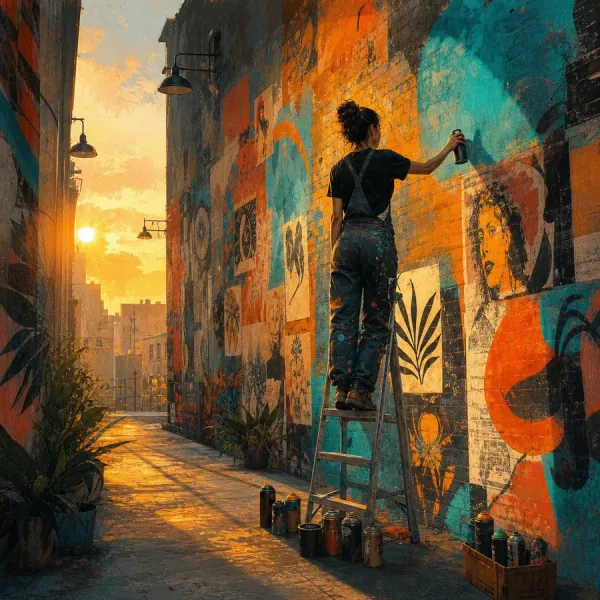
Born from names scrawled across Philadelphia and the New York subway, nourished by the frescoes of the Mexican muralists and the stencils of Paris, street art has become a global art, from Bristol to São Paulo and from Berlin to Bethlehem. You'll discover its techniques and vocabulary, its main stages, its leading figures, from Keith Haring and Basquiat to Banksy, JR and Invader, and the debates it still sparks: vandalism or art, copyright, museums and the market.
Key dates and facts
- 1921
- José Vasconcelos launches the mural program
- 1929
- Rivera begins the History of Mexico at the National Palace
- 1933
- Rivera's Rockefeller Center mural, later destroyed
- 1967
- Wall of Respect in Chicago
- 1971
- New York Times article on Taki 183
- 1979
- Lee Quiñones and Fab 5 Freddy exhibit in Rome
- 1984
- Publication of the book Subway Art
- 1989
- Last graffitied train taken out of the New York subway
- 1997
- The Mild Mild West, first large mural in Bristol
- 2005
- Nine images on the West Bank separation barrier
🧱 What is street art?
Street art, or urban art, refers to art created in public space to be seen by everyone: on walls, sidewalks, trains or street furniture. It often starts out illegal, and its works are ephemeral: rain, cleaning, a new drawing or the demolition of a building can wipe them out. It should not be confused with public art commissioned by institutions, such as statues or official murals, although the line has blurred now that cities themselves invite street artists.
🔤 Graffiti or street art?
The two words overlap without being synonyms. Graffiti, from an Italian word meaning “scratched,” has existed since antiquity: Pompeii, buried under ash in 79, preserved a great many. In its modern form, it consists mainly of writing stylized names, often legible only to insiders. Street art tends to favor images, symbols and messages addressed to every passerby. For the scholar Nicholas Riggle, a work is street art if, and only if, its use of the street is part of its meaning: the wall, the neighborhood and the passerby are not just a surface, but part of the work.
🖌️ A very large toolbox
- The spray can, the king of graffiti tools, with nozzles (caps) of different widths.
- The stencil, which makes it possible to reproduce the same image quickly.
- Paste-ups of posters, drawings or photographs, put up with glue, often at night.
- Mosaics, stickers, and even yarn bombing.
- Reverse graffiti, installations, sculptures placed without permission, and video projections on facades.
A sheet of cardboard, plastic or metal with a shape cut out of it. Pressed against the wall, it lets sprayed paint through only where it has been cut away: in a few seconds the image appears, always identical.
🗣️ The vocabulary of graffiti
Graffiti has its own language, which came from New York. The writer has a pseudonym and a signature name (in French slang, the blaze). The tag is that signature traced in a single gesture. The throw-up is an intermediate form: rounded, bubbly letters painted in a few minutes with two colors, a fill and an outline. The piece (short for masterpiece) is a more elaborate work, done alone or in a group when there is time, on a legal wall or in an abandoned site. Wildstyle interweaves and distorts the letters so much that they become hard for outsiders to read. Writers group together in crews, teams whose name often accompanies their signature.
🇲🇽 The Mexican muralists: history painted on walls
Long before spray paint, one country turned its walls into a giant history book: Mexico. After the Mexican Revolution (1910 – 1920), the new government wanted to forge a national identity proud of its Indigenous and mestizo heritage. In 1921, the minister of public education, José Vasconcelos, launched a state-funded mural program. The murals were meant to instruct as much as to move, including a population that was largely unable to read. The first project was in Mexico City, on the three floors of the former Jesuit college of San Ildefonso, then the National Preparatory School.
🎨 The “big three”
Three painters dominated the movement, nicknamed los tres grandes. Diego Rivera, steeped in European modernism and Cubism, painted everyday life and ancient Mexico; from 1929 to 1935 he covered the walls of the National Palace with a History of Mexico that shaped the country's image, at home and abroad. José Clemente Orozco, who had fought in the Revolution, refused to glorify it: his dark murals show suffering and oppression, so much so that they were criticized and sometimes defaced. David Alfaro Siqueiros, the youngest and most radical, used industrial paints and fast lines inspired by the machine. All three were communists, and their walls carried openly political messages.
🇺🇸 In the heart of America
All three men also worked in the United States. Orozco painted at Pomona College in California as early as the late 1920s. In 1932 – 1933, Rivera created the twenty-seven panels of Detroit Industry at the Detroit Institute of Arts. In 1933 he began Man at the Crossroads for New York's Rockefeller Center, but the mural, which included a portrait of Lenin, provoked protests and was eventually destroyed on the orders of the managing company. In Los Angeles, Siqueiros painted América Tropical in 1932; it was painted over and restored decades later. During the Great Depression, the U.S. government itself employed artists to paint public murals.
The legacy is immense. In Mexico, activist murals continued to be painted into the 1970s and beyond. In the United States, the Mexican example inspired the Chicano muralism of Mexican American communities: in San Diego, Chicano Park, born from a land occupation by residents in 1970, has more than 80 murals. In 1967 in Chicago, the Wall of Respect launched by Bill Walker set off a wave of mural painting. These works were often commissioned or authorized, and therefore different from graffiti; but they established an idea essential to street art: a city wall can speak to everyone.
The rest of the course
This page publishes the first 2 parts. The full course has 8: here is what the next ones cover.
- 🚇 Philadelphia, New York: the birth of modern graffiti
Cornbread's first tags in Philadelphia, the graffiti explosion in the New York subway after the article on Taki 183, crews, painted trains, the book Subway Art and the “war on graffiti” until 1989.
- 🇫🇷 Paris: silhouettes, stencils and paste-ups
The European path of urban art, born in Paris in the 1960s with Zloty and Ernest Pignon-Ernest, then Blek le Rat's invention of the figurative stencil, Miss.Tic's aphorisms and the Paris scene of the 1980s.
- 🖍️ Keith Haring and Basquiat: from the subway to the museum
Two New York artists born on the street who became international stars: Basquiat and his SAMO slogans, Keith Haring and his chalk drawings in the subway, his activist murals and his fight against AIDS.
- 🎈 Banksy, the faceless artist
The career of Banksy, the English street artist whose identity has never been confirmed: beginnings in Bristol, satirical stencils, interventions around the world, Dismaland, and the self-destructing canvas at Sotheby's in 2018.
- 🌐 A planetary art: JR, Invader, Fairey, Os Gêmeos
The great international figures of street art since the 1990s (JR, Invader, Shepard Fairey, Os Gêmeos) and the cities that have become capitals of urban art, from Berlin to São Paulo, Melbourne and Penang.
- ⚖️ Vandal or artist? Today's debates
The questions street art raises: legality and penalties, copyright, the destruction of works (the 5Pointz case), walls removed to be sold, gentrification, festivals and institutionalization.
Study “Street Art” with flashcards and quizzes
In Oria, you read the full course, then practice on it: flashcards, multiple-choice quizzes, open questions or the Feynman method. Cards and questions then come back in your daily review, paced by spaced repetition.
Study this topic in OriaSources
These notes draw on the sources below. If a point seems doubtful, refer back to them.