Planet & nature
The Amazon: Summary and Study Notes
The river, the rainforest and the people who live there
Study this topic in OriaThe essentials
The Amazon is the most powerful river in the world and a forest of 390 billion trees that makes its own rain. You'll discover how this ecosystem works, why it is home to one in ten known species, and how archaeology has revealed a forest that has been inhabited and shaped for thousands of years. Then, with official figures in hand, you'll follow the history of deforestation, the fate of Indigenous peoples and the scientific debate over the famous tipping point.
Key dates and facts
- ≈ 6M km²
- Area of the forest, in a basin of 6 to 7 million km²
- 9 countries
- Including Brazil, which holds nearly 60%
- 390 bn
- Estimated trees, belonging to about 16,000 species
- 1 in 10
- Share of the world's known species that live there
- 40,000+
- Plant species described
- 1,294
- Bird species classified
- 5,600+
- Fish species known (2011)
- ≈ 2.5M
- Estimated insect species
- 1972
- Launch of the Trans-Amazonian Highway
- 2004
- Record: 27,423 km² cleared in one year
🌳 A forest the size of a continent
The Amazon refers both to a river and to the immense tropical rainforest that covers most of its basin, in the north of South America. Depending on how it is drawn, the basin covers about 6 to 7 million km², nearly 40% of the South American continent, and the forest itself occupies about 5.5 to 6 million km². That is more than half of the tropical rainforest left on Earth, and the largest single stretch of it.
🗺️ Nine countries, one forest
The forest is shared by nine countries. Brazil alone holds nearly 60% of it (between 58 and 63% depending on the source), followed by Peru (about 13%) and Colombia (7 to 10%). The rest is split among Bolivia, Venezuela, Guyana, Suriname, Ecuador and French Guiana, a French territory: it is through French Guiana, with its Amazonian Park, that France too counts as an Amazonian country.
More than 30 million people live in the region, about 9% of whom belong to Indigenous peoples, divided into some 350 ethnic groups and more than 3,300 recognized Indigenous territories.
🌲 A forest of records
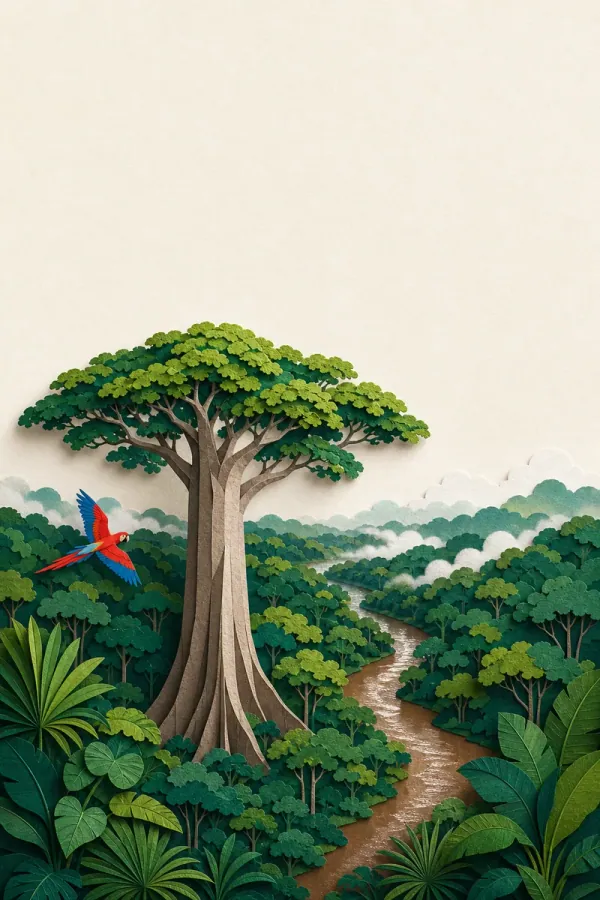
An international study published in 2013, carried out by more than a hundred researchers from the ATDN network, estimated that the forest holds about 390 billion trees belonging to some 16,000 species. That means there are dozens of times more trees in the Amazon than people on the planet. The forest contains several kinds of habitat: terra firme forest, which never floods and is the richest; the várzea, flooded every year by sediment-laden water; and the igapó, drowned by the dark, nutrient-poor water of rivers such as the Rio Negro.
This forest is very old: it probably took shape in the Eocene, more than 50 million years ago, after the extinction of the non-avian dinosaurs, when the widening of the Atlantic Ocean brought a hot, humid climate to the basin. It then advanced and retreated as the climate changed, but never disappeared.
⚔️ Why “Amazon”?
The name comes from the first Europeans to travel down the river. In 1541–1542, the Spaniard Francisco de Orellana, who had set out from the Andes with Gonzalo Pizarro's expedition, let the current carry him all the way to the Atlantic, which he reached at the end of August 1542. His chronicler, the Dominican friar Gaspar de Carvajal, reports that in June 1542 the crew had to fight a people among whom women fought alongside the men. Orellana compared them to the Amazons, the women warriors of Greek mythology described by Herodotus, and the name stuck. Another, disputed theory links the word to a Tupi term meaning “boat destroyer,” a reference to the waves of the tidal bore.
🌊 The Amazon, the world's most powerful river
The Amazon is by far the most powerful river on the planet. Its average discharge at the mouth was estimated at about 209,000 m³ per second for the period 1973–1990, and it can exceed 300,000 m³/s in the rainy season. That is as much as the next six rivers combined, and about one-fifth of all the fresh water that the world's rivers pour into the oceans.
📏 Longer than the Nile?
The question of length, on the other hand, remains unsettled. Depending on which source in the Andes is chosen and where the mouth is placed, the Amazon measures between roughly 6,400 and 7,000 km. In 2007–2008, Brazilian researchers at INPE announced 6,992 km, which would put it ahead of the Nile, but without a validated scientific publication. Conversely, a peer-reviewed paper in 2009 gave 7,088 km for the Nile against 6,575 km for the Amazon. The long-standing consensus among geographers still places the Nile first, but the debate depends above all on measurement methods.
The source itself has moved several times. Long attributed to a glacier on Nevado Huacra, it was placed on Nevado Mismi, in Peru, as confirmed in 2000–2001, before a 2014 study proposed the headwaters of the Mantaro River instead. One thing is certain: the water that ends up in the Atlantic is born in the Peruvian Andes, more than 5,000 m above sea level.
🤝 The Meeting of Waters
At Manaus, the largest city on the river, a famous spectacle takes place: the Meeting of Waters. The Solimões, with its muddy, milky-coffee water, and the Rio Negro, with its dark water, flow side by side without mixing for dozens of kilometers, because they differ in speed and depth; the Solimões, three times more powerful, eventually absorbs the Rio Negro. In Brazil, the river only takes the name Amazonas after this confluence.
🌀 Pororoca and the plume
Near the mouth, during the highest tides, the ocean surges up the river as a breaking wave, the tidal bore, known locally as the pororoca. Several meters high, it moves at more than 60 km/h and can travel up to several hundred kilometers inland. The Amazon has no real delta, in fact: the sea carries its sediment away too quickly.
Farther offshore, the fresh water, lighter than salt water, forms a huge plume that floats on the ocean and changes the salinity and color of the surface over an area of up to 2.5 million km². As early as 1500, the Spanish navigator Vicente Yáñez Pinzón, the first European to reach the mouth, noticed fresh water out at sea and named the river the “Sweet Sea.”
No bridge crosses the main channel of the Amazon for thousands of kilometers: its width (around ten kilometers downstream of Manaus, far more in flood), its depth and its banks, reshaped by every flood, rule it out. People cross by ferry.
The rest of the course
This page publishes the first 2 parts. The full course has 8: here is what the next ones cover.
- 💧 How the forest makes its own rain
How the Amazon ecosystem works: poor soils and fast nutrient recycling, dust from the Sahara, evapotranspiration and “flying rivers,” the myth of the “lungs of the Earth” and its role as a carbon store.
- 🦜 The planet's greatest reservoir of life
Amazonian biodiversity in numbers: plants, insects, birds, fish, and a few iconic species such as the jaguar, the pink river dolphin, the arapaima and the giant otter.
- 🏺 A forest inhabited and shaped for 11,000 years
The ancient human history of the Amazon: the first inhabitants, the debate over Betty Meggers's “counterfeit paradise,” terra preta, geoglyphs, the garden cities of the Xingu, the Casarabe culture in Bolivia and the cities of the Upano Valley revealed by lidar in 2024.
- 👥 Indigenous peoples, past and present
The Indigenous peoples of the Amazon since colonization: the rubber boom and the Putumayo genocide, Rondon's protection policy and the Xingu park, Brazil's 1988 Constitution, uncontacted peoples and the struggle of Chico Mendes.
- 🪓 Deforestation, by the numbers
The history of deforestation in the Brazilian Amazon in figures: the roads of the 1970s, cattle ranching and soy, the 2004 record, the decline until 2012, the rebound under Bolsonaro, then the steep drop since 2023 according to INPE's PRODES data.
- ⚠️ The tipping point: an open scientific debate
The question of the Amazon's tipping point: the risk of “savannization,” the deforestation and warming thresholds put forward by studies, measured loss of resilience, the droughts of 2005, 2010 and 2023, a forest that has become a carbon emitter, and what remains uncertain.
Study “The Amazon” with flashcards and quizzes
In Oria, you read the full course, then practice on it: flashcards, multiple-choice quizzes, open questions or the Feynman method. Cards and questions then come back in your daily review, paced by spaced repetition.
Study this topic in OriaSources
These notes draw on the sources below. If a point seems doubtful, refer back to them.