History
The Conquest of the West: Summary and Study Notes
How the United States took a continent, and what its first inhabitants lived through
Study this topic in OriaThe essentials
In less than a century, the United States stretched from the Mississippi to the Pacific: the Louisiana Purchase, the war with Mexico, the Oregon Trail, the gold rush, the transcontinental railroad. For the Native nations who lived on those lands, the same story is one of the Trail of Tears, massacres, the end of the bison and boarding schools. You'll discover both sides of this conquest, the debates among historians and the way the myth of the Wild West covered up the reality.
Key dates and facts
- 1803
- Louisiana Purchase
- May 14, 1804
- Lewis and Clark set out
- 1805
- Arrival at the Pacific
- Sept. 23, 1806
- Return to St. Louis
- May 28, 1830
- Indian Removal Act
- 1832
- Worcester v. Georgia ruling
- Dec. 29, 1835
- Treaty of New Echota
- 1838
- Removal of the Cherokee
- May 20, 1862
- Homestead Act
- May 10, 1869
- Rails joined at Promontory
🏞️ A West that was already home to many
The conquest of the West is the name given to the expansion of the United States, in the 19th century, from the Appalachians and the Mississippi all the way to the Pacific Ocean. American textbooks speak of westward expansion or of the frontier: the word does not mean a border between countries, but a zone of contact at the edge of a line of settlement, moving westward. Yet these lands were not empty: they had been home to hundreds of Native peoples for thousands of years.
🐎 The peoples of the Plains
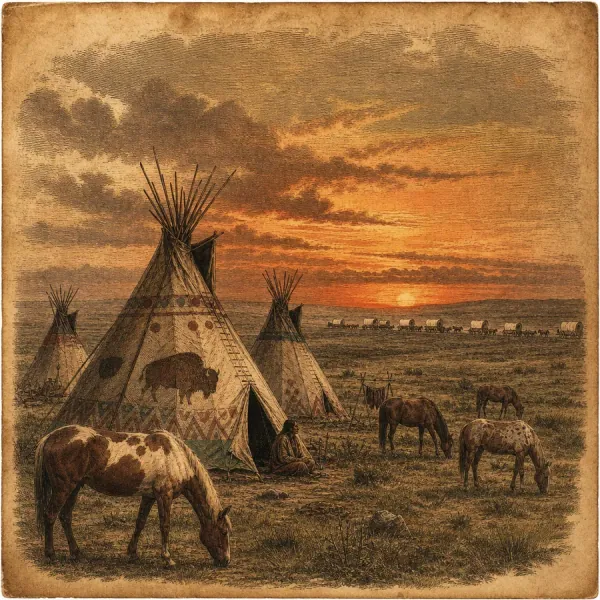
In the middle of the continent, the Great Plains were home to two broad kinds of societies. Some, like the Lakota, Cheyenne, Comanche, Kiowa, Crow or Blackfoot, had become nomads who followed the bison herds. Others, like the Mandan, Pawnee, Hidatsa or Osage, lived in villages, farmed the land and traded with their neighbors.
The horse had vanished from the Americas some 13,000 to 15,000 years ago. Reintroduced by Europeans in the 16th century, it transformed life on the Plains: from the 17th to the 19th century, true horse cultures flourished there, allowing people to hunt and travel much farther. The Comanche, for example, reached the height of their power in the 1840s, launching raids hundreds of miles deep into Mexico.
🐃 The bison, a resource for a whole way of life
The bison was at the heart of this economy. Estimates of its population before the 19th century vary widely, from 25 to 60 million animals depending on the author. It provided meat, hides for clothing and tipis, bones for tools, and hunting it also had a spiritual dimension.
Farther west, California may have had as many as 300,000 Native inhabitants before the Spanish arrived, divided among many peoples speaking different languages.
🗺️ Rival empires
Around 1800, several powers claimed these territories. Spain held the Southwest and California, with its missions, such as San Xavier del Bac, founded in 1700 near Tucson; Mexico, independent in 1821, inherited them, from Texas to California. France had controlled Louisiana from 1682 to 1762, then ceded it to Spain. Great Britain and its Hudson's Bay Company dominated the fur trade in the Northwest, and Russia occupied Alaska.
The young United States, independent since 1783, organized its advance very early. The Northwest Ordinance of 1787 provided that a territory would become a state as soon as it had enough inhabitants, and banned slavery north of the Ohio River. By 1810, the line of settlement had reached the Mississippi. Many historians today classify this process as an example of settler colonialism: colonists come to settle permanently on lands whose inhabitants are pushed out.
🧭 Buying and exploring: Louisiana and Lewis and Clark
The first big step in the conquest of the West was not a battle but a sale. In 1803, Napoleon Bonaparte's France ceded Louisiana to the United States, opening the lands west of the Mississippi to President Thomas Jefferson.
💵 A giant sale in 1803
Napoleon had recovered Louisiana from Spain in 1800, dreaming of rebuilding a French empire in America. But the failure of his army against the revolt in Saint-Domingue (the future Haiti) and the threat of a new war with Britain pushed him to sell. Jefferson had only wanted to buy the port of New Orleans; his envoys, James Monroe and Robert Livingston, ended up accepting the whole territory for $15 million.
On paper, the United States acquired about 2.1 million km² and nearly doubled in size. In reality, France controlled only a small part of these lands, which were mostly inhabited by Native peoples. What the United States really bought was the exclusive right, against the other colonial powers, to obtain these lands by treaty or by conquest. Between 1803 and the 1870s, the federal government then acquired them, nation by nation, through treaties or by force.
🛶 The Corps of Discovery
Jefferson tasked two officers, Meriwether Lewis and William Clark, with traveling up the Missouri, finding a route to the Pacific and studying the peoples, climate, soils, plants and animals they encountered. The expedition left Camp Dubois, in Illinois, on May 14, 1804, crossed the Continental Divide in the Rockies, went down the Columbia River and reached the Pacific in 1805. The return journey, begun on March 23, 1806, ended in St. Louis on September 23 of that year.
Two members of the group are a reminder that this adventure was not only that of two white officers. Sacagawea, a young Shoshone woman, traveled with the expedition alongside her husband, the French-Canadian trapper Toussaint Charbonneau, who considered her his property; she gave birth along the way, in February 1805. York, a man enslaved by Clark, also made the entire journey. On November 24, 1805, both of them took part in the group's vote on where to set up the winter camp, near the mouth of the Columbia. Yet on his return, Clark refused to free York, who received none of the rewards given to the others.
🦫 Trappers and the “desert”
Before the settlers came the trappers, looking for beaver pelts for European hats. These “mountain men” forged the first relationships with many peoples of the West and scouted key passages, such as South Pass in the Rockies, discovered around 1812. When fashion switched to silk hats, the trade collapsed: it had practically disappeared by 1845. Official explorations continued, but in 1823 Major Stephen Long described the Great Plains as an arid “Great American Desert,” a reputation that slowed settlement there for decades.
The rest of the course
This page publishes the first 2 parts. The full course has 9: here is what the next ones cover.
- 🍂 The Trail of Tears: emptying the East of its nations
The Indian Removal Act of 1830, the Cherokee legal battle, the Treaty of New Echota and the deportation of the five southeastern nations to Indian Territory.
- 🦅 “Manifest destiny” and the war with Mexico
The ideology of manifest destiny, the independence and then annexation of Texas, the division of Oregon and the war of 1846–1848 that cost Mexico more than half its territory.
- ⛏️ The Oregon Trail and the gold rush
The wagon trains to Oregon and California, the Mormon exodus, the gold rush of 1848 and its consequences for the Native peoples of California.
- 🚂 The railroad, free land and the newcomers
The laws of 1862 (Homestead Act, Pacific Railroad Act), the first transcontinental railroad completed in 1869, and the diversity of migrants to the West: Europeans, Chinese, African Americans, Hispanics.
- 🏹 The Plains Wars
The wars between the U.S. Army and the nations of the West (1850–1886): Sand Creek, the Treaty of Fort Laramie, the Black Hills, Little Bighorn, Chief Joseph's Nez Perce, Geronimo's Apache.
- 🐃 The end of the bison and Wounded Knee
The extermination of the Plains bison, confinement on reservations, the Ghost Dance and the Wounded Knee Massacre of December 29, 1890.
- 🎬 Assimilating, storytelling, remembering
The assimilation policy (boarding schools, the Dawes Act), the “closing of the frontier” in 1890, Turner's thesis, the myth of the Wild West, the New Western History, international comparisons and Native nations today.
Study “The Conquest of the West” with flashcards and quizzes
In Oria, you read the full course, then practice on it: flashcards, multiple-choice quizzes, open questions or the Feynman method. Cards and questions then come back in your daily review, paced by spaced repetition.
Study this topic in OriaSources
These notes draw on the sources below. If a point seems doubtful, refer back to them.