Economics
The Crash of 1929: Summary and Study Notes
From the Wall Street crash to the Great Depression
Study this topic in OriaThe essentials
In October 1929, the New York Stock Exchange collapsed after years of credit-fueled speculation. Panic spread to the banks, the American economy crumbled, and the crisis then spread across the globe through finance, trade, and the gold standard. You'll follow the chain of events, their social and political consequences — through to Hitler's rise to power — the responses of Hoover, Roosevelt, and Keynes, and the debates that shaped the response to the 2008 crisis.
Key dates and facts
- Sept. 3, 1929
- Dow Jones record: 381.17
- Oct. 24, 1929
- Black Thursday: 12.9 million shares traded
- Oct. 29, 1929
- Black Tuesday: −11.73%
- Jul. 8, 1932
- Low point: 41.22 (−89%)
- 1954
- Back to the 1929 level
- 2.6%
- Nazi vote in May 1928
- 18.3%
- Nazi vote in September 1930
- 37.3%
- Nazi vote in July 1932
- Jan. 30, 1933
- Hitler appointed chancellor
🎷 The Roaring Twenties and the bubble
To understand the crash of 1929, you first have to picture the euphoria that came before it. In the United States, the 1920s — the Roaring Twenties — were a decade of industrial growth and novelty. Mass production put new technologies within reach of the middle class: the automobile, the movies, radio, and chemistry all took off.
🚗 The age of mass consumption
The symbol of the era is the Ford Model T, built without interruption from October 1908 to May 1927 and sold in 15 million units. By 1929, the United States had just under 27 million registered vehicles. At the same time, electricity production nearly quadrupled over the decade: homes got wired up, factories kept running.
This prosperity fed a wave of optimism. Many Americans believed growth would last forever, and the stock market became the place where everyone hoped to get rich fast.
💸 Buying stocks with borrowed money
The engine of the bubble was credit. Thanks to so-called call loans, an investor could buy stock by putting down only about 10% of its price, with the rest lent by the broker: this was margin buying. By August 1929, brokers were lending small investors more than two-thirds of the value of the stock they bought; outstanding broker loans topped $8.5 billion, more than the entire amount of currency in circulation in the United States.
Buying stock largely financed by a loan from a broker. As long as prices rise, the gain is amplified; if they fall, the borrower must repay or the shares are sold off automatically, which speeds up the collapse.
The mechanism was ruthless: rising prices drew in new buyers, who borrowed to buy, which pushed prices up further still. Stock prices eventually broke loose from the real value of the companies behind them. That is the definition of a speculative bubble.
⚠️ Warning signs ignored
Yet the real economy was already showing signs of strain. Between March and September 1929, monthly car production fell from 622,000 to 416,000 vehicles. The stock market, meanwhile, kept climbing: on September 3, 1929, the Dow Jones Industrial Average hit its record high of 381.17 points.
Shortly before the crash, one of the most celebrated American economists of his day, Irving Fisher, summed up the general optimism.
“Stock prices have reached what looks like a permanently high plateau.”
Irving Fisher, economist, shortly before the crash (1929)
Soon after, that “plateau” collapsed. The line has endured as the textbook example of the blindness that accompanies bubbles.
📉 The crash of October 1929
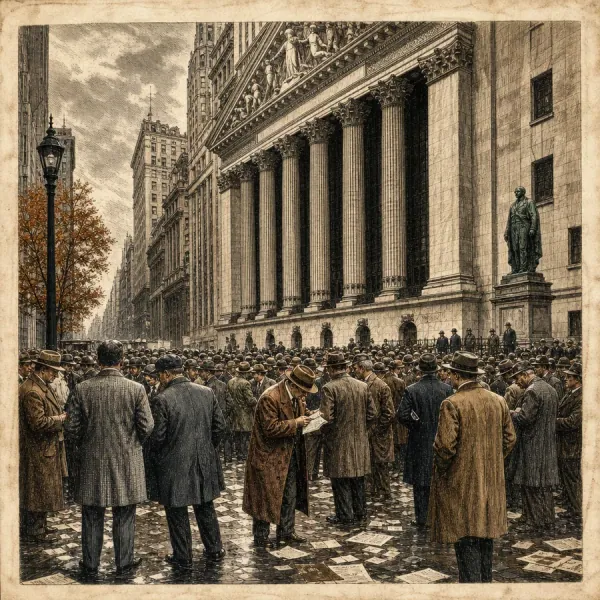
The crash of 1929 refers to the collapse of the New York Stock Exchange, on Wall Street, at the end of October 1929. It wasn't a single day, but a string of panicked trading sessions, followed by a decline that dragged on for nearly three years.
A sudden, massive collapse in stock prices, usually triggered by a wave of panic selling: everyone sells to limit their losses, which drives prices down even further.
🖤 Black Thursday, October 24, 1929
On Thursday, October 24, panic broke out right at the opening bell: the market lost 11% in the first moments of trading. That day, 12.9 million shares changed hands, a record volume. The ticker tape machines, which printed stock prices on paper strips, fell about an hour and a half behind: investors no longer even knew the price at which they were selling, which only deepened the fear.
At midday, a group of leading bankers gathered around J.P. Morgan & Co. decided to step in. Their representative, Richard Whitney, vice president of the Exchange, walked across the trading floor and placed spectacular buy orders, notably on U.S. Steel stock. The gesture reassured the market: most of the day's losses were erased, and the index closed down only about 2%.
💥 Black Monday and Black Tuesday, October 28 and 29
The relief didn't last. On Monday, October 28, the Dow Jones fell 12.82% to 260.64 points; this time, the bankers did not step in. On Tuesday, October 29, about 16 million shares were traded and the index fell another 11.73%, closing at 230.07 points. The ticker tape machines were now running as much as two and a half hours behind.
Investors who had bought on margin got calls from their brokers: pay up immediately or watch your shares get sold automatically. These forced sales accelerated the collapse. In all, roughly $30 billion in stock market wealth vanished.
🕳️ A three-year slide
Yet the worst was not October 1929. After a few rebounds, the market kept falling until July 8, 1932, when the Dow Jones closed at 41.22 points — a loss of about 89% from its September 1929 peak. It would take until November 23, 1954, twenty-five years later, for the index to recover its pre-crash level.
The crash alone does not explain the Great Depression, but it was its symbolic trigger: it ruined savers, weakened the banks that had lent to them, and shattered the confidence that had powered the boom.
The rest of the course
This page publishes the first 2 parts. The full course has 7: here is what the next ones cover.
- 🏦 From stock crash to banking and economic crisis
How the crash turned into a depression in the United States: bank runs, a shrinking money supply, falling production, mass unemployment, and deflation.
- 🌍 Spreading to the whole world
How the American crisis reached Europe: the recall of capital, the failure of Creditanstalt, the German crisis, Smoot-Hawley protectionism, the gold standard, and the case of France.
- ⚖️ The social and political consequences
The hardship of the 1930s (unemployment, Hoovervilles, the Dust Bowl, the Bonus Army), the crisis in the United Kingdom and France, and the rise of Nazism in Germany.
- 🛠️ The responses: Hoover, the New Deal, and Keynes
Hoover's limited response, Roosevelt's New Deal (banking, public works, Social Security), and the intellectual revolution of Keynes.
- 🔍 Lessons and debates: from Friedman to 2008
The major explanations for the Depression (Keynesian, monetarist, gold standard, protectionism) and their influence on the response to the 2008 crisis.
Study “The Crash of 1929” with flashcards and quizzes
In Oria, you read the full course, then practice on it: flashcards, multiple-choice quizzes, open questions or the Feynman method. Cards and questions then come back in your daily review, paced by spaced repetition.
Study this topic in OriaSources
These notes draw on the sources below. If a point seems doubtful, refer back to them.