Economics
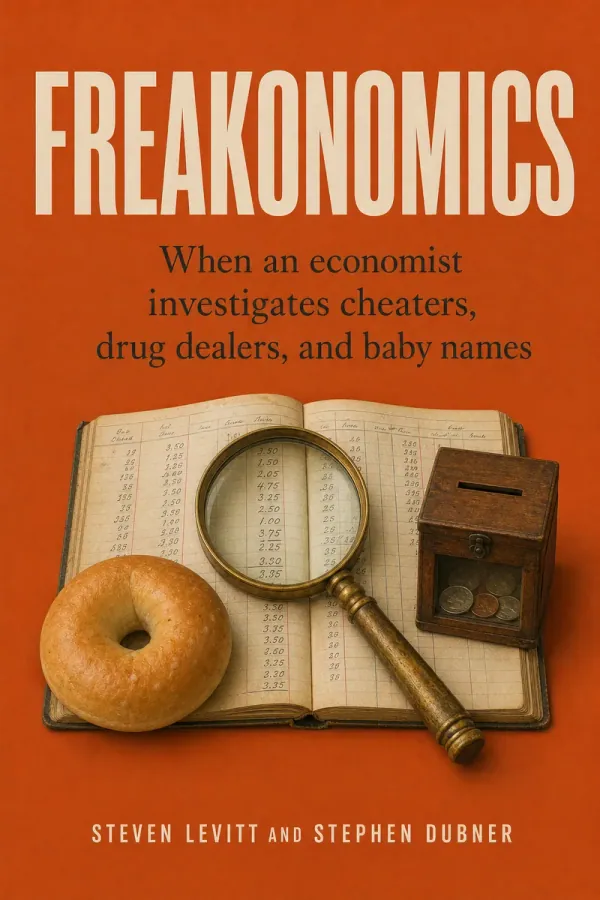
Freakonomics by Steven Levitt and Stephen Dubner: Summary and Study Notes
When an economist investigates cheaters, drug dealers, and baby names
Study this topic in OriaThe essentials
Published in 2005, Freakonomics pairs economist Steven Levitt with journalist Stephen Dubner to ask unexpected questions: do teachers cheat? Why do drug dealers live with their mothers? What caused crime to plummet in the United States? You'll discover the power of incentives, Levitt's methods for catching cheaters, his explosive thesis on abortion and crime, and the many objections the book drew from economists and statisticians.
Key dates and facts
- 2003
- Dubner's profile of Levitt in the New York Times Magazine
- 2005
- Freakonomics published in the United States
- 2006
- Revised, expanded edition
- 2009
- Sequel: SuperFreakonomics
- 2010
- Documentary film and podcast launch
- 4 to 5%
- Of Chicago teachers were cheating, per the study
- 80%
- Win rate for a 7-7 wrestler in his final match
- 85 to 95%
- Of bagels actually paid for by the office vendor
- 1966
- Abortion banned in Romania
- 1973
- Roe v. Wade ruling in the United States
📗 An economist, a journalist, and a phenomenon
Freakonomics: A Rogue Economist Explores the Hidden Side of Everything is the product of an unlikely meeting between a researcher and a journalist.
🤝 A two-hour interview that lasts three days
Steven Levitt, born in 1967, is a young economist at the University of Chicago. A Harvard graduate and a 1994 MIT PhD, he made a name for himself by applying economic tools to subjects his colleagues avoided: crime, drugs, sports, cheating. In 2003, he received the John Bates Clark Medal, awarded every two years to the most promising American economist under 40.
Stephen Dubner, born in 1963, is an American journalist and writer who has worked at the New York Times, the New Yorker, and Time. His editor asks him to write a profile of Levitt for the New York Times Magazine. Neither man is thrilled; Levitt agrees to a two-hour interview, partly because his mother likes the magazine. Dubner ends up stretching the interview over three days. After the article runs in 2003, the two are asked to write a book together.
📈 A success driven by blogs
The book was published on April 12, 2005 by William Morrow. The publisher bets on an unusual campaign, sending advance copies to more than a hundred bloggers. Freakonomics climbs to number two on the New York Times nonfiction bestseller list. By the end of 2009, it had sold more than 4 million copies worldwide; Dubner later cites 5 million copies and translations into 40 languages.
🌐 A sprawling brand
The book becomes a franchise: a blog launched in 2005 (hosted for a time by the New York Times), a 2009 sequel, SuperFreakonomics, then Think Like a Freak and When to Rob a Bank, a documentary film shown at the Tribeca Film Festival in 2010, and above all the podcast Freakonomics Radio, launched in 2010 and hosted by Dubner, which reached 15 million monthly downloads in 2018. Levitt, now an emeritus professor, has also co-founded a consulting firm and hosted his own podcast from 2020 to 2025.
🎯 Economics, the science of incentives
Freakonomics, by Steven Levitt and Stephen Dubner, has no single subject: it's a series of investigations, most of them drawn from Levitt's academic papers. But one thread runs through every chapter.
🥕 It's all about incentives
Anything that pushes someone to act a certain way: a reward, a punishment, other people's opinions, or one's own conscience.
For the authors, economics is first and foremost the study of incentives: how people get what they want, especially when others want the same thing. Understanding a person's incentives often lets you predict, and even unmask, their behavior. The book applies this to unexpected territory: schools, sumo rings, gangs, real estate agencies, cribs, and maternity wards.
⏰ The fine that increased lateness
Incentives aren't only financial, and they can backfire on the people who create them. The book tells the story of a daycare center that, to fight parents arriving late, introduced a $3 fine. The result: lateness increased. By putting a price on being late, the fine erased the moral discomfort parents used to feel: they now felt they were simply paying for a service. As economist Thomas Leonard notes in his review of the book, morality and other people's opinions matter just as much as money.
Another famous example: according to the book, on the evening of April 15, 1987, the deadline for American tax returns, seven million children "disappeared" from tax forms. The IRS had just started requiring a Social Security number for every child claimed, and many fictitious children, invented to lower tax bills, evaporated. The figure has, however, been disputed by economist Ariel Rubinstein, who estimates the real drop was smaller.
🔍 Correlation is not causation
Levitt insists on a point of method: many things go together without one causing the other. There are often more police officers where there is more crime, but it isn't the police who create the crime. His whole talent lies in finding "natural" situations that let him separate cause from mere coincidence, using large datasets and a statistical technique, regression, which the book admits is "more art than science."
"Economics is a science with excellent tools for gaining answers but a serious shortage of interesting questions."
Steven Levitt and Stephen Dubner, Freakonomics (2005)
Hence the book's ambition: take everyday questions seriously, distrust the conventional wisdom repeated by experts, and let the data speak, even when its answers are uncomfortable.
The rest of the course
This page publishes the first 2 parts. The full course has 9: here is what the next ones cover.
- 🕵️ Teachers, sumo wrestlers, and a bagel seller: who cheats?
Levitt's investigations into cheating: Chicago teachers who alter test answers, sumo wrestlers who fix matches, and employees who don't pay for their bagels.
- 🏠 The Ku Klux Klan and real estate agents: the power of information
The chapter on information asymmetry: how secrecy once powered the Ku Klux Klan and how real estate agents profit from knowing more than their clients.
- 💊 Why do drug dealers live with their mothers?
The study of a Chicago gang's books with sociologist Sudhir Venkatesh: rock-bottom wages for street-level sellers, big money at the top, organized like a tournament.
- 📉 Where did all the criminals go?
The book's most explosive thesis: the drop in American crime in the 1990s is partly explained by the legalization of abortion in 1973.
- 🔥 Abortion and crime: a controversy that won't go away
Criticism of the Donohue-Levitt thesis: a coding error found in 2005, competing explanations like leaded gasoline, conflicting European studies, and a 2019 update.
- 👶 Perfect parents and telling names
The last two chapters: what the data say about parents' influence on school success, and what children's names reveal.
- ⚖️ Reception, criticism, and limits
What economists and critics praised and faulted in Freakonomics: economic imperialism, distorted use of other researchers' work, errors left unmentioned, a defamation lawsuit, and a controversial sequel.
Study “Freakonomics” with flashcards and quizzes
In Oria, you read the full course, then practice on it: flashcards, multiple-choice quizzes, open questions or the Feynman method. Cards and questions then come back in your daily review, paced by spaced repetition.
Study this topic in OriaSources
These notes draw on the sources below. If a point seems doubtful, refer back to them.