Civilizations
The Inca: Summary and Study Notes
The largest empire in the Americas, built without wheels or writing
Study this topic in OriaThe essentials
Starting out from the Cuzco Valley, the Inca conquered in a few generations a territory more than 4,000 km (2,500 miles) long, from the highlands of Ecuador to central Chile. You'll discover how Pachacuti founded the Tawantinsuyu, how the empire ran without money or markets, its 40,000 km of roads, its knotted cords, the quipus, and Machu Picchu. You'll also see how a handful of Spaniards led by Francisco Pizarro took advantage of a civil war and epidemics in 1532 to bring down the empire, and what the Andes have kept of the Inca legacy.
Key dates and facts
- c. 300 – 1100
- Tiwanaku civilization, around Lake Titicaca
- c. 600 – 1100
- Wari Empire, which controls the Cuzco region
- early 13th century
- Birth of the Kingdom of Cuzco
- c. 1438
- Expansion begins under Pachacuti
- c. 1438
- Victory over the Chanka; Pachacuti comes to power
- 1463
- Túpac Inca Yupanqui launches the northern conquests
- 1471
- Death of Pachacuti (traditional chronology)
- 1527
- The Shuar halt the advance toward the Amazon
- c. 1420
- Occupation of Machu Picchu begins
- 1911
- Hiram Bingham makes the site known to the world
🏔️ From the legends of Lake Titicaca to the kingdom of Cuzco
In the 15th and 16th centuries, the Inca built the largest empire of the pre-Columbian Americas. Strictly speaking, the word “Inca” refers to the ruler and the nobility of Cuzco, perhaps between 15,000 and 40,000 people, who dominated a population of about 10 million. By extension, the term is used for the whole civilization of this empire.
⛰️ Heirs of the Andes
The Inca Empire was the last chapter of thousands of years of Andean civilizations. Historians count Andean civilization among the rare “pristine” civilizations, which arose without outside influence. Before the Inca, two great states dominated the Andes: Tiwanaku (c. 300–1100), around Lake Titicaca, and Wari (c. 600–1100), which occupied the Cuzco region for about four centuries. Some of the roads, terraces and techniques attributed to the Inca came from these predecessors.
Life at high altitude in the Andes rested on two pillars. First, the potato, which people knew how to preserve for a very long time by freeze-drying it in the frosty high-altitude nights: this is chuño. Second, llamas and alpacas, the only large domestic animals of the pre-Columbian Americas, which provided wool, meat and transport.
🌞 Children of the Sun
The Inca told of their origins through two legends. In the first, four brothers and four sisters, the Ayar, emerged from a cave and made a long journey toward Cuzco; only one brother reached the end, Ayar Manco, who became Manco Cápac, the founder. In the second, reported by the mestizo chronicler Inca Garcilaso de la Vega, Manco Cápac and his wife Mama Ocllo were sent by the Sun god and rose from the waters of Lake Titicaca. They carried a golden staff: wherever it sank into the ground, they would found a city. The staff sank into a mountain in the Cuzco Valley, where the couple taught farming and weaving.
🏘️ One small kingdom among others
History, for its part, shows the Inca as a tribe of herders who settled in the Cuzco region around the 12th century. In the early 13th century, a small Kingdom of Cuzco took shape. A temple to the Sun was built there, on the site of the future Coricancha. For two centuries, successive rulers cautiously extended their influence over neighboring valleys, through wars, marriages and alliances. Nothing yet hinted at the lightning expansion to come.
⚡ Pachacuti and the conquest of an empire
Everything changed in the 15th century. According to tradition, Cuzco was threatened by a neighboring people, the Chanka. Prince Cusi Yupanqui won the war and took power. He then adopted the name Pachacuti (or Pachacutec), meaning “the overturning of the world.” The ninth ruler on the traditional list, he transformed the small kingdom of Cuzco into an empire.
📅 Dates to handle with care
The Inca did not keep systematic track of years. The dates of their history come from Spanish chronicles written later. The most widely used chronology, established by the anthropologist John Rowe in 1945, has Pachacuti reigning from 1438 to 1471, but radiocarbon dating suggests an earlier start to his reign, in the early 15th century. Some researchers go further and see Pachacuti as a partly mythical figure, a symbol of the beginning of the expansion; most consider him a historical person.
🎁 Gifts first, then the army
The method of conquest was well honed. Pachacuti first sent spies to study a region's strength and wealth. Then he sent local leaders messages praising the advantages of the empire, along with gifts such as high-quality textiles. Most accepted and submitted peacefully. Those who refused were conquered by force. The sons of subject leaders were raised in Cuzco, where they learned Inca administration before returning home to govern their lands.
🗺️ From Ecuador to Chile
His son Túpac Inca Yupanqui took command of the armies in 1463, then succeeded him. His greatest conquest was the kingdom of Chimor, on the north coast of Peru, the Inca's only real rival. He pushed into what are now Ecuador and Colombia. His son Huayna Cápac added still more land in the north. In the south, the empire reached central Chile, near the Maule River, where the Mapuche resisted it; in the east, toward the Amazon, the Shuar stopped its advance in 1527.
In less than a century, the empire stretched nearly 4,500 km (2,800 miles) from north to south, more than three times the size of present-day France. How many inhabitants? Estimates range from 4 to 37 million; most fall between 6 and 14 million. The anthropologist Gordon McEwan stresses that the Inca built one of the largest imperial states in history without the wheel, draft animals, iron or writing.
The rest of the course
This page publishes the first 2 parts. The full course has 8: here is what the next ones cover.
- 🗂️ The Tawantinsuyu: an empire without money
The political and social organization of the empire: the four regions (suyu), the Sapa Inca, “son of the Sun,” the decimal administration, compulsory labor (mit'a) instead of taxes, the storehouses, the ayllu, the Quechua language and education.
- ☀️ Inti, Pachamama and the royal mummies
Inca religion: the cult of the Sun (Inti) imposed on the whole empire, Viracocha, Pachamama and the local huacas, the three worlds, the mummies of the rulers, the Inti Raymi festival and child sacrifice (capacocha).
- 🪢 Roads, messengers and quipus
The know-how that held the empire together: the Qhapaq Ñan road network (about 40,000 km), its bridges and way stations, the chaski runners, the knotted quipus, Inca arithmetic, calendar and medicine.
- 🏯 Machu Picchu and the art of building
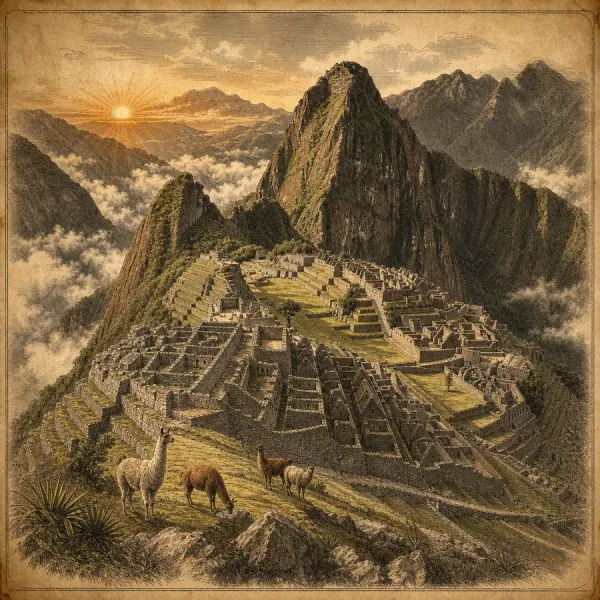
The height of Inca architecture: mortarless stone walls, farming terraces, and Machu Picchu, Pachacuti's royal estate, its inhabitants, its abandonment and its fame since 1911.
- ⚔️ 1532: Cajamarca and the fall of the empire
The fall of the Inca Empire: epidemics, the civil war between Huáscar and Atahualpa, Francisco Pizarro's capture of Atahualpa at Cajamarca (November 16, 1532), ransom and execution, Manco Inca's revolt and the end of Vilcabamba in 1572.
- 🌄 The Andean legacy, from Túpac Amaru II to today
What remains of the Inca: the revolt of Túpac Amaru II (1780), the Quechua language spoken by millions of people, community traditions, the Inti Raymi revived in 1944, the roads listed by UNESCO and misconceptions about the empire.
Study “The Inca” with flashcards and quizzes
In Oria, you read the full course, then practice on it: flashcards, multiple-choice quizzes, open questions or the Feynman method. Cards and questions then come back in your daily review, paced by spaced repetition.
Study this topic in OriaSources
These notes draw on the sources below. If a point seems doubtful, refer back to them.