Classic novels
The Plague by Albert Camus: Summary and Study Notes
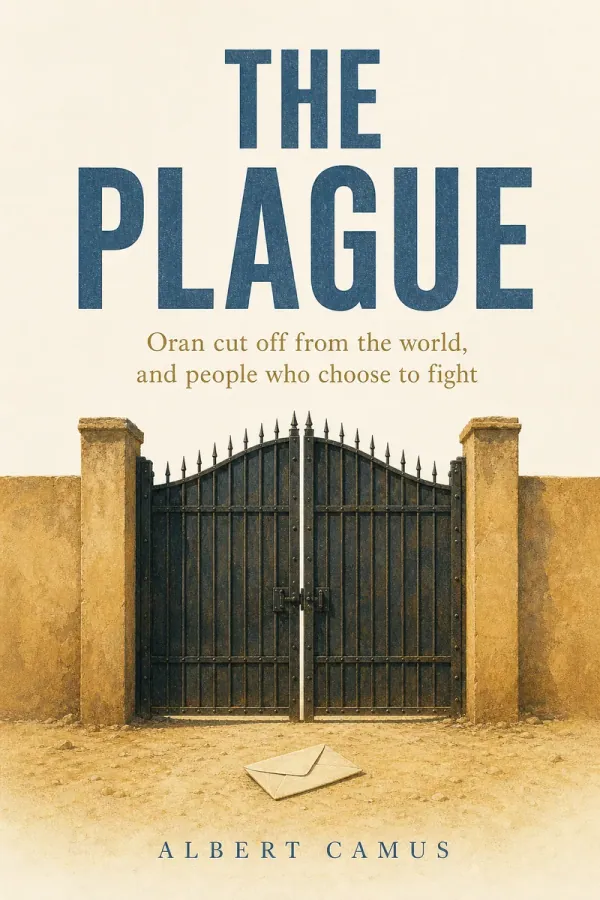
Oran cut off from the world, and people who choose to fight
Study this topic in OriaThe essentials
Published in June 1947, The Plague tells of the year an epidemic of plague strikes Oran, then a city in French Algeria, which finds itself shut off from the world. Around Dr. Rieux, a journalist, a priest, a humble clerk and a mysterious traveler confront the scourge, each in his own way. You'll discover how Albert Camus wrote this novel during the war, the plot part by part, its characters, its big ideas about revolt and solidarity, the debates it has sparked and its astonishing comeback during the Covid-19 pandemic.
Key dates and facts
- April 1941
- The project noted in the Notebooks
- March 13, 1942
- Camus tells Malraux about his plague novel
- 1943
- Version with four narrators
- June 1947
- Published by Gallimard
- 1947
- Publication and the Prix des Critiques
- 1948
- First English translation
- 1992
- Film by the Argentine Luis Puenzo
- 2020
- Sales triple during the pandemic
🌍 A novel that ripened during the war
Albert Camus was thinking about a novel on the plague as early as the late 1930s: his Notebooks contain scattered ideas from 1938 on, and in April 1941 he set down the project more clearly. On March 13, 1942, he told the writer André Malraux that he was writing a novel about the plague, a subject that, he said, seemed strangely natural to him. His first novel, The Stranger, came out a few months later, in June 1942.
🏔️ Writing far from Algeria
Suffering from tuberculosis, Camus left Algeria to recover in central France. He wrote a first version of the novel at Le Panelier, a hamlet in the Haute-Loire, a few miles from Le Chambon-sur-Lignon, a village that would later be honored for hiding Jews during the war. He then joined the Resistance and edited the underground newspaper Combat. The novel was thus written in the middle of the German Occupation of France, which would weigh on how it was read.
✏️ Successive versions
By 1943, the core of the story was in place, but Camus hesitated over the form. One version had four narrators, including a classics teacher who comments on the plague accounts of the ancient authors Thucydides and Lucretius. In the final text, a single narrator remains, who reveals his identity only at the end. When he finished the book in 1946, Camus was discouraged: he felt he had completely failed. He nevertheless handed it to Gallimard, which published it in June 1947. It was an immediate success, and the novel won the Prix des Critiques.
🦠 Real epidemics in Oran
The epidemic in the novel is imaginary, but Oran, a major city in western Algeria, really did experience scourges: plague epidemics in the 16th and 17th centuries, a very deadly cholera outbreak in 1849, then small flare-ups of plague in the 20th century, notably in the 1940s. According to an academic study, these recent flare-ups, ranging from a few dozen to nearly two hundred cases, were very far from the catastrophe Camus describes.
☀️ Albert Camus, from Belcourt to the Nobel
Albert Camus was born on November 7, 1913, in Mondovi, now Dréan, in eastern Algeria, then French territory. He was what is called a pied-noir, a French person born in Algeria into a family of European origin. His father, a farm laborer who became a cellarman, was killed at the front in October 1914, during World War I. Albert grew up in Algiers, in the poor district of Belcourt, with an almost silent mother and a stern grandmother.
📚 School as a lifeline
His schoolteacher, Louis Germain, spotted this brilliant boy and coached him for free for the scholarship exam: thanks to him, Camus went on to secondary school. He played goalkeeper for a university club in Algiers and discovered philosophy with his teacher Jean Grenier. But tuberculosis, which struck him young, prevented him from pursuing an academic career. All his life, he would remain loyal to the poor world of his childhood. On receiving the Nobel Prize, he wrote to Louis Germain to tell him that without him, none of this would have happened.
📰 Journalist and Resistance fighter
From 1938, he worked as a journalist for Alger républicain, where he was outraged by the harshness of the colonial authorities toward the Arab and Berber populations. In Paris, he published The Stranger and the essay The Myth of Sisyphus in 1942, then joined the Resistance and took charge of Combat. On August 8, 1945, two days after Hiroshima, he was one of the few Western intellectuals to denounce the atomic bomb, in an editorial.
🔁 The absurd, then revolt
Camus organized his work into cycles. The first, the cycle of the absurd, observes that the world has no given meaning; it is placed under the sign of Sisyphus. The second, the cycle of revolt, asks how to live and act in spite of everything, under the sign of Prometheus: The Plague (1947), the plays State of Siege and The Just Assassins, then the essay The Rebel (1951). He rejected the label of existentialist that was often pinned on him.
In October 1957, at 44, he was awarded the Nobel Prize in Literature, the second-youngest laureate in history and the first writer born in Africa to receive it. During the Algerian War, his position, in favor of greater autonomy and a civilian truce but opposed to independence, drew sharp criticism. He died in a car accident on January 4, 1960, in Villeblevin, in the Yonne, at the age of 46.
The rest of the course
This page publishes the first 2 parts. The full course has 9: here is what the next ones cover.
- 🐀 Part I: the rats and the closed city
The novel's first part: the death of the rats in Oran, the first patients, Dr. Rieux, the authorities' hesitation and the closing of the city.
- 🚪 Parts II and III: exile and the summer of the plague
Parts II and III: life in the closed city, the suffering of those separated from loved ones, Rambert's escape plan, Paneloux's sermon, the volunteer health teams and the summer when the plague reaches its peak.
- 🕯️ Part IV: the child, the priest and friendship
The fourth part: Rambert chooses to stay, the death of Judge Othon's son, Paneloux's second sermon and death, Tarrou's confession and the two friends' swim in the sea.
- 🎆 Part V: deliverance and memory
The fifth part: the epidemic recedes, Tarrou dies, Cottard goes mad, the gates open, the narrator is revealed and a final warning is given.
- 👥 Rieux, Tarrou, Rambert and the others
The novel's main characters and what each represents in the face of the scourge: the doctor, the witness, the journalist, the priest, the clerk, the profiteer.
- 🧭 Allegory, revolt and solidarity
The novel's big ideas: chronicle and allegory of the Occupation, the limits of that reading, echoes of the Holocaust, the move from the absurd to revolt, and human solidarity.
- 📚 Success, criticism and a comeback in 2020
The novel's success since 1947, its translations, postcolonial criticism, its spectacular comeback during the Covid-19 pandemic and its adaptations.
Study “The Plague” with flashcards and quizzes
In Oria, you read the full course, then practice on it: flashcards, multiple-choice quizzes, open questions or the Feynman method. Cards and questions then come back in your daily review, paced by spaced repetition.
Study this topic in OriaSources
These notes draw on the sources below. If a point seems doubtful, refer back to them.