History
The September 11 Attacks: Summary and Study Notes
The morning that opened the 21st century
Study this topic in OriaThe essentials
On September 11, 2001, members of al-Qaeda hijacked four airliners in the United States: two struck the Twin Towers of the World Trade Center in New York, a third hit the Pentagon, and the fourth crashed in Pennsylvania after its passengers fought back. You'll understand where this attack came from, what the intelligence agencies knew, how the world reacted, and how the wars in Afghanistan and Iraq, new antiterrorism laws and passenger screening followed from it. You'll also see what the investigations say in the face of conspiracy theories, and how the victims are remembered today.
Key dates and facts
- April 4, 1973
- The World Trade Center opens
- February 26, 1993
- First attack on the North Tower
- 1996
- Bin Laden's first fatwa
- August 7, 1998
- Bombings of two US embassies in Africa
- 8:46 a.m.
- American Flight 11 hits the North Tower
- 9:03 a.m.
- United Flight 175 hits the South Tower
- 9:37 a.m.
- American Flight 77 hits the Pentagon
- 10:03 a.m.
- United Flight 93 crashes in Pennsylvania
- October 7, 2001
- Start of the war in Afghanistan
- March 2003
- Invasion of Iraq
🏙️ Before 9/11: two towers and a network
The September 11, 2001, attacks targeted the United States at the heart of its symbols: global finance in New York, military power in Washington. To understand this attack, you need to know both the places that were struck and the organization that planned it.
🗼 The Twin Towers, emblems of New York
The World Trade Center was a complex of seven buildings in Lower Manhattan, including the two famous Twin Towers designed by the American architect Minoru Yamasaki. Opened on April 4, 1973, and 110 stories tall (about 417 meters for the North Tower, 415 for the South Tower), they were briefly the tallest buildings in the world. Tens of thousands of people worked there every day; on August 7, 1974, the high-wire artist Philippe Petit made a famous crossing between them on a cable. For many, they symbolized globalization and American prosperity. On February 26, 1993, a bomb placed beneath the North Tower had already killed six people.
🕸️ Bin Laden and al-Qaeda
Osama bin Laden led al-Qaeda, a jihadist organization, meaning one that justifies armed violence in the name of Islam. Expelled from Sudan in 1996, he settled in Afghanistan, where the Taliban regime let him set up his camps. That same year, he issued a first fatwa, a religious proclamation, declaring war on the United States; in 1998, a second called for killing Americans, civilians included.
Bin Laden and those around him put forward several grievances: the presence of American troops in Saudi Arabia, a land he considered forbidden to non-Muslims, US support for Israel, and the international sanctions against Iraq. Investigators see these as the stated motivation for the attacks. Some researchers add a strategy: drawing America into a war against the Muslim world in order to win new followers. On August 7, 1998, al-Qaeda had already struck the American embassies in Kenya and Tanzania.
🧭 A plot years in the making
The September 11, 2001, attacks were the result of a project that al-Qaeda developed over several years. They also exposed serious flaws in the way American agencies shared their information.
🗂️ The mastermind and the operatives
According to the American commission of inquiry, the architect of the plot was Khalid Sheikh Mohammed, an al-Qaeda member already linked to the first World Trade Center bombing. He pitched the idea of flying planes into buildings to bin Laden in 1996; bin Laden gave the go-ahead in late 1998 or early 1999, chose the participants and funded the operation. According to the commission, its total cost to al-Qaeda was between 400,000 and 500,000 dollars.
The pilots were recruited partly from a cell based in Hamburg, Germany: Mohamed Atta, Marwan al-Shehhi and Ziad Jarrah, chosen because they were educated, spoke English and knew Western life; a fourth, Hani Hanjour, already held a pilot's license. In all, nineteen hijackers took part: fifteen Saudis, two Emiratis, an Egyptian and a Lebanese. Several took flying lessons in the United States starting in 2000.
🚨 Warnings that never came together
The intelligence agencies were not completely in the dark. The CIA knew that two al-Qaeda members, Nawaf al-Hazmi and Khalid al-Mihdhar, had entered the United States, but it did not alert the FBI in time. In July 2001, an FBI agent in Phoenix warned his superiors about bin Laden sympathizers enrolled in flight schools. On August 6, 2001, the daily brief given to President George W. Bush was titled “Bin Ladin Determined To Strike in US.” In mid-August, a Minnesota flight school reported a troubling student, Zacarias Moussaoui, who was arrested for an immigration violation; a search of his computer was refused for lack of sufficient evidence.
These pieces were never put together. The White House counterterrorism chief, Richard Clarke, summed up the problem: the information existed, scattered between the CIA and the FBI, but it never got to the right place at the right time. Investigators also pointed to a legal barrier, dating from 1995, between intelligence officers and criminal investigators.
The rest of the course
This page publishes the first 2 parts. The full course has 9: here is what the next ones cover.
- 🕗 The morning of September 11
How the September 11, 2001, attacks unfolded: the four hijacked flights, the strikes on the Twin Towers and the Pentagon, the passenger revolt on United Flight 93, the collapse of the towers and the closing of the airspace.
- 🕯️ The victims and the rescuers
The human toll of the September 11 attacks: 2,977 dead from more than 90 countries, firefighters and police officers killed, the injured, orphaned children, the identification of victims and illnesses linked to the toxic dust.
- 🌐 A world in shock
International reactions to the September 11 attacks: condemnations, UN Resolution 1368, NATO's Article 5, Canada's solidarity at Gander, reactions in the Muslim world, and a rise in hate incidents against Muslims and Sikhs in the United States.
- 🪖 The response: Afghanistan, Iraq and the “war on terror”
The US military response after 9/11: the war in Afghanistan from October 2001, the fall of the Taliban, Guantánamo, the 2003 Iraq War and its disputed justifications, the death of bin Laden in 2011, the withdrawal from Afghanistan in 2021 and the human toll of the wars that followed.
- 🛂 Security versus liberty: the world after
The lasting consequences of 9/11 for societies: new antiterrorism laws in the United States and elsewhere, the Patriot Act, NSA surveillance, airport screening, and the economic shock.
- 🔎 Understanding: investigations, collapse and conspiracy theories
What the investigations into 9/11 established: the 2004 national commission and its “four kinds of failures,” NIST's explanation of the towers' collapse, the Saudi question, and why scientists reject the conspiracy theories.
- 🌳 Memory: pools, beams of light and a surviving tree
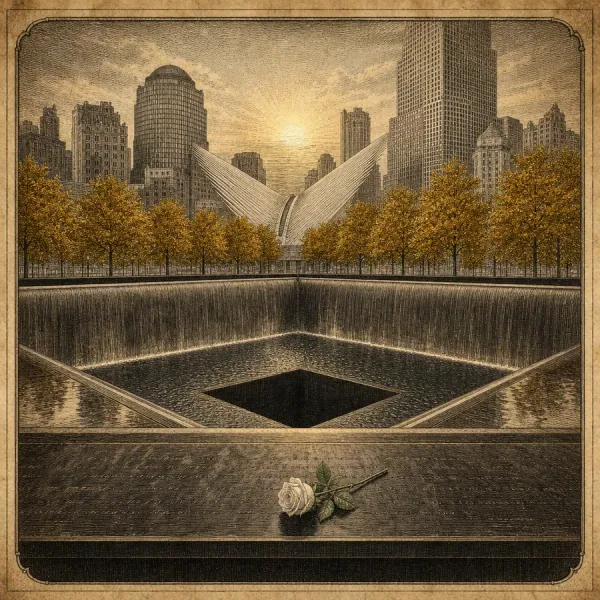
The memory of the September 11 attacks: the Tribute in Light, the national memorial and its two pools in New York, the Survivor Tree, the museum, the rebuilding of the site with One World Trade Center, and the Pentagon and Shanksville memorials.
Study “The September 11 Attacks” with flashcards and quizzes
In Oria, you read the full course, then practice on it: flashcards, multiple-choice quizzes, open questions or the Feynman method. Cards and questions then come back in your daily review, paced by spaced repetition.
Study this topic in OriaSources
These notes draw on the sources below. If a point seems doubtful, refer back to them.