History
Charles de Gaulle: Biography and Study Notes
From a young Saint-Cyr officer to the man of June 18 and the founder of the Fifth Republic
Study this topic in OriaThe essentials
Born in Lille in 1890, Charles de Gaulle becomes an officer, is captured at Verdun, and argues before 1940 for bold new ideas about tanks. You will follow the June 18 appeal, Free France, the liberation of Paris, and the long years in the political wilderness. You will see how he returns to power in 1958, founds the Fifth Republic, ends the Algerian War, and faces down May 1968, before leaving power in 1969 and dying at Colombey-les-Deux-Églises in 1970.
Key dates and facts
- May 17, 1940
- Counterattack at Montcornet
- June 18, 1940
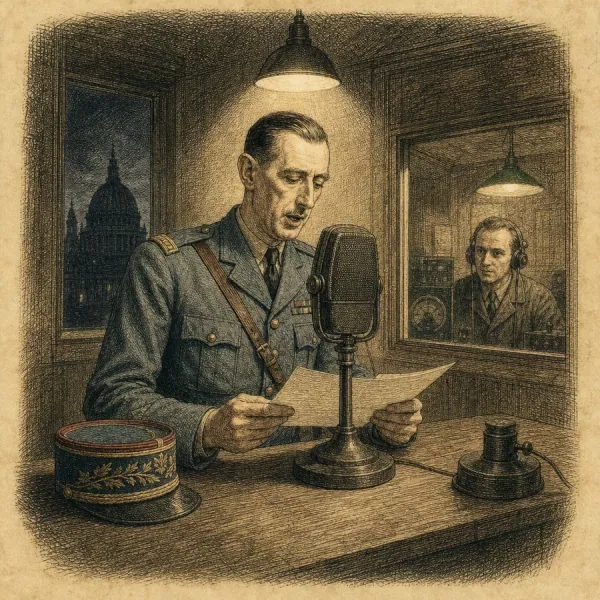
- Appeal on the BBC
- August 2, 1940
- Sentenced to death in absentia
- May 1943
- Settles in Algiers
- August 25, 1944
- Liberation of Paris
- January 20, 1946
- Resigns as head of the GPRF
- 1947
- Founds the RPF
- 1954
- First volume of the War Memoirs
- May 13, 1958
- Crisis in Algiers
- September 28, 1958
- Constitution approved by referendum
🏫 A Catholic, patriotic childhood
Charles de Gaulle was born on November 22, 1890, in Lille, at 9 Rue Princesse. His family lived in Paris, but his mother had traveled to Lille to give birth, in keeping with Maillot family tradition. Charles was the third of five children of Henri de Gaulle and Jeanne Maillot, a cousin of her husband. He had three brothers and one sister.
👨👩👦 A family of devout, well-read Catholics
His father, wounded in the war of 1870, was a deeply learned man who held three doctorates. He taught literature, history, and mathematics at the Jesuit Collège de l'Immaculée-Conception in Paris, where Charles was his pupil. A monarchist at heart, he eventually came to doubt the guilt of Captain Dreyfus. He introduced his son to the works of Maurice Barrès, Henri Bergson, and Charles Péguy. His mother was, if anything, more passionate still: in his War Memoirs, de Gaulle honored her as a woman “who carried for her country a passion as uncompromising as her religious faith.” Young Charles grew up steeped in reverence for national greatness and the Catholic faith.
📖 A pupil already dreaming big
Seen as a “difficult” child by his own family, he was at first considered an average student, less brilliant than his older brother Xavier, though he excelled in history. At fifteen, in 1905, he wrote a story imagining himself as “General de Gaulle,” saving France. He would later confide that, since adolescence, he had been convinced he was destined to lead the nation.
At the turn of the twentieth century, the laws of 1901 and 1905 barred religious orders from teaching in France. His father therefore enrolled Charles with French Jesuits who had relocated to Belgium, at the château of Antoing: his first taste of exile.
The Special Military School that trains officers of the French Army. Admission is by competitive examination, after dedicated preparatory study.
🎖️ Saint-Cyr and Colonel Pétain
After a year of preparation at the Collège Stanislas in Paris, he passed the entrance exam for Saint-Cyr in 1909, ranking 119th out of 221. As the law required, he first served a year as an ordinary soldier in the 33rd Infantry Regiment at Arras, then entered the school. Very tall, he progressed quickly and graduated in 1912, ranked 13th. He chose to return to the 33rd Infantry Regiment as a second lieutenant. His commanding officer was a colonel headed for a towering destiny of his own: Philippe Pétain, whom he would follow for some fifteen years before breaking with him. On October 1, 1913, de Gaulle was promoted to lieutenant. Less than a year later, war broke out.
🪦 The Great War: wounds and captivity
When the First World War broke out in August 1914, all four de Gaulle brothers were mobilized as officers; all four would come home alive and decorated. Lieutenant Charles de Gaulle left with the 33rd Infantry Regiment.
🩹 Wounded in his very first battle
In his first engagement, at Dinant, in Belgium, on August 15, 1914, he was hit in the leg by a bullet. Operated on in Paris, he was promoted to captain in February 1915 and rejoined the front in Champagne, where he commanded a company. On March 10, 1915, he was wounded again, this time in the left hand. Impatient to get back into the fight, he ordered fire on the enemy trenches against his superiors' wishes, which earned him eight days' suspension from duty. A demanding officer, sometimes abrasive, he nonetheless stood out for his intelligence and his courage under fire.
💥 Verdun: Douaumont, March 2, 1916
During the Battle of Verdun, on March 2, 1916, the 33rd Regiment defended the village of Douaumont and found itself surrounded. Attempting to break through, de Gaulle dove into a shell hole; German soldiers followed him in and wounded him with a bayonet thrust to the left thigh. He was taken prisoner. Believing him dead, the French army cited him for valor. Later, his political opponents would spread rumors about the circumstances of his capture.
🔒 Thirty-two months in captivity
Treated in Mainz, he was interned at Osnabrück, then moved from camp to camp, eventually reaching the fortress of Ingolstadt, in Bavaria, a reprisal camp reserved for prisoner-officers judged troublesome. There he crossed paths with the aviator Roland Garros, the future general Catroux, and the future Soviet marshal Mikhail Tukhachevsky. To fight off boredom, he gave his fellow prisoners long, masterful lectures on the war then raging.
Above all, he tried to escape five times, without success: hidden in a laundry basket, digging a tunnel, breaking through a wall, or disguised as a nurse. Each failed attempt was punished with long stretches of solitary confinement. In a letter to his mother, he spoke of a “wretched exile.” In all, he spent thirty-two months in captivity, across several camps.
A harsher place of detention where Germany sent prisoner-officers who attempted to escape or defied camp discipline.
😔 The feeling of having missed the war
Freed after the armistice of November 11, 1918, he was reunited with his family that December. He carried a bitter memory of those years: he described himself as a “ghost,” a soldier who had been unable to serve while his comrades fought. He nonetheless received the Cross of Chevalier of the Legion of Honor in 1919, along with the Croix de Guerre. From then on, he was determined to make up for lost time and build a career.
The rest of the course
This page publishes the first 2 parts. The full course has 9: here is what the next ones cover.
- 📚 The officer-writer and the battle over tanks
The interwar years: a mission in Poland, marriage to Yvonne Vendroux, the War College, a career spent close to Pétain, books (The Edge of the Sword, The Army of the Future), the fight for autonomous armored divisions, and the break with Pétain.
- 🎙️ The June 18 appeal and Free France
The Battle of France at the head of the 4th Armored Division, entry into the Reynaud government, the flight to London and the appeal of June 18, 1940, Vichy's death sentence, the building of Free France, relations with Churchill and Roosevelt, and the move to Algiers in 1943.
- 🗼️ Liberation, power, then the years in the wilderness
The Provisional Government (GPRF), the return to France in June 1944, the liberation of Paris, the great reforms of the Liberation, the resignation of January 1946, the Bayeux speech, the RPF, and retirement to Colombey while writing the War Memoirs.
- 🏛️ 1958: the return and the Fifth Republic
The crisis of May 13, 1958, in Algiers, Charles de Gaulle's return to power as the last prime minister of the Fourth Republic, the Constitution of 1958, his election to the presidency, the new franc, the atomic bomb, the Petit-Clamart assassination attempt, and the election of the president by direct universal suffrage.
- 🌍 Algeria and the end of the empire
Charles de Gaulle's Algerian policy: “I have understood you,” continuation of the war, self-determination, the generals' putsch, the OAS, the crackdowns of October 17, 1961, and Charonne, the Évian Accords and independence in 1962, the fate of the pieds-noirs and the harkis, and the decolonization of Africa.
- ⚡ Grandeur, May 1968, and departure
The policy of national independence (the bomb, withdrawal from NATO's integrated command, a Europe of nations, the veto against the United Kingdom, recognition of China, Quebec libre), the 1965 re-election, the crisis of May 1968, and the lost referendum that forced his resignation on April 28, 1969.
- 🕊️ Colombey, death, and legacy
Charles de Gaulle's final months at Colombey, writing Memoirs of Hope, his death on November 9, 1970, a simple funeral as he had requested in his will, and his legacy: the Constitution of 1958, nuclear deterrence, a consensus figure who is still criticized.
Study “Charles de Gaulle” with flashcards and quizzes
In Oria, you read the full course, then practice on it: flashcards, multiple-choice quizzes, open questions or the Feynman method. Cards and questions then come back in your daily review, paced by spaced repetition.
Study this topic in OriaSources
These notes draw on the sources below. If a point seems doubtful, refer back to them.