History
The Paris Commune: Summary and Study Notes
72 days when Paris tried to govern itself
Study this topic in OriaThe essentials
In the aftermath of a lost war against Prussia, Paris refused the authority of the government based in Versailles and elected its own assembly, the Commune. For 72 days, it passed bold measures on work, schools, secularism and the place of women, before being crushed during the Bloody Week. You'll understand why the uprising broke out, how insurgent Paris worked, what the repression was like and why the Commune became a reference point for revolutionaries all over the world, from Lenin to Mao.
Key dates and facts
- July 19, 1870
- France declares war on Prussia
- September 4, 1870
- The Republic is proclaimed
- January 28, 1871
- Armistice after the siege of Paris
- February 8, 1871
- A monarchist-majority Assembly is elected
- November 28, 1871
- Ferré and Rossel executed at Satory
- 1872
- First convoy of deportees to New Caledonia
- March 3, 1879
- Partial amnesty
- July 11, 1880
- Full amnesty
🏙️ Paris in 1870: a republican, working-class capital
The Paris Commune was the insurrection that governed the French capital from March 18 to May 28, 1871. To understand it, you first have to look at the city that carried it. Since 1789, Paris had often brought down regimes: the storming of the Bastille, the Three Glorious Days of 1830, the revolution of February 1848. The writer Jules Vallès called the city the “bivouac of revolutions,” a phrase taken up by historians such as Britain's Robert Tombs and France's Michel Cordillot.
🗳️ A city that votes against the Emperor
Since Louis-Napoléon Bonaparte's coup d'état in 1851, Paris had been denied an elected mayor: the city was run by the prefect of police and by the prefect of the Seine, Baron Haussmann. Yet republican feeling kept growing. In the legislative elections of 1869, Paris elected eight republicans out of nine deputies. In the plebiscite of May 8, 1870, the “no” vote against the Empire reached 77% in Belleville, a working-class district in the east. The funeral of the journalist Victor Noir, killed by Prince Pierre-Napoléon Bonaparte, drew some 200,000 people.
🏗️ A city split in two
Paris had grown from about one million inhabitants in 1851 to nearly two million in 1870. Haussmann's great works had cut straight boulevards through the city and built monuments such as the Opéra Garnier, but rising rents had pushed the poorest out to the faubourgs annexed in 1860, while the west and the center housed the wealthiest. The 1866 census counted 455,400 workers, 120,600 clerks and 140,000 employers, mostly running small workshops: more than 60% of employers worked alone or with a single worker.
✊ An organizing labor movement
The 1860s saw the birth of a militant labor movement. Strikes had been tolerated since 1864 and public meetings since 1868. The International Workingmen's Association (the “First International”), whose motto from 1864 was “the emancipation of the working classes must be conquered by the working classes themselves,” was represented in Paris by Eugène Varlin. Alongside it were the Blanquists, followers of the revolutionary Auguste Blanqui, who believed in insurrection. For Michel Cordillot, three forces would converge in 1871: the rise of the Republic, the growth of workers' organizations and a patriotism inflamed by the war.
⚔️ Defeat, siege and anger
The Paris Commune was born of a military defeat. On July 19, 1870, Napoleon III's France declared war on Prussia. The poorly prepared French army went from one setback to the next.
🇫🇷 The Republic proclaimed, Paris surrounded
After the emperor's surrender at Sedan, the deputies of Paris proclaimed the Republic on September 4, 1870. A Government of National Defense continued the war, but as early as September 19 the German armies surrounded Paris. The siege lasted more than four months: hunger, cold, then bombardment. Hundreds of thousands of men enlisted in the National Guard, a citizens' militia that elected its officers. On October 31, 1870, and January 22, 1871, uprisings were already demanding a “Commune,” that is, an elected, revolutionary city government.
On January 18, 1871, the German Empire was proclaimed in the Hall of Mirrors at the Palace of Versailles. Ten days later, the government signed the armistice. Many Parisians, who had held out through the siege, experienced it as a betrayal.
🗺️ A rural Assembly against a republican Paris
The armistice provided for the election of a National Assembly to make peace. On February 8, 1871, the countryside elected a monarchist, conservative majority, while Paris sent 36 republicans out of 43 deputies. The peace terms were harsh: the annexation of Alsace-Lorraine, an indemnity of 5 billion gold francs, and a partial occupation of Paris by German troops for three days.
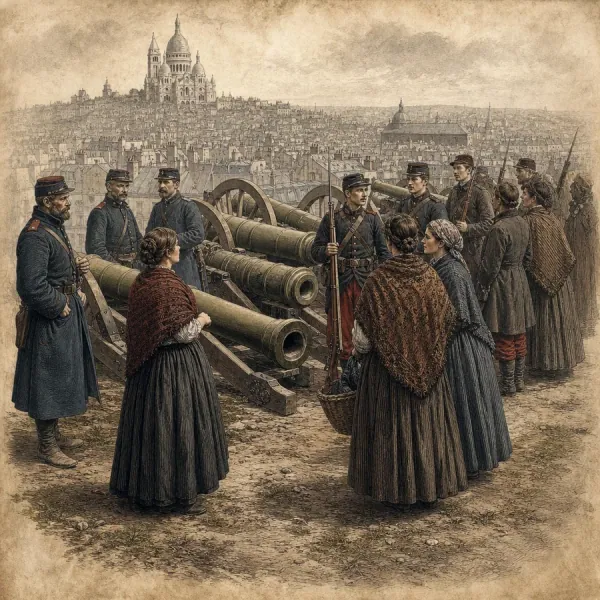
The Assembly and the head of the executive, Adolphe Thiers, then took one decision after another that infuriated the capital. On March 10, the Assembly ended the moratorium on commercial debts, threatening thousands of artisans and shopkeepers with bankruptcy, and cut off the pay of many National Guardsmen. It also chose to sit in Versailles, the old city of the kings, rather than in Paris. On March 15, the battalions of the National Guard federated and elected a Central Committee: hence the name “Fédérés” given to the future insurgents.
The rest of the course
This page publishes the first 2 parts. The full course has 9: here is what the next ones cover.
- 💥 March 18, 1871: the affair of the cannons
The uprising of March 18, 1871: Thiers's attempt to seize the cannons of Montmartre, the soldiers fraternizing with the crowd, the execution of two generals and the government's retreat to Versailles.
- 🏛️ Governing Paris: elections, council and direct democracy
The political organization of the Paris Commune: the elections of March 26, the makeup and factions of the council, the binding and recallable mandate, the Committee of Public Safety and the divisions between majority and minority.
- 📜 The measures: work, schools, secularism and women's rights
The main decisions of the Paris Commune: emergency social measures, cooperative workshops, the ban on night work for bakers, the separation of church and state, free secular schooling, the Women's Union.
- 🎭 Living in insurgent Paris: clubs, press and symbols
Daily life under the Paris Commune: the atmosphere, clubs in churches, the boom in newspapers, the Federation of Artists, anticlericalism, the toppling of the Vendôme Column and the worldwide echo.
- 🔥 The war against Versailles and the Bloody Week
The second siege of Paris and the Bloody Week of May 21–28, 1871: the forces involved, the troops' entry, barricades, fires, executions of hostages and massacres, and the debate over the death toll.
- ⛓️ Trials, deportation and amnesty
The judicial repression after the Paris Commune: arrests, exile, courts-martial, deportation to New Caledonia, the amnesty laws of 1879–1880 and the rehabilitation of 2016.
- 🌍 Rival memories and a global legacy
The afterlife of the Paris Commune: the black and tricolor legends, the Sacré-Cœur, the Communards' Wall, songs, the readings of Marx, Engels, Lenin and Mao, anarchists and historians' debates.
Study “The Paris Commune” with flashcards and quizzes
In Oria, you read the full course, then practice on it: flashcards, multiple-choice quizzes, open questions or the Feynman method. Cards and questions then come back in your daily review, paced by spaced repetition.
Study this topic in OriaSources
These notes draw on the sources below. If a point seems doubtful, refer back to them.