Classic novels
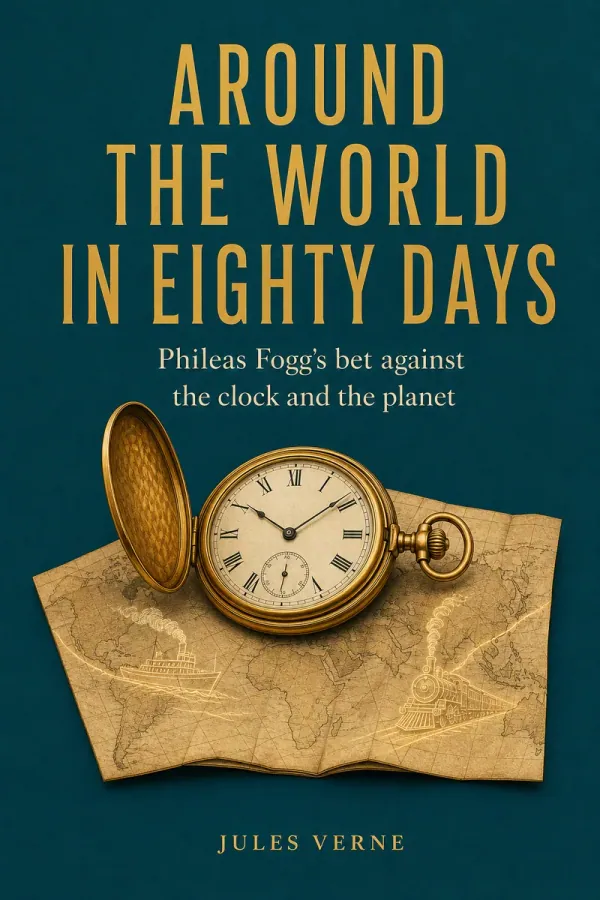
Around the World in Eighty Days by Jules Verne: Summary and Study Notes
Phileas Fogg's bet against the clock and the planet
Study this topic in OriaThe essentials
Serialized at the end of 1872, Around the World in Eighty Days tells the race of Phileas Fogg, a London gentleman of mechanical precision, and his French valet Passepartout, pursued by a policeman who thinks they are thieves. Trains, steamships, an elephant, a sail-powered sled: the novel celebrates a world that the Suez Canal and the railroads had just shrunk, and it ends with a famous geographical twist. You'll discover Jules Verne, the context of 1872, the journey stage by stage, the characters, the secret of the day gained, and the book's immense legacy.
Key dates and facts
- 1828
- Born in Nantes
- 1863
- Five Weeks in a Balloon with Hetzel
- 1871
- Settles in Amiens
- 1872
- Writes Around the World
- 1872
- Serialized in Le Temps
- 1874
- Play at the Porte-Saint-Martin
- 1889
- Nellie Bly in 72 days
- 1956
- Michael Anderson's Oscar-winning film
⚓ Jules Verne, from Nantes to the Extraordinary Voyages
Jules Verne was born on February 8, 1828, in Nantes, on the Île Feydeau, then a small island in the Loire River. His father was a lawyer; his mother came from a Nantes family of sailors and shipowners. The boy grew up on the riverbank, fascinated by merchant ships. Legend has it that at eleven he tried to slip aboard a ship bound for the Indies as a cabin boy; biographers now know this story was invented, or at least greatly exaggerated, by his niece.
🎭 Law, theater, and the library
His father intended him to take over his law practice. In 1848, Jules went to Paris to study law, earning his degree in 1851. But he preferred literature: he frequented the salons, befriended Alexandre Dumas fils, who staged his first comedy in 1850, and became secretary of a theater. He also spent hours at the National Library, copying onto index cards everything he learned about geography and science, a method he kept all his life. He published adventure stories in the Musée des familles and began dreaming of a new genre, the “novel of science.” In 1857 he married Honorine Morel and worked for a time as a stockbroker at the Paris Bourse.
🎈 Meeting Hetzel
In 1862 he showed the publisher Pierre-Jules Hetzel, who published Victor Hugo and George Sand, the manuscript of a balloon journey over Africa. Hetzel asked him to rework it; the novel, Five Weeks in a Balloon, came out in early 1863 and was a huge success, even abroad. Hetzel had him sign a contract: three volumes a year, first serialized in his Magasin d'éducation et de récréation. Together they launched the Extraordinary Voyages, a series that would run to sixty-two novels and eighteen short stories. The project, as Hetzel announced it, was to recount in an entertaining way all the geographical, geological, physical, and astronomical knowledge of modern science. There followed Journey to the Center of the Earth (1864), From the Earth to the Moon (1865), and Twenty Thousand Leagues Under the Seas (1869–1870).
🕰️ The hard years
The years 1870–1871 were hard. During the Franco-Prussian War, Verne served in the coast guard. He had money worries, and his father died on November 3, 1871. In July 1871 he settled in Amiens, his wife's hometown. It was there, in the library of the Société industrielle, rich in scientific journals, that he prepared his next novel. On March 8, 1872, when he was received into the Amiens Academy, he replaced the customary acceptance speech with a reading from the book he was writing: Around the World in Eighty Days.
🌐 1869–1872: the world shrinks
In the 19th century, the Industrial Revolution transformed transportation. Railroads and steamships shortened distances, or rather the time needed to cover them. But three almost simultaneous events changed everything between 1869 and 1870.
🚂 Three shortcuts in two years
- In 1869, the United States completed its first transcontinental railroad, linking the Atlantic to the Pacific.
- The same year, the Suez Canal opened in Egypt: ships from Europe no longer had to sail around Africa to reach the Indian Ocean.
- In 1870, the railway lines of India were joined across the subcontinent, from Bombay to Calcutta.
For the first time, a traveler could sit down, draw up a timetable, buy tickets, and go around the planet in relative comfort, a feat until then reserved for the most adventurous explorers. It was the end of the age of exploration and the beginning of global tourism.
📰 An idea in the air
Verne invented neither the idea nor even the title. On October 3, 1869, the French periodical Le Tour du monde published a short article titled “Around the World in Eighty Days,” which mentioned the still-unfinished stretch of railway between Allahabad and Bombay and proposed a timetable very close to the novel's. In 1870, an American railroad company published an itinerary around the globe in 77 days and 21 hours. The American traveler George Francis Train claimed to have completed a trip around the world in eighty days in 1870; he later went so far as to present himself as Jules Verne's Phileas Fogg. Finally, in 1872, the British agency of Thomas Cook organized the first round-the-world tourist trip, which left on September 20, 1872, and lasted seven months.
Verne himself described the spark: one day, in a Paris café, he read in a newspaper that a man could travel around the world in eighty days. He immediately thought he could make his traveler gain or lose a day thanks to a difference in meridian. The ending had found itself, he explained. He added that he sometimes kept an idea in his head for ten or fifteen years before giving it shape.
The rest of the course
This page publishes the first 2 parts. The full course has 9: here is what the next ones cover.
- 🃏 The wager at the Reform Club
The novel's opening: Phileas Fogg, a gentleman who runs like clockwork, hires Passepartout, bets £20,000 at the Reform Club, and leaves that same evening.
- 🐘 From Suez to Calcutta: the elephant and Aouda
The crossing to India, the pagoda incident in Bombay, the unfinished railway line, the purchase of the elephant Kiouni, and the rescue of Aouda.
- 🏮 Hong Kong and Yokohama: opium and the circus
The stops in Asia: Fix reveals himself, Passepartout is drugged in an opium den, Fogg misses the steamer, then everyone meets up again in Japan at a circus.
- 🚂 America by train, by sled, then by burning ship
Crossing the United States and the Atlantic: the Medicine Bow bridge, the attack on the train, Passepartout's rescue, the sail-powered sled, the Henrietta burned plank by plank.
- 🎩 Fogg, Passepartout, Fix, and Aouda
The four main characters, their contrasts, and the novel's themes: keeping one's word, loyalty, composure, and the measurement of time.
- 🌅 The day gained: the meridian trick
The ending: Fogg thinks he has lost, but he gained a day by traveling east. An explanation of the phenomenon, its sources, and its critics.
- 🏁 From serial to world records: a bet that never ends
The serialization synchronized with the journey, success on stage, translations, real-life imitators from Nellie Bly to Michael Palin, and adaptations.
Study “Around the World in Eighty Days” with flashcards and quizzes
In Oria, you read the full course, then practice on it: flashcards, multiple-choice quizzes, open questions or the Feynman method. Cards and questions then come back in your daily review, paced by spaced repetition.
Study this topic in OriaSources
These notes draw on the sources below. If a point seems doubtful, refer back to them.