Civilizations
Ancient Greece: Summary and Study Notes
The city-states that invented politics, philosophy, and theater
Study this topic in OriaThe essentials
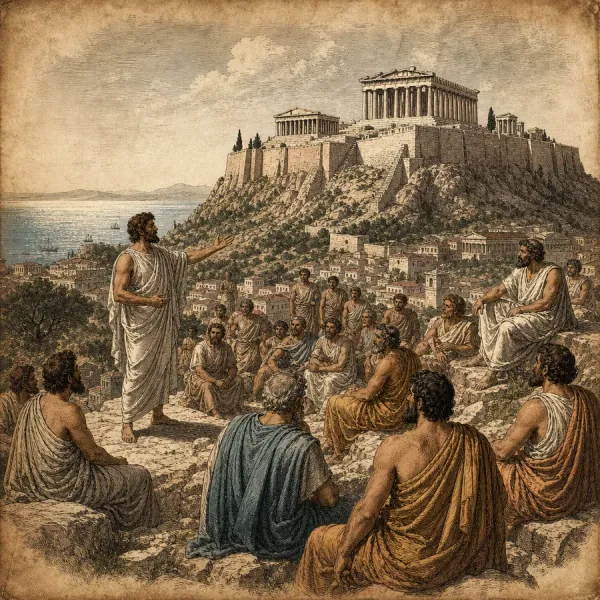
For more than a thousand years, the Greeks lived in hundreds of independent city-states, from Asia Minor to Sicily. You'll discover how the city-state was born, how Athens invented democracy and why Sparta fascinated its neighbors, relive the wars against the Persians and then among the Greeks themselves, step into their temples, stadiums, and theaters, follow Alexander the Great all the way to the Indus, and understand what we still owe to the ancient Greeks today.
Key dates and facts
- c. 1200 BC
- Beginning of the Dark Ages
- c. 800 BC
- Beginning of the Archaic period
- 480 BC
- Beginning of the Classical period
- 323 BC
- Death of Alexander, beginning of the Hellenistic period
- 31 BC
- Battle of Actium, end of the Hellenistic kingdoms
- 594 BC
- Solon becomes archon
- 508 BC
- Cleisthenes's reforms
- 451 BC
- Misthos and the citizenship law
- 429 BC
- Death of Pericles
- 490 BC
- Athenian victory at Marathon
🗺️ A world of city-states
The ancient Greeks did not call themselves “Greeks,” a word that comes from Latin; they called themselves Hellenes, descendants of a mythical king named Hellen, and they called their land Hellas. Ancient Greece was never a unified country: it was a group of peoples who shared a language, gods, and customs, but who lived in hundreds of independent, often rival, communities.
⛰️ A dividing geography
The Greek world stretched across present-day Greece, the islands of the Aegean Sea, and the west coast of Asia Minor, now Turkey. Over time, it reached Sicily and southern Italy, known as Magna Graecia, the shores of the Black Sea, and many other Mediterranean coasts. The terrain explains part of this division: every island, valley, and plain is cut off from its neighbors by sea or mountains, which favored a multitude of small communities.
🏛️ The city-state, heart of Greek life
The most common form of organization was the polis, the city-state, which took shape in the Archaic period. A city-state was above all a community of citizens: people did not say “Athens” but “the Athenians,” not “Sparta” but “the Spartans.” Citizens were always adult men, which excluded a large part of the population: women, slaves, and foreigners. Each city-state had a center, usually a town, and roughly the same institutions: an assembly, a council, courts, and magistrates, governed from the 7th century BC onward by written laws.
Depending on the city, power lay in the hands of an elite — oligarchy — or of most adult men — democracy, of which Athens represented the most advanced form; in the Archaic period, tyrants also seized power in some cities. The philosopher Aristotle would later define man as a “political animal,” who can only flourish within a polis. Our word “politics” itself comes from polis. Not all of Greece lived in city-states, however: in the north and west, peoples organized into ethnē, sometimes ruled by kings as in Macedonia, lived alongside the world of the city-states.
🕰️ The major periods
Before the Greece of city-states, the Minoan civilization flourished in Crete, followed by the Mycenaean civilization, whose Linear B tablets are the oldest surviving texts in Greek. After the collapse of the Mycenaean palaces, around 1200 BC, historians distinguish four major periods:
What united these Greeks? For the historian Herodotus: common ancestry, a shared language despite its dialects, and shared rites. A century later, the Athenian orator Isocrates proposed a more open definition: a Greek is one who shares in Greek education, rather than one who shares Greek origin.
🏺 The Archaic period
After the “Dark Ages,” a poorly documented period following the collapse of Mycenaean civilization, the Greek world experienced a dramatic acceleration in the 8th century BC. The beginning of the Archaic period is often placed, symbolically, in 776 BC, the supposed date of the first Olympic Games. It ends with the wars against the Persians, in 480–479 BC.
🔤 The alphabet and the epics
Around 800 BC, the Greeks adopted writing by drawing on the Phoenician alphabet: this was the birth of the Greek alphabet. The great epic narratives of Homer, the Iliad and the Odyssey, and the poems of Hesiod, who are thought to have lived in the second half of the 8th century BC, became the founding texts of all Greek culture. Lyric poetry followed, with writers such as Sappho and Pindar.
⛵ Setting off to found new cities
As city-states took shape, the Greeks launched, after 750 BC, into a great wave of colonization. They founded new cities along the shores of the Mediterranean and the Black Sea, particularly in Sicily and southern Italy, known as Magna Graecia. A shortage of land, driven by population growth, probably explains much of this outward movement. Each colony was a new city-state, governing itself.
🛡️ Hoplites and tyrants
Warfare changed too. With the “hoplite revolution,” armies became armies of citizens: heavily armed foot soldiers, the hoplites, who fought packed together in tight ranks, the phalanx. Since soldiers bought their own equipment, well-off farmers and craftsmen gained a new standing alongside the aristocracy. City-states also experienced sharp social tensions, between the rich and the indebted poor. Against this backdrop, tyrants — men who exploited unrest to seize power — took control of many cities, such as Argos, Corinth, and Athens.
🪙 Coinage, temples, and statues
Another innovation came from Asia Minor: minted coinage, which spread rapidly across the Greek world. The first stone temples appeared in the 7th century BC; by the early 6th century, the model of the Greek temple was set: a rectangular building surrounded by columns, housing the statue of the god. Sculptors, inspired by Egypt, created kouroi, statues of standing nude young men. Potters invented the black-figure style after 600 BC, then, around 525, the red-figure style, in which the figures kept the color of the clay against a black background.
By the end of the period, two city-states stood out for their power: Sparta, with the most formidable army, and Athens, which ended tyranny and invented its democratic system.
The rest of the course
This page publishes the first 2 parts. The full course has 9: here is what the next ones cover.
- 🗳️ Athens and democracy
The birth and workings of Athenian democracy: Solon, Cleisthenes's reforms of 508 BC, the Ecclesia, the use of lot, ostracism, and the age of Pericles.
- 🛡️ Sparta, the city of soldiers
Sparta's distinctive organization: citizen-soldiers, helots, and perioikoi, collective education, two kings, ephors and the Gerousia, military power, and the "Spartan mirage."
- ⚔️ From the Greco-Persian Wars to the Peloponnesian War
The wars against the Persian Empire (Marathon, Thermopylae, Salamis, Plataea), followed by the long war between Athens and Sparta, from 431 to 404 BC.
- ⚡ Gods, myths, and the Olympic Games
Greek religion (the gods of Olympus, sacrifices, sanctuaries, the oracle of Delphi, beliefs about death), the great myths, and the ancient Olympic Games.
- 🎭 Philosophy, theater, and history
Greek intellectual inventions: the first philosophers, Socrates, Plato, and Aristotle, history-writing with Herodotus and Thucydides, tragic and comic theater, and the medicine of Hippocrates.
- 🐎 Alexander the Great and the Hellenistic world
The rise of Macedon, Alexander the Great's conquests as far as the Indus, the division of his empire, Alexandria and Hellenistic science, up to the Roman conquest.
- 🏛️ The Greek legacy
What ancient Greece passed on: Greco-Roman culture, Byzantium, rediscovery by the humanists, archaeological excavations, and the legacy in politics, thought, and the arts.
Study “Ancient Greece” with flashcards and quizzes
In Oria, you read the full course, then practice on it: flashcards, multiple-choice quizzes, open questions or the Feynman method. Cards and questions then come back in your daily review, paced by spaced repetition.
Study this topic in OriaSources
These notes draw on the sources below. If a point seems doubtful, refer back to them.