Great discoveries & mysteries
Göbekli Tepe: Summary and Study Notes
The oldest known sanctuary, built by hunter-gatherers
Study this topic in OriaThe essentials
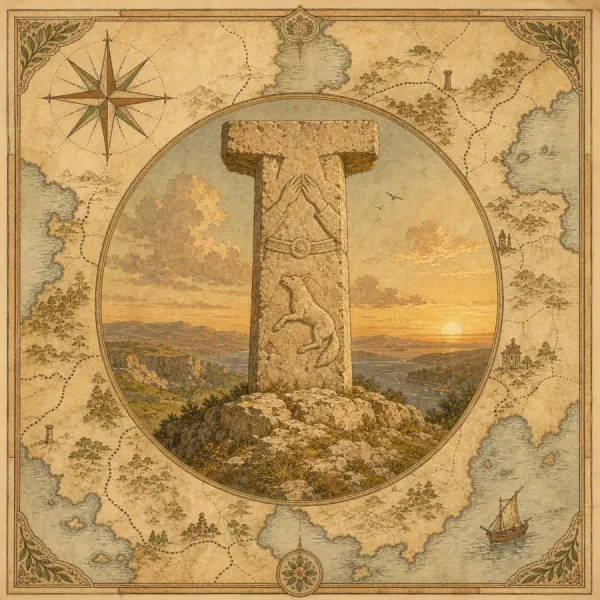
On a hill in southeastern Turkey, archaeologists have uncovered stone enclosures set with giant T-shaped pillars, raised more than 11,000 years ago. You'll follow the investigation since 1963 and discover the carved animals, the main hypotheses about the site's purpose and what it changes in our story of the Neolithic. You'll also see why the idea of a “first temple” has been qualified, and why science rejects theories of a lost civilization or an apocalyptic comet.
Key dates and facts
- 1963
- Site spotted by a Turkish-American survey
- 1994
- Klaus Schmidt identifies the pillars
- 1995
- Excavations begin
- 2014
- Death of Klaus Schmidt
- c. 9500 BC
- First enclosures and round houses
- c. 8800 BC
- First large monolithic pillars set in walls
- Late 9th millennium BC
- Landslides, enclosure D abandoned
- c. 8000 BC
- Decline of the site, small dwellings in the ruins
- 2011
- World Heritage nomination
- 2018
- Inscription by UNESCO
🏔️ A potbellied hill on the edge of Mesopotamia
Göbekli Tepe (pronounced roughly “gur-BECK-lee TEH-peh”) means “Potbelly Hill” in Turkish. It is an archaeological site in Şanlıurfa Province, in southeastern Turkey, about fifteen kilometers northeast of the city of the same name and not far from the Syrian border. It sits on top of a limestone plateau, at an altitude of about 765 meters, at the foot of the Taurus Mountains. From there, the view takes in the Harran plain and the headwaters of the Balikh, a tributary of the Euphrates: this is the northern edge of Mesopotamia, in the region also known as the “Fertile Crescent.”
🗺️ A man-made mound
What looks like a natural hill is actually a tell, an artificial mound formed by the buildup of structures and debris. It rises about 15 meters and covers 8 to 9 hectares, depending on the measurement. Beneath the soil lie large circular enclosures ringed by stone walls, within which stand T-shaped limestone pillars, 3 to 5.5 meters tall and often carved with animals. They are among the oldest known megaliths in the world.
⏳ More than 11,000 years old
Radiocarbon dating places the construction of the first enclosures around 9500 BC, and the occupation of the site until at least about 8000 BC (some authors extend the range to around 7500). To grasp the gap: Göbekli Tepe is about 6,000 years older than the earliest phases of Stonehenge, which has its own chapter in Explorer, and about 7,000 years older than the Egyptian pyramids. At that time, writing, metal, the wheel and pottery did not yet exist.
The first phase of the Neolithic in the Near East, before the invention of pottery, divided into two sub-periods: PPNA (c. 9600 – 8800 BC) and PPNB (c. 8800 – 7000 BC). It is the period when the first permanent villages and the first experiments in farming and herding appeared.
❓ Why all the fuss?
For a long time, monumental architecture was thought to be the work of farming societies, wealthy and organized enough to feed builders. Yet Göbekli Tepe was built at the dawn of agriculture, by communities that still lived mainly by hunting and gathering. The site therefore forces us to rethink the order of things: what if large gatherings, beliefs and collective building projects accompanied, or even preceded, the birth of agriculture? It is this question, and the way archaeologists have gradually refined their answers, that has made Göbekli Tepe one of the most debated discoveries of the past thirty years.
🔎 The investigation: from “small cemeteries” to Klaus Schmidt
The story of Göbekli Tepe's discovery is the story of a clue that was long misread. Well before the archaeologists, the hill was already a special place for local people: the region's Kurds call it Girê Mirazan, “the hill of wishes,” and a mulberry tree marking a Muslim pilgrimage site still stands there.
📋 1963: a survey that missed it
The site was spotted in 1963 (1965 according to some sources) during a major survey carried out by Istanbul University, under Halet Çambel, and the University of Chicago, under Robert Braidwood. The American archaeologist Peter Benedict noticed thousands of flint flakes on the surface, a sure sign of Pre-Pottery Neolithic occupation. But he interpreted the tops of the large slabs sticking out of the ground as gravestones and mainly reported “small cemeteries.” The hill, farmed for a long time, had been reworked by generations of farmers who moved stones out of their way, and some pillars had even been partly broken. With no obvious sign of architecture, no excavation was undertaken.
🧭 1994: Klaus Schmidt's eye
In October 1994, the German archaeologist Klaus Schmidt (1953 – 2014) was searching the region for sites comparable to Nevalı Çori, a nearby Neolithic village where he had excavated buildings with T-shaped pillars. He reread the 1963 report and asked in the villages where there were hills covered in flint. Mahmut Yıldız, whose family owned the land and had already reported finds to the local museum, led him to Göbekli Tepe. On the spot, Schmidt realized that the mound could not be natural and that the “gravestones” looked exactly like the tops of the Nevalı Çori pillars. They weren't graves: they were the heads of buried megaliths.
⛏️ Twenty years of digging
Excavations began in 1995, led by the Şanlıurfa Museum and the German Archaeological Institute (DAI). The first giant pillar soon came to light. Schmidt bought a house near Urfa, which became his base, and his team dug for two months in spring and two months in autumn. Mahmut Yıldız joined the excavation and would become its guardian. In 2011, Schmidt estimated that about 5% of the site had been excavated.
Klaus Schmidt died of a heart attack on July 20, 2014. Research then continued under the coordination of Lee Clare for the DAI and the direction of the Turkish prehistorian Necmi Karul, of Istanbul University. The new team excavates less extensively and focuses on detailed documentation and on conserving the areas already uncovered. It is this team, as we will see, that has profoundly revised several of Schmidt's conclusions.
The rest of the course
This page publishes the first 2 parts. The full course has 9: here is what the next ones cover.
- 🗿 Stone enclosures and giant pillars
The site's architecture: circular enclosures, anthropomorphic T-shaped pillars, quarries and the debate over the labor required.
- 🦊 Foxes, snakes and vultures: the art of the pillars
The iconography of Göbekli Tepe: wild animals, abstract symbols, human figures, the totem pole and the skull cult.
- ⏳ Dating a 1,500-year building project
How archaeologists dated the site, and how Schmidt's chronology was replaced by eight phases of occupation.
- ⛪ First temple… or large village?
The serious hypotheses about the site's purpose: a sanctuary for nomadic hunter-gatherers according to Schmidt, then a village where ritual and daily life coexisted.
- 🌾 What Göbekli Tepe changes about the Neolithic
The debate over the order of agriculture, settled life and beliefs, and the other T-pillar sites of the region (Taş Tepeler).
- 🚫 Lost civilization, comet, observatory: the rejected theories
Popular theories about Göbekli Tepe (an advanced Ice Age civilization, a cosmic impact, an astronomical observatory) and the reasons archaeologists reject them.
- 🏛️ Göbekli Tepe today
UNESCO listing, protection of the site, conservation controversies and what remains to be excavated.
Study “Göbekli Tepe” with flashcards and quizzes
In Oria, you read the full course, then practice on it: flashcards, multiple-choice quizzes, open questions or the Feynman method. Cards and questions then come back in your daily review, paced by spaced repetition.
Study this topic in OriaSources
These notes draw on the sources below. If a point seems doubtful, refer back to them.