Great discoveries & mysteries
Lascaux Cave: Summary and Study Notes
Cave art, from Lascaux to Chauvet
Study this topic in OriaThe essentials
In September 1940, four young people squeezed into a hollow in the Vézère valley, in southwestern France, and found walls covered with aurochs, horses and deer painted some 21,000 years ago. You'll follow the investigation into the discovery, how the artists worked, the long debate over dating and the main theories about what these images mean. You'll also see how success nearly destroyed the cave, and how Lascaux compares with Chauvet, Altamira and the oldest rock art in the world.
Key dates and facts
- Sept. 8, 1940
- Marcel Ravidat spots the entrance
- Sept. 12, 1940
- First exploration by the four young people
- Sept. 21, 1940
- Visit by Abbé Henri Breuil
- Dec. 27, 1940
- Listed as a historic monument
- 1940
- Breuil attributes the works to the Perigordian
- 1951
- First radiocarbon dates by Willard Libby
- 1998 – 2002
- New dates on reindeer antler
- 2019
- The Lasco program publishes a date of about 21,000 years
- July 14, 1948
- Opens to the public
- 1960
- The “green sickness” appears
🔦 September 1940: four teenagers and a hole
Lascaux Cave opens onto a limestone hill at Montignac, in the Vézère valley, in the Dordogne, in southwestern France. Its discovery, in the middle of World War II, has been retold so often that the facts first need to be sorted from the embellishments.
🐕 A dog, a rabbit, an uprooted tree
According to the most common version, on September 8, 1940, Marcel Ravidat, 18, was walking on the hill with his dog Robot. The animal chased a rabbit into a hole left by an uprooted tree. At the bottom was an opening about twenty centimeters wide. Ravidat threw stones into it and heard them roll a long way down: the cavity was huge. Since it lay 500 meters from the Château de Lascaux, he thought of a tunnel, perhaps the local legend of a secret passage to the manor.
On September 12, he came back with a large knife and a makeshift lamp, along with Jacques Marsal, Georges Agniel and Simon Coencas. They widened the hole, slid inside and discovered, by the light of their lamp, walls covered with painted animals.
🧐 Untangling the legends
Accounts of the discovery are many and sometimes contradictory: a dog that fell into the hole, a lost ball, a cavity already known to the village children. Ravidat himself embellished the story over the years, claiming for example that his dog had fallen into the cave. What is established is the two-stage exploration, on September 8 and 12, 1940, and the names of the four young people who went in on the 12th.
🎓 From the schoolteacher to the great prehistorian
After several visits, Jacques Marsal ended up telling everything to his parents, who were puzzled to see him come home covered in dust. On September 16, their former schoolteacher, Léon Laval, was told; he first thought it was a joke, then was won over by drawings of the walls made by a former pupil. The news reached Abbé Henri Breuil, the leading expert on prehistoric art, who had taken refuge in the region to escape the occupying forces. He visited the cave on September 21, 1940, with other specialists, and immediately confirmed its importance.
Breuil asked the young discoverers to guard the cave day and night. They camped in a tent at the entrance… and charged two francs for a visit. The first visitors, for their part, didn't hesitate to scratch the paint or carve their initials. The cave was listed as a historic monument as early as December 27, 1940. At the time it belonged to the owners of the Lascaux estate, the La Rochefoucauld-Montbel family, who sold it to the French state in 1972.
Simon Coencas, the last survivor of the four, would attend the inauguration of the full replica of the cave in December 2016, at the age of 89.
🐂 A small cave, an immense decor
Lascaux is a modest cave: all its galleries together are no more than 235 meters long. A layer of impermeable marl protects it from water seeping in, which kept its walls dry and its paintings fresh for thousands of years. Henri Breuil, who gave the chambers names borrowed from church architecture, nicknamed it “the Sistine Chapel of cave art.”
Art made on the walls of caves and rock shelters (paintings, drawings, engravings), as opposed to portable art, made of objects that can be carried around, such as figurines or engraved bones.
🐎 The Hall of the Bulls
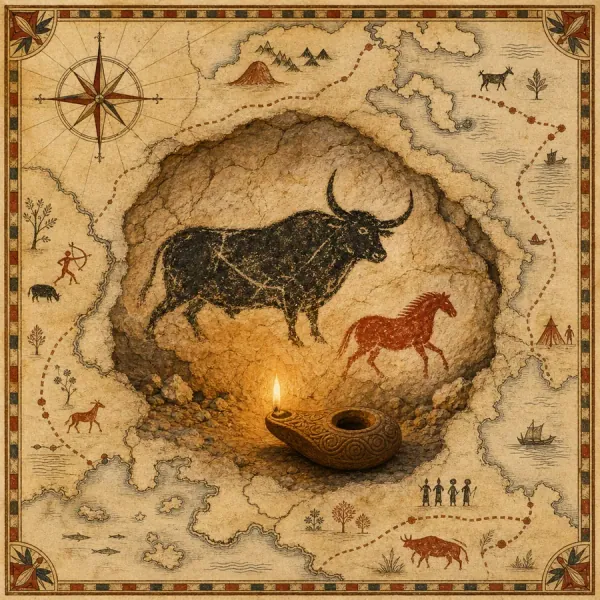
The first chamber, the Hall of the Bulls or Rotunda, is about 17 meters long. Its calcite-covered walls are poorly suited to engraving, so it is decorated only with paintings, some of which reach five meters in length, among the largest animal figures known in cave art. Two lines of aurochs, wild cattle now extinct, face each other, accompanied by about ten horses, small stags, the cave's only bear, and a strange animal with two lines on its forehead, nicknamed “the unicorn.”
🦌 From the Axial Gallery to the Apse
- The Axial Gallery extends the Hall of the Bulls: cows, horses, stags and ibexes seem to wind from one wall to the other up to the ceiling, four meters high, which probably required scaffolding.
- The Nave holds the frieze of the Swimming Stags, the Black Cow and the Crossed Bison, two bison tail to tail whose legs overlap to create an impression of depth.
- The Chamber of Felines, very hard to reach, contains engravings of big cats and a rare horse seen from the front.
- The Apse is covered with more than a thousand intertwined engravings, including the only reindeer depicted at Lascaux.
🐦 The Shaft, the most mysterious scene
At the back of the Apse opens the Shaft, a drop of four to five meters. Here is the most enigmatic scene at Lascaux: a schematic bird-headed man who seems to be falling backward in front of a bison disemboweled by a spear; near him, an elongated object topped by a bird, perhaps a spear-thrower; on the left, a rhinoceros walks away. Unlike most Paleolithic walls, where animals are simply placed side by side, the elements here seem connected to one another. For the prehistorian André Leroi-Gourhan, the scene probably evokes a mythological story whose meaning escapes us.
🔢 How many figures?
Counts vary depending on what is included. In the 1950s, the archaeologist André Glory recorded 1,433 depictions; about 1,900 are listed today in French inventories, and some English-language sources mention nearly 6,000 figures when all signs and markings are included. Among the identified animals, horses far outnumber the others, ahead of deer, aurochs and bison. Abstract signs are also abundant: dots, sticks, barbed signs and colored checkerboards that Breuil called “blazons.” On the other hand, there are no landscapes, no plants, no ground: the animals float on the rock, as almost always in Paleolithic art.
The rest of the course
This page publishes the first 2 parts. The full course has 8: here is what the next ones cover.
- 🎨 How the artists worked
The pigments, tools, lighting and techniques of the Lascaux painters, and what the remains found on the floor tell us about them.
- ⏳ How old is Lascaux? An 80-year investigation
How the age of the paintings has been estimated, from Breuil's style-based approach to the first radiocarbon dates in 1951 and the results of the Lasco program published in 2019.
- 🤔 Why paint deep inside a cave?
The main theories about the meaning of the art of Lascaux, from hunting magic to sanctuary, shamanism and star maps, and what research takes from them.
- 🦠 A victim of its own success
How opening to the public in 1948 damaged the cave, why it has been closed since 1963 and the long fight against fungi in the 21st century.
- 🌍 Chauvet, Altamira and the others
Lascaux compared with the other great cave art sites: Chauvet in France, Altamira in Spain, and even older rock art in Indonesia and South Africa.
- 🏛️ Visiting Lascaux without going in
The facsimiles of Lascaux, from Lascaux II in 1983 to the full replica Lascaux IV opened in 2016, and the traveling exhibition that toured the world.
Study “Lascaux Cave” with flashcards and quizzes
In Oria, you read the full course, then practice on it: flashcards, multiple-choice quizzes, open questions or the Feynman method. Cards and questions then come back in your daily review, paced by spaced repetition.
Study this topic in OriaSources
These notes draw on the sources below. If a point seems doubtful, refer back to them.