Great discoveries & mysteries
The Nazca Lines: Summary and Study Notes
The giant drawings of the Peruvian desert
Study this topic in OriaThe essentials
In the desert of southern Peru, Andean peoples traced hundreds of giant lines and figures about 2,000 years ago, best seen from high ground. You'll discover who the Nazca were, how they drew with nothing more than ropes and stakes, and the serious hypotheses about what the lines were for: a calendar, a water cult, processional paths. You'll also see why the extraterrestrial theory is rejected, and how drones and artificial intelligence nearly doubled the number of known figures in 2024.
Key dates and facts
- 1,300 km
- Combined length of the lines
- 370 m
- Size of the largest figures
- 10 – 15 cm
- Usual depth of the markings
- 1994
- Inscribed as a UNESCO World Heritage Site
- c. 100 BC
- Beginnings of the Nazca culture
- 450 – 550
- Middle Nazca, heyday of the aqueducts
- c. 650
- Rise of the Wari
- c. 750
- Collapse of Nazca society
- 1553
- First written mention by Pedro Cieza de León
- 1927
- Toribio Mejía Xesspe identifies the lines
🏜️ Giant drawings in the desert
The Nazca Lines are a set of enormous drawings traced directly onto the desert floor in southern Peru, about 400 km (250 miles) south of Lima. They spread across an arid high plateau between the towns of Nazca and Palpa, in the Ica region, along today's Pan-American Highway. They were made by Andean peoples roughly 2,000 years ago, mostly between the 5th century BC and the 6th century AD, according to estimates.
A large design made on the ground by digging, by moving stones aside or by piling them up. The Nazca geoglyphs are the most famous, but there are others elsewhere, such as the great chalk figures of England or the Atacama Giant in Chile.
📏 Lines, trapezoids and animals
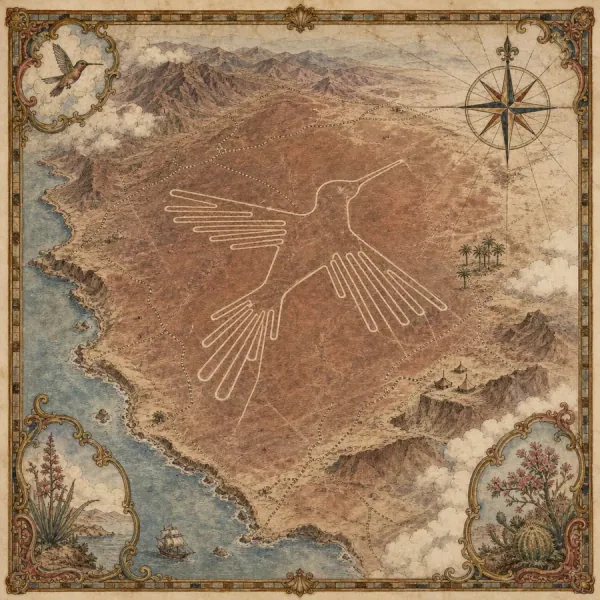
Most of the markings are straight lines that run across the landscape, sometimes for several kilometers, without veering, crossing ravines and hills. Laid end to end, they total more than 1,300 km. Added to these are geometric shapes: triangles, spirals, zigzags and large trapezoids. Finally, more than 70 drawings depict animals and plants: a hummingbird, a monkey, a spider, a condor, a heron, a fish, an orca, a lizard, a dog, trees, flowers, and even a human figure.
Their size is dizzying. The condor is about 134 m (440 ft) long, the monkey about 93 m by 58, the spider 47 m. The largest figures reach about 370 m. Most are drawn with a single continuous line that never crosses itself. Their shapes are easiest to read from the air, but they can also be seen from the surrounding hills.
🪨 A drawing in negative
The desert floor is covered with small reddish-brown pebbles, colored by a thin coating of iron oxide. Removing them uncovers a lighter, yellowish-gray soil underneath. The lines are therefore shallow trenches, usually 10 to 15 cm (4 to 6 in) deep and from 30 cm to nearly 2 m wide. The contrast is enough to make the drawing visible from afar.
☀️ Why have they survived?
Marks this shallow should have vanished long ago. They owe their survival to the plateau's exceptional climate, one of the driest in the world: almost no rain, little wind at ground level and very stable weather. On top of that, the pale soil at the bottom of the lines is rich in lime and gypsum; moistened by the morning mist, it hardens into a crust that protects it from erosion.
In 1994, UNESCO added the “Lines and Geoglyphs of Nasca and Palpa” to its World Heritage list. The site draws visitors from all over the world.
🏺 Who were the Nazca?
The Nazca Lines are named after an Andean culture that flourished on the southern coast of Peru, in the valleys of the Río Grande de Nazca and the Ica Valley, between roughly 100 BC and AD 800. The Nazca left no writing, like all the pre-Hispanic peoples of South America, the Inca included. We know them through archaeology: their pottery, their textiles, their tombs and their great public works.
🧵 Heirs of the Paracas
The Nazca followed the Paracas culture, famous for its extraordinarily fine textiles, and borrowed many of its traditions. They too excelled at weaving, on the backstrap loom, in cotton and wool, as people in the region still do today. The desert has preserved many fabrics found in tombs.
🎨 Pottery in twelve colors
Their signature is polychrome pottery, painted before firing in at least twelve different colors: double-spouted bottles, bowls, vases, figurines. They show fruit, animals, scenes from daily life and, above all, mythical beings that are part human, part animal: the mythical killer whale, the spotted feline, the great anthropomorphic being. This pottery turns up at every level of society, a sign that it circulated widely.
⛰️ Cahuachi, the pilgrims' city
The great center of this culture is Cahuachi, in the Nazca Valley: natural hills reshaped into earthen pyramids, plazas and platforms. Archaeologists have found plenty of fine pottery there but little everyday tableware, which suggests it was not a permanently inhabited city but a ceremonial center where people came on pilgrimage for rituals and feasts tied to farming, water and fertility. Cahuachi was abandoned around the middle of the Nazca period, probably during a severe drought.
💧 Aqueducts that still work
In this desert, water was a matter of survival. The Nazca dug puquios, underground channels that tap groundwater at the foot of the mountains. Their walls are made of river stones without mortar so the water can seep in, and access shafts, the ojos (“eyes”), let workers climb down to clean them. Several dozen are still in use, notably at Cantalloc, near Nazca. The Nazca grew maize, squash, beans, sweet potatoes and cassava, as well as cotton.
🌀 Beliefs and rituals
Nazca religion seems to have centered on agriculture and fertility, which makes sense in such an extreme environment. Its imagery shows masked figures, interpreted as ritual specialists. Archaeologists have also found “trophy heads,” skulls prepared and pierced so they could be carried or displayed during ceremonies; their exact meaning is still debated: war trophies or rituals linked to the fertility of the crops.
🌧️ A decline tied to climate
From around AD 500, Nazca society declined, and by about 750 it had collapsed. One hypothesis points to massive floods caused by El Niño, made worse by the gradual felling of huarango trees (Prosopis pallida), which held the soil in place, to make room for fields of maize and cotton. At the same time, power shifted to the highlands with the rise of the Wari culture, around 650.
The rest of the course
This page publishes the first 2 parts. The full course has 8: here is what the next ones cover.
- 📐 How were they drawn?
The drawing techniques reconstructed by archaeologists: clearing the pebbles, ropes and stakes, scaling up a small design, and Joe Nickell's experiment reproducing a giant figure without any aerial help.
- 🔭 A 20th-century discovery
From the first Spanish mentions in 1553 to the studies of Toribio Mejía Xesspe, Paul Kosok and Maria Reiche, the “Lady of the Lines” who devoted her life to mapping and protecting them.
- 🧭 What were they for? The serious hypotheses
The main scientific hypotheses about the purpose of the lines: an astronomical calendar, a cult of water and mountains, ritual procession routes, the link with Cahuachi, and what researchers think today.
- 👽 Aliens, balloons and other false leads
The rejected theories and why: Erich von Däniken's “landing strips,” Jim Woodman's hot-air balloon, and the scientific arguments that rule them out.
- 🛰️ Drones and AI: a 21st-century harvest
Recent discoveries by Japan's Yamagata University and other teams: new geoglyphs since 2004, Paracas figures spotted by drone in 2018, a cat found in 2020 and 303 figures found with AI (study published in 2024).
- 🛡️ A fragile treasure
The threats facing the lines: illegal squatters, a quarry, trucks, Dakar Rally vehicles, the 2014 Greenpeace incident and concerns about climate change.
Study “The Nazca Lines” with flashcards and quizzes
In Oria, you read the full course, then practice on it: flashcards, multiple-choice quizzes, open questions or the Feynman method. Cards and questions then come back in your daily review, paced by spaced repetition.
Study this topic in OriaSources
These notes draw on the sources below. If a point seems doubtful, refer back to them.