Psychology & decisions
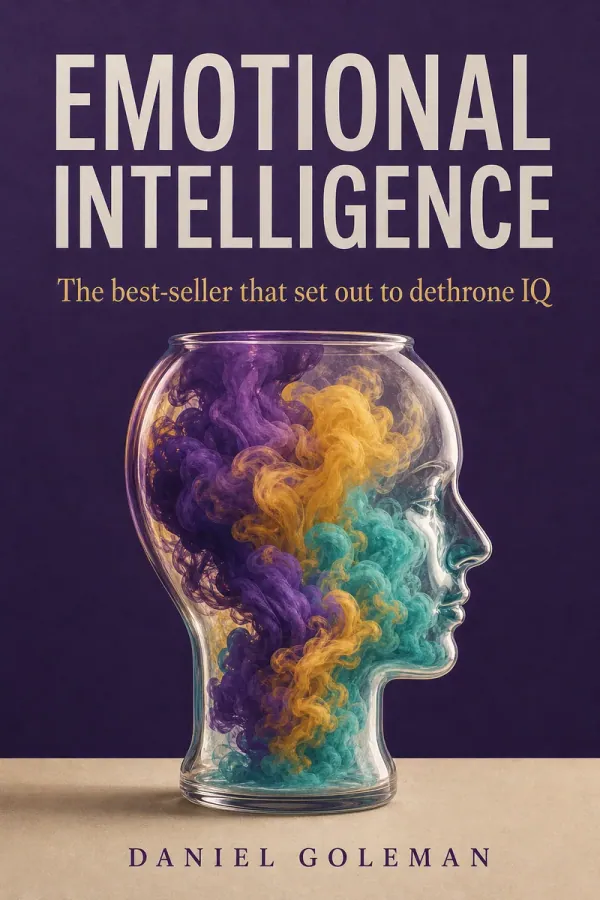
Emotional Intelligence by Daniel Goleman: Summary and Study Notes
The best-seller that set out to dethrone IQ
Study this topic in OriaThe essentials
In 1995, science journalist Daniel Goleman popularized an idea born with two researchers, Peter Salovey and John Mayer: that there is an intelligence of emotions, just as decisive for success as IQ. The book became a worldwide phenomenon and reshaped both schools and workplaces. You'll discover where the concept came from, the amygdala "hijack," Goleman's five domains, the marshmallow test, and the harsh criticism from researchers along with what remains of emotional intelligence today.
Key dates and facts
- 1990
- Salovey and Mayer's founding article
- 1995
- Publication of Emotional Intelligence
- 1997
- French translation from Robert Laffont
- 1998
- Working with Emotional Intelligence
- 1993
- CASEL co-founded at Yale
- 1998
- "What Makes a Leader?" in the Harvard Business Review
- 2002
- Primal Leadership
- 2008
- 147 American companies and firms use EI
- 1946
- Born in Stockton, California
- 1977
- First book, on meditation
🧠 The book that challenged IQ
Emotional Intelligence is a book by the American psychologist and science journalist Daniel Goleman, published in 1995 by Bantam Books. Its subtitle sums up its thesis: Why It Can Matter More Than IQ.
For decades, school and career success had been thought of mainly through IQ, assumed to measure a largely fixed intelligence. Goleman argues that an essential piece is missing: the ability to know your own emotions, to master them, to motivate yourself, to understand other people's feelings, and to keep up good relationships. According to him, these skills can be learned, and schools should teach them.
🚀 A publishing phenomenon
The book stayed on the New York Times bestseller list for about a year and a half and became a best-seller in many countries; it is now available in 40 languages. In October 1995, Time magazine put it on the cover with the question "What's your EQ?" The magazine would later rank it among the 25 most influential management books ever written.
In France, the book came out in 1997 from Robert Laffont, translated by Thierry Piélat, then in paperback from J'ai lu. The phrase "emotional intelligence," sometimes shortened to EI, and its numerical counterpart, the "emotional quotient" or EQ, then entered everyday language, from magazines to corporate training programs.
📌 What the book promises
Goleman didn't invent the concept: he borrowed it from two researchers, Peter Salovey and John Mayer, and enriched it with a wealth of studies on the brain, childhood, relationships, health, and work. He even claims that IQ accounts, at best, for only about 20% of the factors that determine success in life, leaving plenty of room for other qualities. This promise explains the book's success. It also explains why researchers, including those who had coined the concept, eventually distanced themselves from it.
🎓 Before Goleman: Salovey and Mayer
The idea Daniel Goleman popularized in Emotional Intelligence has a longer history. In the 1950s, psychologist Abraham Maslow was already speaking of "emotional strength." The phrase "emotional intelligence" appears in articles from 1964 and 1966, and the abbreviation "EQ" was used in 1987 by Keith Beasley in the British Mensa society's magazine.
🌈 Several intelligences
A turning point came in 1983, when Harvard psychologist Howard Gardner published Frames of Mind. In it, he defends the theory of multiple intelligences: IQ is not enough to account for human abilities. Among the forms of intelligence he describes are interpersonal intelligence, the ability to understand others, and intrapersonal intelligence, the ability to understand oneself.
📄 The 1990 article
In 1990, two researchers, Peter Salovey of Yale University and John D. Mayer of the University of New Hampshire, published an article simply titled "Emotional Intelligence" in the journal Imagination, Cognition and Personality. In it, they define an ability to observe one's own emotions and those of others, to tell them apart, and to use that information to guide one's thinking and actions.
Their idea pushed back against an old opposition between reason and emotion: used well, emotions can help us think. Salovey would later become a leading psychologist, serving as president of Yale University from 2013 to 2024.
Mayer and Salovey's refined version of the emotional intelligence concept: perceiving emotions, using them to facilitate thought, understanding them, and managing them in oneself and in others.
🧪 An intelligence measured like IQ
For Mayer and Salovey, emotional intelligence is a genuine mental ability, which should be measured through tasks rather than through questionnaires in which people rate themselves. Their test, the MSCEIT (Mayer-Salovey-Caruso Emotional Intelligence Test), poses problems to solve: recognizing emotions on faces, predicting how an emotion will evolve, choosing the best response in a tense situation. It is this cautious model, centered on specific abilities, that Goleman's book would considerably expand.
The rest of the course
This page publishes the first 2 parts. The full course has 9: here is what the next ones cover.
- ⚡ Two minds and the amygdala "hijack"
The first part of Goleman's book, on the emotional brain: the idea of two minds, the amygdala's role, the "amygdala hijack," and the possibility of learning to master it.
- 🖐️ Goleman's five domains
Goleman's five-domain model: self-awareness, managing one's emotions, motivation, empathy, and managing relationships, and its evolution into four spheres and a "mixed model."
- 🍬 The marshmallow test and self-control
Walter Mischel's marshmallow experiment, used by Goleman to illustrate self-control, and the recent replications that have significantly qualified its conclusions.
- 🏫 From school to the workplace
The book's influence: social-emotional learning in schools (CASEL), its application to leadership and management, and the 1998 Harvard Business Review article.
- ✍️ Daniel Goleman, psychologist and journalist
The life of Daniel Goleman, author of Emotional Intelligence: childhood in Stockton, Harvard, time in India, career at The New York Times, books on meditation and leadership.
- ⚖️ What research holds against the book
Scientific criticism of Goleman's Emotional Intelligence: Salovey and Mayer's own distancing from it, exaggerated promises, an overly broad concept, and problems of measurement and prediction.
- 📊 What remains of emotional intelligence?
The current scientific verdict on the emotional intelligence Goleman popularized: modest but real links with work performance, school achievement, and health, the possibility of training it, and an overall look at the book.
Study “Emotional Intelligence” with flashcards and quizzes
In Oria, you read the full course, then practice on it: flashcards, multiple-choice quizzes, open questions or the Feynman method. Cards and questions then come back in your daily review, paced by spaced repetition.
Study this topic in OriaSources
These notes draw on the sources below. If a point seems doubtful, refer back to them.