Psychology & decisions
Intelligence and IQ: Summary and Study Notes
What the tests really measure, and what they don't
Study this topic in OriaThe essentials
IQ was born in Paris in 1905 to help struggling schoolchildren, then went on to be used to sort soldiers, immigrants and students all over the world. You'll discover how it's really calculated, whether there is one intelligence or several, and what the score does and doesn't predict. You'll also see why scores climbed throughout the 20th century, what researchers say about genes and environment, and which myths are best forgotten.
Key dates and facts
- 1882
- Galton opens the first mental testing center
- 1905
- Binet and Simon's first scale
- 1912
- William Stern invents the intelligence quotient
- 1916
- Lewis Terman's Stanford revision
- 1914
- Goddard's tests at Ellis Island
- 1917 – 1918
- 1.75 million American recruits tested
- 1927
- Buck v. Bell ruling on sterilization
- 1971
- Griggs v. Duke Power ruling on hiring
- 1948
- First evidence of massive gains (Tuddenham)
- 1952 – 1982
- +21 points among Dutch conscripts
🧠 What is intelligence?
Everyone thinks they know what an “intelligent” person is. Yet when scientists try to define the word, they don't agree. There is agreement on a list of abilities: learning, forming concepts, understanding, reasoning logically, recognizing patterns, planning, solving problems, making decisions, retaining information and using language. But how these abilities are organized, and how to measure them, remains a matter of research and debate.
The set of mental abilities that allow us to learn, understand, reason and adapt to new situations. Researchers have no single agreed-upon definition.
🧑🔬 The definition of a great test maker
The American psychologist David Wechsler, creator of the most widely used IQ tests in the world, defined intelligence as “the global capacity of a person to act purposefully, to think rationally, and to deal effectively with his environment.” He believed it was made up of distinct elements that could be isolated and measured, but that remained linked to one another.
This definition already says something important: a test never measures “intelligence” directly, the way a scale measures mass. It measures performance on tasks, from which an estimate is drawn. That's why IQ is a tool and not a truth about a person.
🌏 An idea that changes across cultures
The way people think about intelligence isn't the same everywhere. In many East Asian cultures, it is closely tied to social roles: one Chinese conception defines it notably as the ability to put yourself in other people's shoes and understand them. In several African communities, it also has a social dimension: in Chichewa, a language spoken by around ten million people in southern-central Africa, the equivalent word suggests both quick-wittedness and the ability to take on responsibilities. Even in the United States, some people associate intelligence mainly with reasoning and IQ, while others add wisdom and an understanding of others.
The psychologist Robert Sternberg argues that ignoring these differences amounts to looking at the world from an unintentionally egocentric point of view. This debate runs through the whole history of IQ: are we measuring a universal ability, or a form of intelligence valued by schools and by a particular culture?
🏫 Binet, Simon and the birth of testing
At the end of the 19th century, scientific psychology was very young, and many researchers dreamed of measuring the mind. The Englishman Francis Galton, a cousin of Charles Darwin, opened the world's first mental testing center in 1882. Convinced that intelligence was mostly hereditary, he looked for a link between it and physical traits: reflexes, grip strength, head size. He found no correlation and eventually gave up.
🇫🇷 A request from the public schools
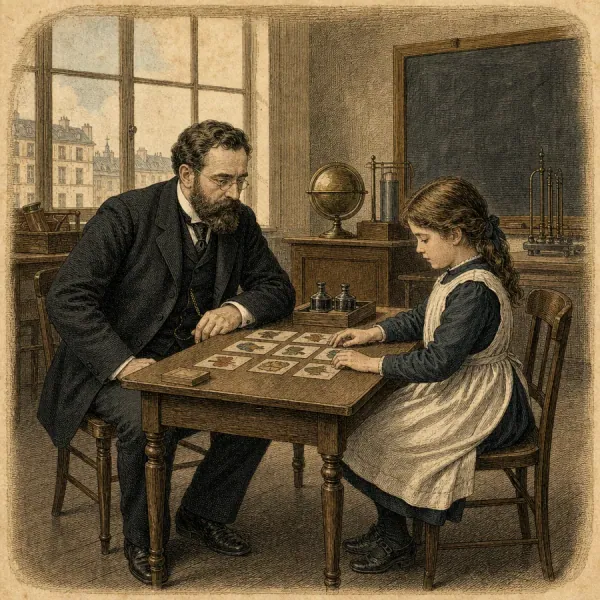
The breakthrough came from Paris. In France, school had become compulsory in 1882, and some children struggled to keep up. In 1904, the psychologist Alfred Binet (1857–1911) served on a commission of the Ministry of Public Instruction. One question divided its members: should these children be sent to institutions attached to asylums, as the psychiatrist Désiré-Magloire Bourneville wanted, or stay in special classes within ordinary schools? And who should decide? Bourneville wanted a medical examination. Binet wanted objective criteria, so that no child would be labeled by mistake.
With the young psychiatrist Théodore Simon, who worked with children facing severe difficulties, Binet published in 1905 a first version of their Metric Scale of Intelligence. The complete version appeared in 1908, followed by a revision in 1911, shortly before Binet's death.
🧩 Thirty tasks of increasing difficulty
The scale included about thirty tasks. The simplest involved following a beam of light with the eyes or responding to the examiner. Next came pointing to parts of the body, repeating two digits, and defining words like “house” or “fork.” The hardest required repeating seven random digits, finding three rhymes for the French word obéissance (“obedience”) or making a sentence with three given words. The result gave a mental age: a six-year-old who passed everything six-year-olds pass, and nothing more, had a mental age of six.
Binet and Simon remained cautious. They stressed the great diversity of intelligence, the value of qualitative observation, and the fact that intellectual development varies and depends on the environment. For them, intelligence was not fixed.
“A few modern philosophers seem to lend their moral approval to these deplorable verdicts when they assert that an individual's intelligence is a fixed quantity, a quantity that cannot be increased. We must protest and react against this brutal pessimism.”
Alfred Binet, Les Idées modernes sur les enfants (1909) (translated)
➗ William Stern's “quotient”
In 1912, at the University of Breslau, the German psychologist William Stern proposed dividing mental age by chronological age. He called this ratio the Intelligenzquotient, hence the abbreviation IQ. Multiplied by 100, it gives the “ratio IQ”: IQ = mental age / chronological age × 100. A ten-year-old with a mental age of twelve thus scores 120.
🇺🇸 Crossing the Atlantic
The American Henry H. Goddard translated the scale into English and spread it from 1908–1910. At Stanford University, Lewis Terman adapted it to a large American sample and in 1916 published the “Stanford Revision,” which for decades became the most popular test in the United States. Simon's name gradually faded. Above all, the tool's spirit changed: designed to identify children who needed help, it would also be used to sort and exclude.
The rest of the course
This page publishes the first 2 parts. The full course has 9: here is what the next ones cover.
- 📊 How IQ is calculated today
The shift from Stern's ratio IQ to Wechsler's deviation IQ (1939): a mean of 100, a standard deviation of 15, how the population is distributed, margins of error, and today's main tests.
- 🧩 One intelligence or several?
Spearman's g factor (1904), Thurstone's primary abilities, Cattell's fluid and crystallized intelligence, the CHC model (1999), Gardner's multiple intelligences (1983) and Sternberg's triarchic theory.
- ⚠️ When tests were used to exclude
The eugenic and discriminatory uses of IQ in the 20th century: Goddard, the US Army tests of 1917–1918, the 1924 law, forced sterilizations, then Gould's criticisms and the debate over The Bell Curve.
- 🎯 What IQ predicts, and what it doesn't
The statistical links between IQ and school success, work, income, health or crime, what a correlation means, and why IQ is only one factor among many.
- 🧬 Genes and environment: what we really know
The heritability of IQ and what it actually means, the role of the family environment, the absence of an intelligence gene, the effects of education, health and pollutants, and the consensus on group differences.
- 📈 The Flynn effect: scores that rise… then level off
The rise in IQ test scores of about 3 points per decade during the 20th century, its possible explanations, and then its slowdown or reversal in several countries since the 1990s.
- 🔭 IQ today: uses, myths and good habits
Current uses of the tests (diagnosis, psychological assessment, high-IQ societies), common beliefs debunked by research (the Mozart effect, brain training), and Binet's legacy.
Study “Intelligence and IQ” with flashcards and quizzes
In Oria, you read the full course, then practice on it: flashcards, multiple-choice quizzes, open questions or the Feynman method. Cards and questions then come back in your daily review, paced by spaced repetition.
Study this topic in OriaSources
These notes draw on the sources below. If a point seems doubtful, refer back to them.