Philosophy
Confucius: Biography and Study Notes
The teacher who shaped China for two thousand years
Study this topic in OriaThe essentials
Born into a poor family in the small state of Lu, Kong Qiu, whom the West calls Confucius, set out to bring peace back to a China torn apart by war. A disappointed minister, he spent thirteen years on the road before returning home to teach until his death. You'll discover his life (separating history from tradition), the Analects compiled by his disciples, his great ideas (ren, li, junzi, governing by example) and the extraordinary fate of Confucianism, from state religion to the Cultural Revolution.
Key dates and facts
- 551 BC
- Birth according to tradition
- c. 548 BC
- Death of his father
- c. 532 BC
- Marriage, then birth of Kong Li
- 109 – 91 BC
- Sima Qian writes his biography
- 505 BC
- Yang Hu's revolt in Lu
- 501 BC
- Confucius becomes a governor
- 498 BC
- Dismantling of the fortresses
- 497 BC
- Departure from Lu
- 136 BC
- Confucianism becomes the Han official doctrine
- 1687
- Latin translation published in Paris
🏮 A poor childhood in the state of Lu
The man the West calls Confucius was really named Kong Qiu: Kong is his family name, Qiu his given name. He was also known by his courtesy name, Zhongni, and his disciples called him Kongzi or Kong Fuzi, “Master Kong.” It was from this last form that Jesuit missionaries in China, probably Matteo Ricci, coined the Latin name “Confucius” at the end of the 16th century.
🏯 A divided China
Confucius lived in the era Chinese historians call the Spring and Autumn period, named after a chronicle of the state of Lu covering the years 771 to 481 BC. In theory, China still obeyed the kings of the Zhou dynasty. In practice, they had lost all real power: the country was broken up into rival principalities that fought one another for supremacy. The small state of Lu, in today's Shandong province, in northeastern China, was itself dominated by three great aristocratic families that kept the duke under their thumb.
👶 What history says, what legend says
According to tradition, Confucius was born on September 28, 551 BC in Zou, near the town of Qufu. One difficulty should be kept in mind, though: his first biography, written by the historian Sima Qian in his Records of the Grand Historian (the Shiji), dates from 109 to 91 BC, more than four centuries after his death. It mixes plausible facts with marvelous tales. Legend has it that a Chinese unicorn, the qilin, announced his birth, that two dragons landed on the roof of the house and that heavenly voices foretold the coming of a holy son. Historians see this as the pious dressing of a life that had become a model.
👨👩👦 An orphan of the minor nobility
His father, Kong He (or Shuliang He), was an aging commander of the local garrison whose ancestors are said to have come from the neighboring state of Song; not all modern historians accept this noble ancestry. He died when the boy was three, leaving his family in poverty. Young Qiu was raised by his mother, Yan Zhengzai. He belonged to the shi class, a group between the aristocracy and the common people.
At nineteen, he married a young woman of the Qiguan clan; a year later their son, Kong Li, was born, followed by two daughters. To make a living, he held modest jobs: tradition shows him as a bookkeeper, then as a keeper of sheep and horses. At the same time, he trained in the Six Arts, the educational program of the day. When his mother died, he was twenty-three according to tradition; he observed the three years of mourning prescribed by the rites, a gesture that already showed his attachment to ancient customs.
📚 The teacher who opened his school to all
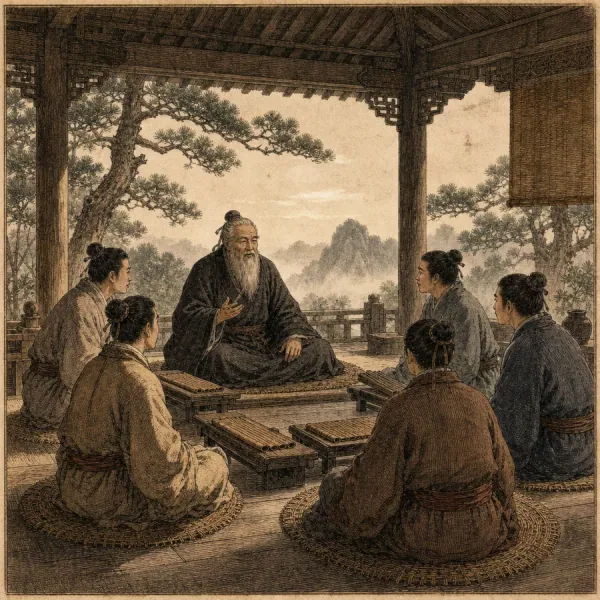
At around thirty, Confucius began to teach. He did not found an official institution: he gathered around him young men who wanted to learn, and that is what makes him, in Chinese tradition, his country's first great educator and the pioneer of private teaching.
🎯 The Six Arts
The curriculum rested on the Six Arts: rites, music, archery, chariot driving, writing and arithmetic. Confucius added the study of ancient texts: poems, chronicles and documents of the early Zhou kings. But for him, the point was not to pile up knowledge: to learn was to transform oneself into a better person. The first word of the Analects, the book in which his disciples recorded his sayings, is precisely the character meaning “to study.”
“Is it not pleasant to learn with a constant perseverance and application? Is it not delightful to have friends coming from distant quarters?”
Confucius, Analects, I, 1, translated by James Legge
🚪 A door open to all
The great novelty was that this school was open to young men of every background. Confucius charged no enrollment fee, only a symbolic gift, a bundle of dried meat; wealthy students gave according to their means. He accepted nobles, commoners and even former convicts. According to his disciple Zigong, he treated his students as a doctor treats the sick, turning no one away. Most came from Lu, but others arrived from Wei, Qin, Chen, Qi or Chu.
Tradition credits him with three thousand students, seventy-two or seventy-seven of whom are said to have mastered the Six Arts. The ancient sources, Sima Qian and a collection called the Kongzi jiayu, name 96 disciples in all. His favorite was Yan Hui, probably the poorest of them all, whom he admired for his integrity. Others, such as Zilu or Ran Qiu, were known for their skill at governing.
🗣️ Teaching through questions
In the Analects, Confucius never gives long lectures. He answers questions, quotes poems, offers comparisons, and expects his students to find the rest of the way themselves. He tailors his answer to the person asking: the same question sometimes gets different answers depending on the disciple's character.
☯️ The meeting with Laozi: a legend
A famous tradition says that Confucius went to Luoyang, the Zhou capital, to consult Laozi, the supposed father of Taoism, about funeral rites, and that he came back so shaken that he stayed silent for three days. Murals from the Han period already depict the scene. But this meeting, told mainly by Taoist authors, probably never happened: in all likelihood, Laozi was not a historical figure.
The rest of the course
This page publishes the first 2 parts. The full course has 9: here is what the next ones cover.
- ⚖️ Minister in Lu: the test of power
Confucius's political career in Lu from 501 to 497 BC: governor, minister of justice, an attempt to dismantle the great families' fortresses, and his departure.
- 🛤️ Thirteen years on the road
From 497 to 484 BC, Confucius and his disciples wandered from court to court in search of a prince who would apply his ideas: the episodes of Kuang, of Chen and Cai, one failure after another.
- 🕯️ Return to Lu and death
Confucius's last years in Lu: teaching, work on the ancient texts, advice to rulers, bereavements, his death in 479 BC and his tomb at Qufu.
- 📜 The Analects, a book written by his disciples
How the Analects (Lunyu) came to be: compiled by several generations of disciples, early versions, rediscovered manuscripts, the book's structure and the major French translations.
- 🤝 Ren, li, junzi: the great moral ideas
The core notions of Confucius's ethics: transmitting rather than inventing, ren (humaneness), the rule of reciprocity, the rites (li), righteousness (yi), filial piety and the noble person (junzi).
- 🏛️ Governing by example
Confucius's political thought: the ruler's virtue rather than punishment, the rectification of names, the duty of remonstrance and a meritocracy based on learning.
- 🌏 Legacy: from state religion to Confucius Institutes
The fate of Confucianism after Confucius: Mencius and Xunzi, persecution under the Qin, official doctrine of the Han, Neo-Confucianism, discovery by Europe, 20th-century attacks and today's revival.
Study “Confucius” with flashcards and quizzes
In Oria, you read the full course, then practice on it: flashcards, multiple-choice quizzes, open questions or the Feynman method. Cards and questions then come back in your daily review, paced by spaced repetition.
Study this topic in OriaSources
These notes draw on the sources below. If a point seems doubtful, refer back to them.